The Tariff War That Rewrote Global Order
How Trump’s 2025 trade gambit triggered the fastest geopolitical realignment in a century — and why the Supreme Court might blow it all up.
December 2025. The U.S. Supreme Court is preparing to issue a ruling that could wipe out with a single stroke the most aggressive American trade policy since 1930. Costco is suing for refunds. The U.S. Treasury is holding $90 billion collected under tariffs that three levels of judges have declared illegal. Trump warns of an “economic catastrophe” if the Court strips away his favorite weapon.
But the real story isn’t happening in courtrooms. It’s the fact that, legal or not, these tariffs have already changed everything.
⚡ Breaking: The Legal Time Bomb
The Supreme Court heard oral arguments on November 5. The decision could drop any day—and with it, the possibility that the U.S. government must refund tens of billions in illegally collected tariffs. The International Emergency Economic Powers Act of 1977 never mentions the word “tariffs.” Trump used it anyway to impose the most extensive trade barrier in 90 years.
USA: When Protectionism Devours Itself
The stated goal? “Protect American industry.” The reality? An economic experiment that drove the average U.S. tariff rate from 2.5% in January 2025 to 27% in April—the highest level since 1934. Then, after a stock market crash, a forced pause brought it back to 17.9% by September.
The numbers tell a truth no rhetoric can mask:
- $205 billion collected in tariffs through October 2025—three times more than in 2024, but still ridiculously insufficient to replace income taxes, despite Trump’s fantasies of completely eliminating federal income tax.
- $1,200-1,400 average tax increase per American household in 2025-2026. This isn’t a “tax on China.” It’s a tax Americans pay every time they buy anything.
- -0.9 to -1.1% projected U.S. GDP decline according to Yale’s Budget Lab. Not growth. Contraction.
- Collapse in manufacturing employment—the very companies tariffs are supposed to “protect” are planning staff cuts for 2026 due to rising operating costs.
“The most beautiful word in the dictionary is ‘tariff,'” says Trump. His voters are discovering that the most painful word on their bank statement is “inflation.”
Agriculture, textiles, manufacturing—all hit. The trade deficit? Simply redistributed: less China, more Vietnam, India, Thailand. American industry hasn’t “come back.” It’s just shifted to more expensive suppliers.
And now the most immediate threat: Trump is considering exiting the USMCA, the trade agreement with Canada and Mexico that he himself renegotiated as “the best ever.” Consistency was never his strong suit.
China: Patience as Strategic Weapon
While America wrestles with court rulings and autarkic fantasies, China has already turned the page.
December 2025: China’s trade surplus exceeds $1 trillion for the first time in history. Exports to the U.S. collapsed 29% in November—the eighth consecutive month of double-digit declines. But total Chinese exports? Up 5.9% year-over-year.
How? Simple. While Trump fought his tariff war, Beijing built alternatives:
- ASEAN exports +8%—Southeast Asia became the second-largest market after the EU.
- EU exports +15%—Europe more than compensated for American losses.
- The October 2025 trade truce between Trump and Xi reduced reciprocal tariffs from their peak of 145-125% to about 47-32%, but China kept all its export control frameworks intact. Calibrated choke-points, Morgan Stanley analysts call them.
The strategy is crystal clear: dual circulation—growth driven by the domestic market, technological self-sufficiency in semiconductors and AI, expansion of the Belt and Road Initiative as an alternative trade network.
Xi is betting his strategic resolve will outlast Trump’s. Judging by the numbers, he’s winning. China even announced it will honor “every part” of the trade agreement—buying 12 million metric tons of American soybeans by year-end—but nobody’s fooled: these are tactical concessions, not capitulations.
🎯 Rare Earth Control
China controls 70% of the global rare earth supply. In October, when Trump imposed 100% tariffs on Chinese goods in response to export restrictions, Beijing didn’t flinch. It simply tightened licensing requirements. The message? “You need us more than we need you.”
Europe: Awakening of the Sleeping Giant
For years, Europe hesitated. Negotiated. Tried the diplomatic route. Then Trump declared April 2, 2025 “Liberation Day”—the day he imposed 20% tariffs on nearly all European products.
The European response? A surgical mix of retaliation, legal pressure, and strategic autonomy building.
- July 2025: EU-U.S. trade deal—achieved after months of negotiations under the threat of tariffs increasing to 30%. The EU agreed to pay a 15% tariff (including autos, pharmaceuticals, semiconductors) but secured elimination of all European tariffs on U.S. industrial goods exported to Europe.
- €600 billion in European investments in the U.S. during Trump’s term—a strategic move to placate the White House while maintaining industrial sovereignty.
- The Anti-Coercion Instrument (ACI)—the EU’s secret weapon, never used before but now on the table. This “trade bazooka” would allow Europe to strike not just with counter-tariffs, but with investment restrictions, limited access to U.S. digital services (Amazon, Microsoft, Netflix), and public procurement blocks.
The ACI threat wasn’t used. It didn’t need to be. The mere idea that Europe could actually strike where it hurts—tech services where the U.S. has a trade surplus—was enough to bring Trump back to the negotiating table.
But Europe learned a harsh lesson: you can’t rely on formal agreements with an America that violates them 12 days after signing (as done with USMCA). The response? Strategic diversification:
- Intensified trade agreements with India, Japan, Mercosur
- European Green Deal and Chips Act to reduce technological dependence
- Replacement of the 14.3% Russian LNG still imported as of May 2025 with American gas—but only as negotiating leverage, not permanent dependence

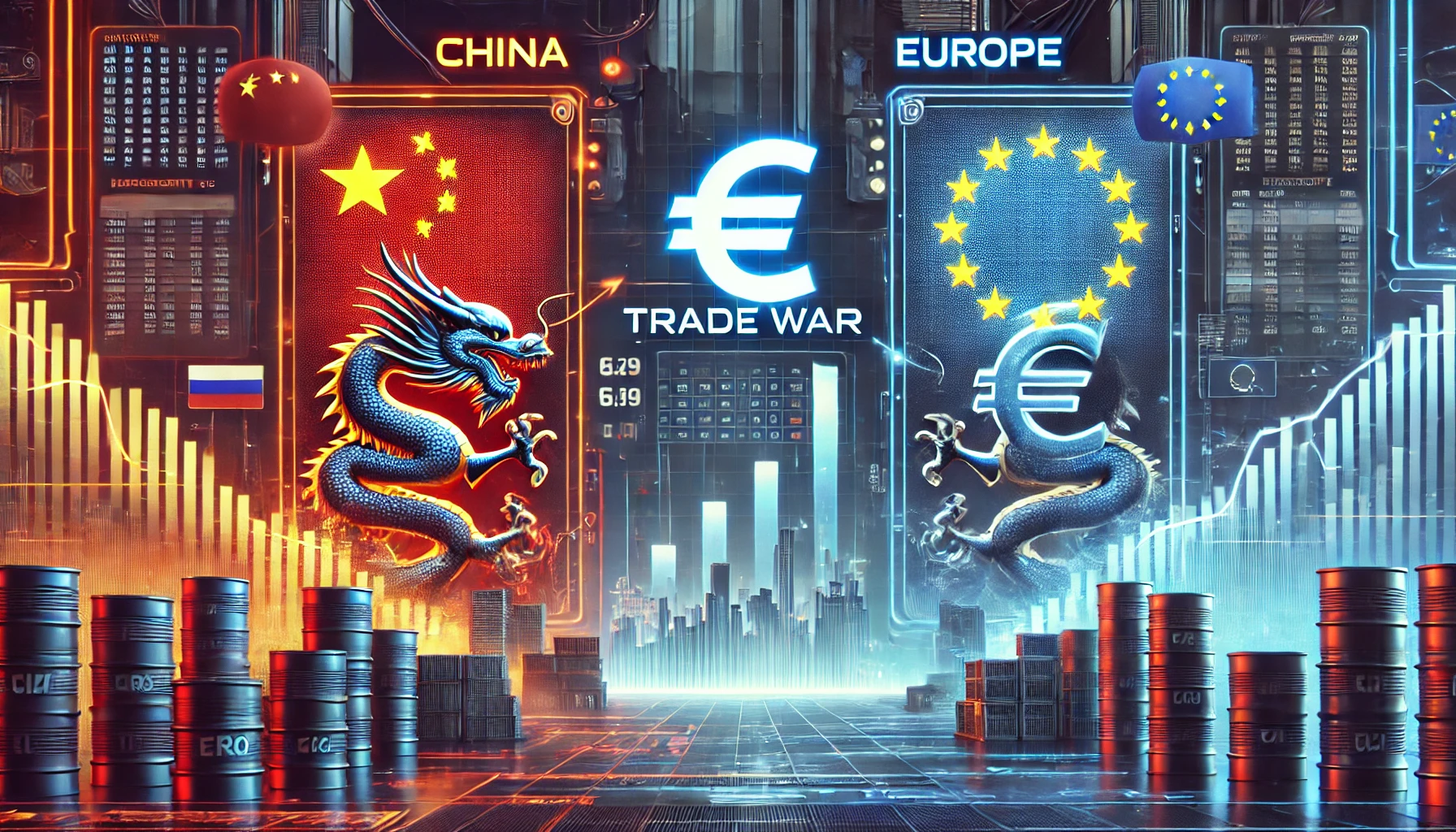
Image designed by CYBERMEDIATEINMENT.
Germany
Leading on automotive diplomacy. Its automakers secured some exemptions, but at a steep price: commitment to shift more production to U.S. territory.
France
Leading the hardline faction pushing for ACI use. Macron publicly called for a “Buy European Act” for European public procurement.
Italy
Focus on agricultural protections and SME support. Sectors like high-end textiles and agri-food took significant hits.
The Global Cost: Who Really Pays?
The WTO had to revise its forecasts three times in 2025. The latest verdict (October 2025):
- Global merchandise trade: +2.4% in 2025 (revised up from -0.2% in April, but only because companies did massive front-loading before tariffs took effect)
- Global trade 2026: +0.5%—near-stagnation. The full impact of tariffs will only be felt in 2026, when pre-accumulated inventories run out.
- Global GDP: -0.6 percentage points versus no-tariff scenario
But aggregate numbers hide the real story. Trade policy uncertainty—TPU—skyrocketed to historic highs in 2025. Higher than Brexit. Higher than the 2018-2019 U.S.-China trade war. Higher even than COVID-19 for supply chains.
The consequences?
- Companies maintain excess inventory, hedges against losses, supply chain reconfiguration—everything has a cost
- Investments freeze. Nobody invests when they don’t know what the rules will be in three months
- Global South countries suffer most—low-value, high-volume goods (raw materials, basic agricultural products) can’t be stockpiled in advance like semiconductors or pharmaceuticals
UNCTAD was clear: “Uncertainty itself can be more disruptive than tariffs.” And they were right. U.S. imports exploded in Q1 2025 (+14%) as everyone rushed to import before tariffs, then collapsed in Q2 (-20%). This rollercoaster paralyzes global economic planning.
The Global South: Fragmentation as Opportunity
Vietnam, India, Mexico, Thailand—the “winners” of the trade war. Their exports to the U.S. grew while China took the hit. But don’t call them winners too quickly.
Why? Because many of those “Made in Vietnam” or “Made in Mexico” products still contain Chinese components. Supply chains don’t move, they camouflage. And Trump knows it. That’s why he constantly threatens to exit USMCA and impose even stricter “rules of origin.”
The real fracture runs deeper: South-South trade is holding up better than North-South trade. Asia-Pacific, ASEAN, Mercosur—they’re building trade ecosystems that increasingly revolve less around the Atlantic axis.
India signed deals with the EU and increased imports from Russia (especially energy). Africa is slowly (too slowly) building its continental free trade zone. Latin America looks increasingly toward China and Europe.
Global trade fragmentation isn’t a threat. It’s already reality.
Conclusion: The Order Nobody Wanted, Everyone Got
Back to the Supreme Court. If the justices declare IEEPA tariffs illegal, Trump will have to refund $90 billion. The government will need to issue bonds to cover the gap. Markets will react. Inflation might spike. Trump will scream about judicial conspiracy.
But you know what won’t change?
The fact that the world has already changed direction.
China won’t go back to depending on the American market. Europe won’t go back to trusting Washington’s promises. The Global South won’t go back to passively accepting rules written on Wall Street.
Trump wanted to “Make America Great Again.” He got “Make Everyone Else More Autonomous.”
- European strategic autonomy ✓
- Chinese dual circulation ✓
- Global South trade diversification ✓
- Irreversible erosion of trust in the rules-based trade system ✓
The 2025 tariffs weren’t a trade war. They were an evolutionary accelerator. A catalyst for changes that had been brewing for years but nobody had the courage to trigger.
The real legacy of this tariff war? Not the trade deficit numbers. Not the court rulings. Not even the billions collected or lost.
The real legacy is that the world stopped waiting for America to decide the rules of the game. And started writing new ones—with or without Washington’s permission.
Welcome to the new global order. Not the one we wanted. The one we earned.
Updated: December 8, 2025
Sources: WTO Global Trade Outlook (Oct 2025), UNCTAD Trade Updates, Tax Policy Center, Peterson Institute for International Economics, Bloomberg, CNBC, Reuters