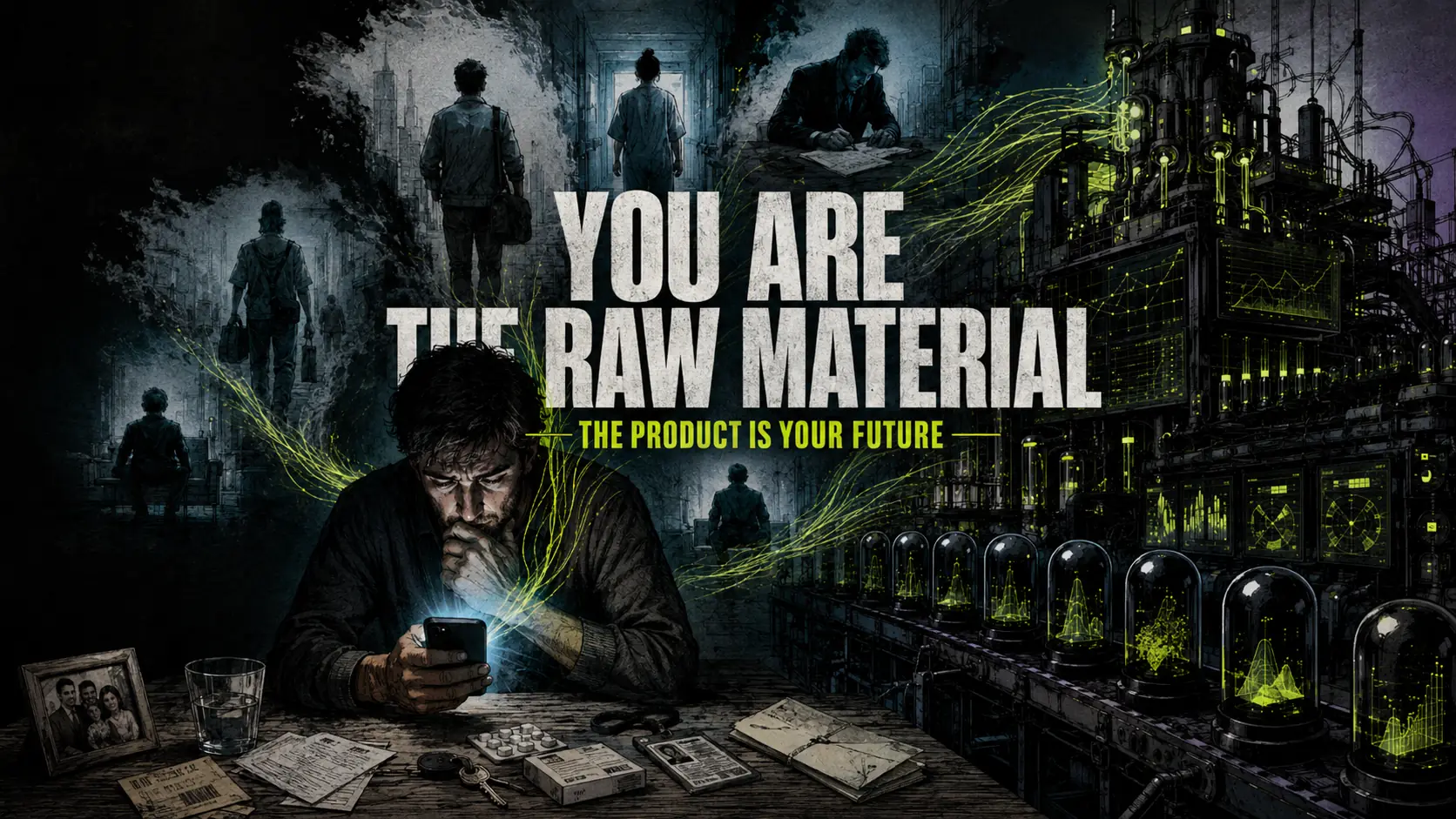
You Are the Raw Material. The Product Is Your Future
Investigation · Digital Surveillance
Digital surveillance does not stop at collecting data: it turns behaviour, intention and future possibility into proprietary predictions. From Zuboff to Marx and Polanyi, from Merleau-Ponty to cybernetics, an anatomy of the market that sells what we have not yet done — and of the reasons why none of it is destiny.
«The human being really does become the manipulandum he takes himself to be.»
— Maurice Merleau-Ponty, Eye and Mind, 1961
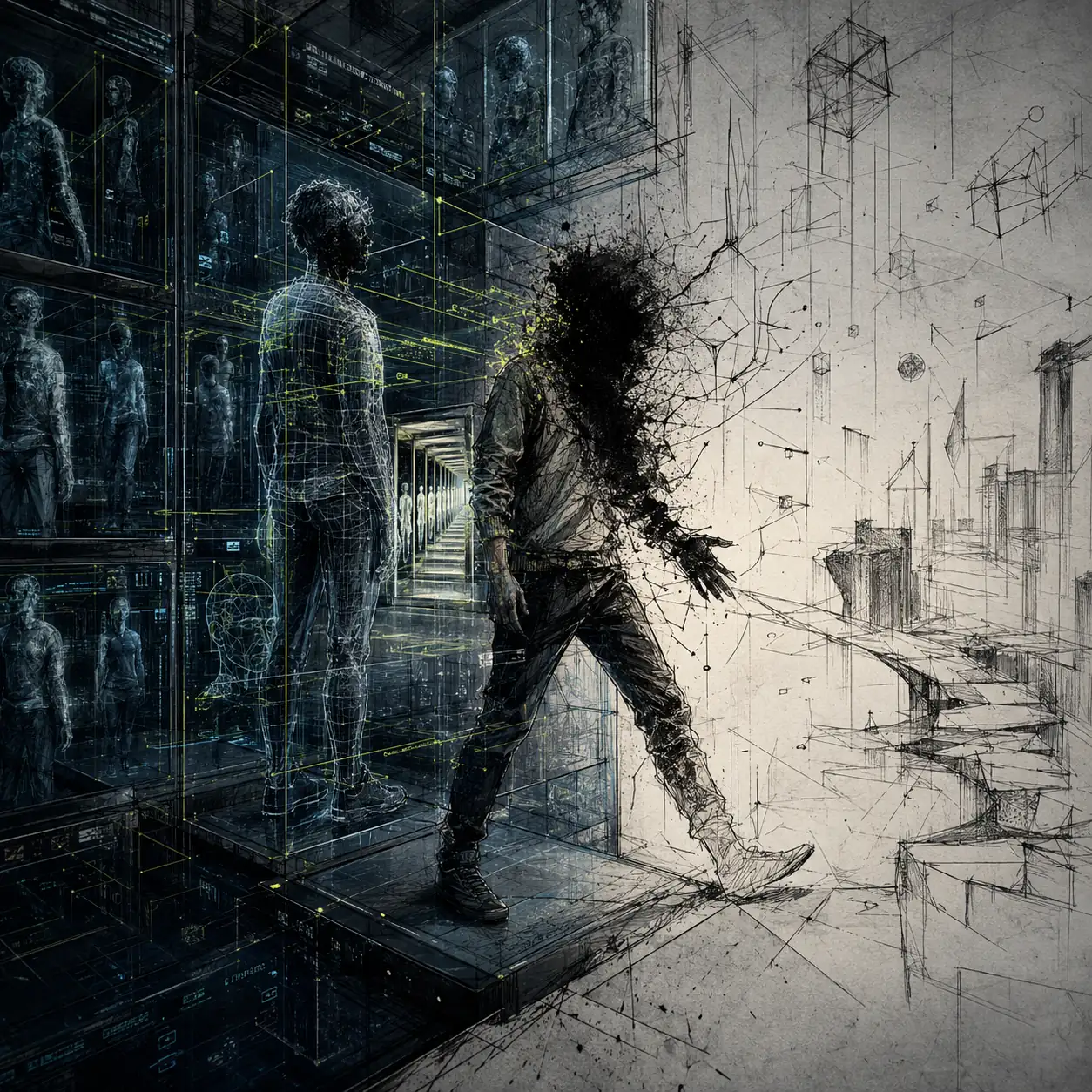
Someone opens an app and types a question they have not yet asked anyone else. Whether to leave their job. Which insurance policy to choose. How to get out of debt. What that symptom might mean. How to answer a message that hurt them.
They have done nothing. Nothing bought, nothing clicked, nothing signed. And yet they have already handed over something worth more than any purchase: the map of the alternatives they are weighing, at the exact moment the decision is still reversible.
McLuhan put it in a formula that looked like wordplay and was in fact a theorem: the medium is the message. What you ask the assistant hardly matters. What matters is that the conversational medium enters the way you deliberate, that it sits upstream of action rather than downstream. Search engines intercepted a question already formulated. Social platforms observed a reaction already given. Digital surveillance now reaches the point where intention is still being formed, and that displacement is the whole story.
Hence the one question this article tries to keep open until the end:
Who owns a decision before it has been made?
The Factory Does Not Produce Data, It Produces Certainty
One formula made digital capitalism digestible for an entire generation: if the service is free, you are the product. It is effective. It is also wrong.
In most cases you are not the product being sold, and neither is your raw data. Back in 1977 Dallas Smythe had already identified the real commodity of commercial communication, and it was neither the viewer nor the content: it was attention, packaged and sold to advertisers. Forty years before the slogan, Smythe had corrected it. The precise sequence is not «you are the product», but:
experience → behavioural data → surplus → inferences → predictions → interventions → profit.
The commercial client is not buying you. It is not buying an archive of your activity either. It buys the chance to reach you at the favourable moment, a prediction about your propensity to purchase, the capacity to reshape the environment in which you will decide, a reduction of economic uncertainty about your conduct.
Surveillance capitalism is the economic model that turns human experience into behavioural data, isolates a surplus portion of that data — the behavioural surplus, not required to deliver the service — and uses it to manufacture predictions sold on behavioural futures markets. This is the definition Shoshana Zuboff built in 2015 and expanded in 2019. Its most radical consequence sits in a word that usually slips past unnoticed: prediction.
Because the economic good is not the data. Data is the input. The economic good is certainty.
Digital Surveillance Already Has a Price List
Industrial capitalism wanted production to be predictable. Financial capitalism wanted risk to be governable. This model applies the same ambition to human conduct. Its problem is not knowing who you are — it answers different questions: what you will buy, where you will go, when you will be most vulnerable to an offer, which content will hold you, how much you are willing to pay, which alternative will manage to change your mind.
That certainty already has a price, a rate card, a market. Surveillance pricing — according to a preliminary report from the US Federal Trade Commission in early 2025 — means that location, browsing history, even mouse movements and the products left sitting in a cart can be used to differentiate the prices shown to you from those shown to someone else. (A preliminary report, released into a political landscape that has since shifted: worth verifying before treating it as decisive — but the direction holds.) In B2B, intention has been a commodity for years, and it has a name: intent data. It is bought, priced and scored. The intention market is not emerging. It already exists. It is only changing phase.
The possibility that the market itself changes in front of you, on the basis of what it believes it knows about you.
The Cybernetic Roots of Digital Surveillance
None of this is as new as it looks. Its root is cybernetics. Norbert Wiener defined control as communication and feedback: a system regulating itself by gathering information about its own effects. James Beniger, in The Control Revolution, showed that the information society is not a Silicon Valley invention but the outcome of a control crisis opened by industrialisation — control as information processing. And the Tiqqun collective, in The Cybernetic Hypothesis, named the decisive move: sidestepping the impossibility of determining behaviour by converting the problem of uncertainty into a problem of information. Reducing the individual to a node on a feedback loop that irons out its own ripples. The stated goal — control, prediction and surveillance grounded in mass data collection — is the underlying logic Zuboff would describe decades later.
Digital surveillance, in other words, is not a Google anomaly. It is the commodification of a cybernetic function — uncertainty, information, control — that precedes and exceeds any platform.
And that function carries an ideology. Merleau-Ponty named it in 1961, while cybernetics was at its peak. He called operational thinking that way of thinking which treats everything as an object to be manipulated, an absolute artificialism that sees in human creations a natural process of information modelled on the machine. He turned it into a prophecy: should that thinking extend its dominion over man and history, ignoring what we know through contact and situation, then the human being really does become the manipulandum he takes himself to be. Surveillance pricing is, quite literally, operational thinking turned into a rate card.
The Crack in the Certainty Factory
There is a fault line running through the factory of certainty, and it is structural. They are selling certainty about a system that cannot be computed. Turing proved it for machines: there are undecidable problems, questions no algorithm can answer. Gregory Chaitin extended it to information: there are incompressible truths that will not reduce to any formula shorter than themselves. And the neuroscientist Miguel Nicolelis argues it for the brain: non-computable, the product of non-linear interactions among billions of cells, impossible to simulate on a Turing machine. His analogy lands beside surveillance pricing with surgical precision: you cannot predict whether the stock market will rise, because you cannot compute it.
(Nicolelis’s theory is contested, at the frontier. There is no need to take it as proof that «the mind is not a machine» — that is the old Lucas–Penrose trap, and it leaves you exposed. It serves more modestly, and more solidly, as a limit: no sufficiently rich formal system closes on itself. There is always a remainder.)
Which means the product is, in part, a bluff. They are selling the prediction of an incompressible system. So the question becomes: how is the bluff covered?
Who owns a decision before it has been made?
Who Owns the Inference
The answer to the bluff is not a better model. It is intervention. But before getting there, it is worth asking who is holding the instruments.
Every time you post, react, linger, search or scroll, you produce a signal. You implicitly train recommendation systems, you hold other users in place, you generate commercial data. There is a Marxian reading that describes you as a worker surrendering productive capacity in exchange for access. There is a reading closer to Zuboff that describes you as someone who never knowingly entered a market at all: you were looking for information, relationships, services, and the data was produced incidentally and then appropriated.
There is no need to choose quickly. Nancy Fraser named the pair that holds both readings together — exploitation and expropriation — and she is also the author who rereads Polanyi. With her one can say the most honest thing: we are simultaneously workers, consumers, raw material and market. That overlap is more interesting than any slogan claiming to reduce us to one of those figures.
But who owns the value? Not whoever produces the signals. McKenzie Wark coined the right term: the vectoralist class, which owns neither factories nor content, but the vector — the infrastructure that captures, classifies and interprets. We produce the signals; they own the instruments for turning them into inferences. The asymmetry is not about data. It is about inference.
The Most Radical Fictitious Commodity
Here Polanyi allows the theoretical leap. Land, labour and money were for him fictitious commodities: treated as commodities despite not having been produced for sale. Part of the recent literature has proposed adding data to the list. But data is never truly raw; it demands classification, infrastructure, labour. The most radical fictitious commodity is not data. It is a person’s future possibility. A singular economic object, because it does not exist yet, was never voluntarily produced by anyone, depends on proprietary inference — and can be sold without the subject knowing either the content or the price of the prediction concerning them.
It has a third property, the most dangerous of all: selling it can help bring it about. The prediction reorders content, selects an offer, sets a price, sends a notification, hides an alternative, makes one choice easier than another. It does not describe the future. It participates in building it. It is performative — in the precise sense Donald MacKenzie and the sociology of markets give the term: certain models do not photograph reality, they produce it.
The Architecture Is Not Neutral
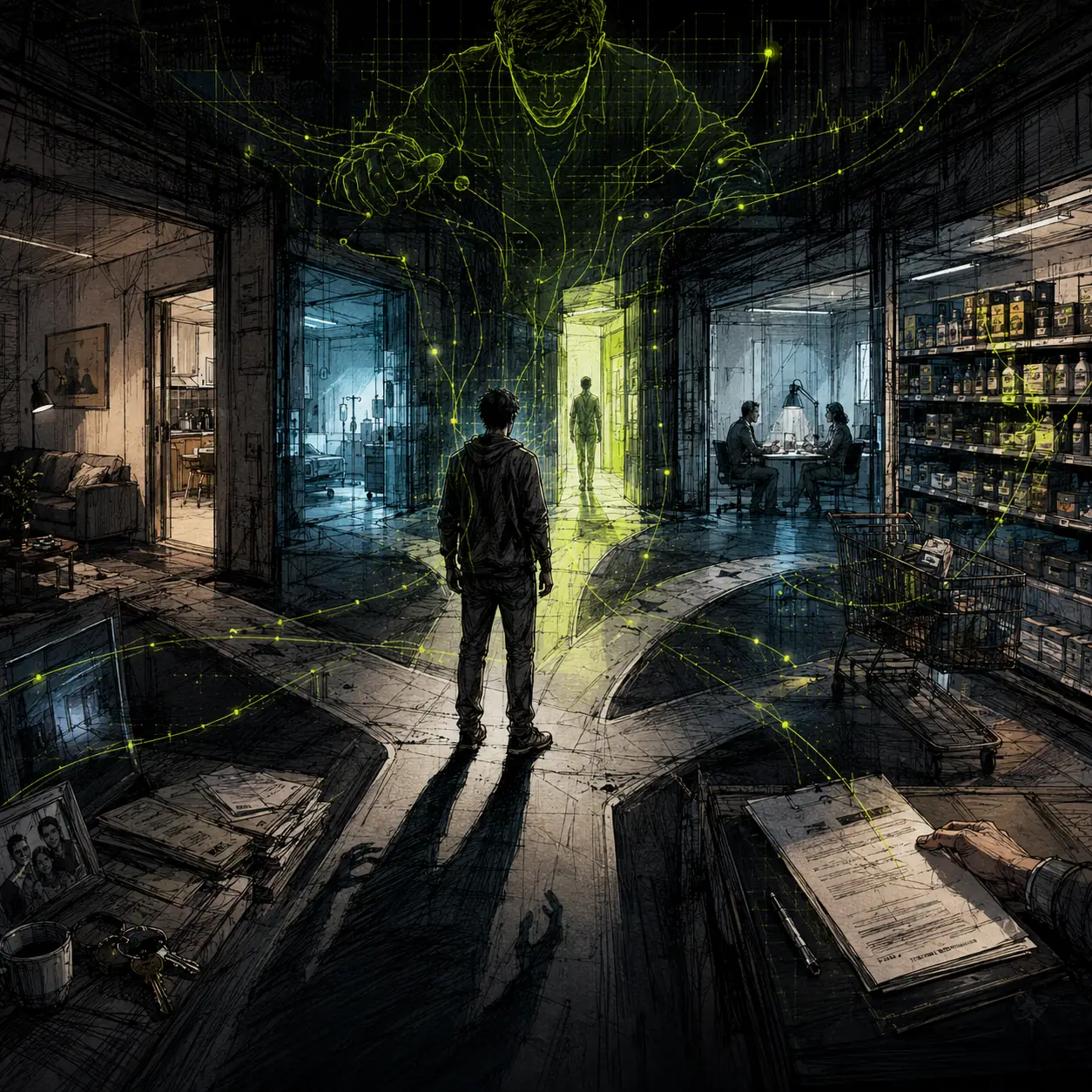
It is the insurance score that sets your premium on the basis of presumed behaviour. It is the ranking that decides what you will see and therefore what you will think you chose. It is price segmentation showing you a world calibrated to you. Heidegger would call the architecture behind it Gestell: a way of disclosing the world that makes it appear as standing reserve, resource on call. Benjamin Bratton would call it the Stack: planetary computation as a layer of power. Either way it is power crystallised in architecture, disclosing the human as on-demand surplus.
And it works with our complicity. Byung-Chul Han described this better than anyone: neoliberal power does not repress freedom, it exploits it. In the digital panopticon we were not locked in — we threw ourselves in, in a form more efficient than discipline. We self-optimise, we expose ourselves out of devotion, we turn confession into performance. The conversational interface is the perfect psychopolitical device: it does not extract intention, it has us declare it.
Against Analog Nostalgia
At this point the temptation is to set an authentic, embodied, non-computable human against the machine. It is a temptation to refuse, because it is analog nostalgia: the ghost of a pure human waiting to be redeemed. That human never existed. Bernard Stiegler showed as much: there is no human prior to the prosthesis, humanity is born already technical, already artificial. And the faculty this economy captures — protention, anticipation, the expected-future of consciousness — was always co-constituted by technical supports. That «intentional surplus» one might be tempted to announce as a new concept already has a pedigree: it is the industrial capture of an anticipatory faculty that was technical from the outset. Katherine Hayles told the story of how cybernetics made information «lose its body»; Donna Haraway, with the Cyborg Manifesto, closed off every escape route toward innocent nature; Foucault had already noted that «man» is a recent invention, a figure that can be erased.
Which leads to a political consequence rather than a nostalgic one: the embodied human is a construction too, as much as the informational one. If both are constructs, the surviving question is not metaphysical — which is true by nature? — but political: who imposes it, to whose advantage, and could it be otherwise?
It is worth saying what this is not. It is not technophobia. The critique does not arrive from a phenomenological outside hostile to the machine: it assembles inside cybernetics. There is, after all, a second-order cybernetics — von Foerster, Varela, Maturana — in which the observer is part of the system, there is no external helmsman, and the system produces itself rather than submitting to steering from outside. The target is not cybernetics as such. It is the control fantasy of its first-order version: the one this economy rests on.
Why Digital Surveillance Has to Intervene
Nor is the system omnipotent. Evgeny Morozov objects that this is not a new species of capitalism but capitalism with monopoly rents. Nick Couldry and Ulises Mejias speak of data colonialism: appropriation rather than extraction. Wendy Chun points out that prediction is fallible, discriminatory and self-fulfilling. But fallibility does not weaken the thesis: it relocates it. You can face consequences not for what you did, but for what a model — possibly a wrong one — considers you likely to do.
This is where the debt left open earlier gets paid. Precisely because the non-computable cannot be computed, the machine cannot confine itself to predicting. It has to intervene.
The model’s failure is not an accident: it is the engine of coercion. Certainty that cannot be calculated gets manufactured instead, by shaping the environment of the decision. This is Merleau-Ponty’s manipulandum coming true — the human made manipulable because a system decided to treat him as such.
Against what, then, if not against a nature to be defended? The future needs a different vocabulary. Henri Bergson had one: duration is the creation of the new, irreducible to spatialised, calculable time — the future is not given, it is invented. (Duration, not the élan vital: that would let naturalism back in through the window.) And Derrida draws the distinction cleanly: le futur is the predictable, programmable future, an extension of the present; l’avenir is the structurally unforeseeable to-come, what will not be programmed. This economy is precisely that: the colonisation of l’avenir by le futur.
Who owns a decision before it has been made?
Regulating Digital Surveillance Asks the Wrong Question
We have moved from the surveillance of action to the surveillance of deliberation. This is not an accusation that every assistant uses every conversation for advertising: it is a structural thesis. A conversational technology possesses the capacity to enter the process by which intention forms. That capacity opens a new economic and political frontier, regardless of how it is used today.
Regulation has noticed, in part. The GDPR recognises that personal data is not only what you provide directly: derived and inferred data can fall within the right of access. The Digital Services Act imposes greater transparency on very large platforms, at least one recommendation option not based on profiling, and public ad repositories. The European AI Act prohibits certain manipulative techniques. These are real barriers.
But they ask the wrong question. Even when I can access my data, can I know the model of my future an organisation has built? Can I see the inference, contest it, refuse to be assessed on behaviour I have not yet exhibited?
And above all: the solution cannot be individual. Rejecting cookies, changing settings, clearing history — useful gestures that return a political-economic problem to the responsibility of the individual. Polanyi understood this: to commodification, society responds with a double movement. Here the counter-movement has concrete forms — data trusts, collective bargaining over data, interoperability imposed by law, strategic litigation. Not privacy settings: collective power.
The Right to an Unassigned Future
Hannah Arendt gives that power its deepest foundation, and it is no accident that her critique strikes exactly this point. Arendt was already attacking the reduction of action to statistically predictable behaviour — her distrust of «the social» and of the behavioural sciences is a direct hit on behavioural surplus. Surveillance wants behaviour, which is to say the predictable. Politics is action, which is to say the inaugural. And action rests on natality: the capacity to begin something no model foresees, because it does not follow from what came before. Cornelius Castoriadis doubles this at the collective level with the radical imaginary: the society that institutes itself and cannot be deduced, autonomy against the ensemblistic-identitary closure that is the very logic of the datum.
Hence the four rights this piece claims — not as individual protections but as collective capacities: to know the relevant inferences; to contest a prediction; not to be assessed on presumed behaviour; and the right to an unassigned future.
The last of these needs a positive name, not only a defence stated in the negative. Édouard Glissant offers one: the right to opacity. This is not privacy as data concealment. It is the right not to be rendered entirely transparent, legible, computable by the other. And it is an anti-colonial right — it welds precisely onto Couldry and Mejias’s data colonialism. So formal impossibility (Gödel, Turing, Chaitin, Nicolelis) and ethical opacity (Glissant) lay a two-layered floor: not everything can be formalised, and not everything should be.
Tiqqun knew the tactic: noise, unpredictability, illegibility. «Panic makes cybernetics panic», because chaos constrains prognostic thinking. But individual opacity is not enough on its own — it has to be coupled to institutional barriers, or it stays a private gesture inside a collective problem.
And one political act precedes all the others, the one Yuk Hui names with his cosmotechnics: showing that the Californian-cybernetic vision of the world is one configuration among many, not the only one available, presented as universal. Re-particularising it. Because the moment it stops looking like technological destiny and becomes a choice again — authored, interested, otherwise-possible — political space reopens.
This is how the four layers add up. The right to an unassigned future is not a wish: it is overdetermined by four different languages saying the same thing. Formal impossibility — no total prediction is available. To-come — no future is entirely programmable. Natality — no action is entirely deducible from the past. Opacity — no human being should be rendered entirely transparent. Which is why the ending is not rhetorical.
Back to the epigraph, then. We are not defending a human-as-nature against the machine: the embodied is constructed too, and analog nostalgia is a closed road. But no construction of the human closes on itself — there is always a remainder — and none is imposed without an author and an interest. The manipulandum is not our nature. It is one synthetic configuration of the human, imposed and dressed up as inevitability. Unmasking the disguise is the political act.
The problem, then, is not how much platforms know about our past. It is what power they acquire when they can convert that past into a claim on our future.
The new private property is not about what we have done. It is about the probability of what we have not yet decided.
And the only question left is political, not philosophical: can we be free, if the environment in which we choose is designed by those who profit from predicting — and producing — our choice? The answer is written nowhere. Which, come to think of it, is exactly the point.
- FTC, Surveillance Pricing Study — Initial Findings (2025)
- Shoshana Zuboff, Big Other (Journal of Information Technology, 2015) and The Age of Surveillance Capitalism (2019)
- Dallas Smythe, Communications: Blindspot of Western Marxism (1977)
- Norbert Wiener, Cybernetics (1948) · James Beniger, The Control Revolution (1986)
- Tiqqun, The Cybernetic Hypothesis
- Maurice Merleau-Ponty, Eye and Mind (1961)
- Alan Turing (1936); Gregory Chaitin, algorithmic information · Miguel Nicolelis & Ronald Cicurel, The Relativistic Brain (2015)
- Nancy Fraser, on expropriation/exploitation and Polanyi · McKenzie Wark, A Hacker Manifesto (2004)
- Karl Polanyi, The Great Transformation (1944)
- Martin Heidegger, The Question Concerning Technology (1954); Benjamin Bratton, The Stack (2015)
- Byung-Chul Han, Psychopolitics (2014) · Bernard Stiegler, Technics and Time
- N. Katherine Hayles, How We Became Posthuman (1999) · Donna Haraway, A Cyborg Manifesto (1985)
- Heinz von Foerster / Francisco Varela, second-order cybernetics
- Evgeny Morozov; Nick Couldry & Ulises Mejias, The Costs of Connection (2019); Wendy Chun, Updating to Remain the Same (2016)
- Henri Bergson, on duration; Jacques Derrida, le futur / l’avenir
- Hannah Arendt, The Human Condition (1958); Cornelius Castoriadis, The Imaginary Institution of Society (1975)
- Édouard Glissant, Poetics of Relation (1990), the right to opacity
- Yuk Hui, The Question Concerning Technology in China (2016), cosmotechnics