
The Great Deception of the Social Media Ban
Social media ban: When “Protecting Minors” Really Means Setting Big Tech Free
Call it progress. Call it child protection. Call it a political victory.
Just don’t call it a solution. Because it’s the problem dressed up as an answer.
Denmark is banning social media for under-15s. Australia for under-16s. Fines up to 50 million dollars for platforms that don’t comply. The Danish prime minister declares that smartphones “steal childhood”. The Australian prime minister celebrates a “response to parents’ demands”.
Political theatre at its finest. Governments posing as saviours. Laws that promise to halt the digital epidemic. Headlines cheering a historic turning point.
Sherry Turkle, who has spent thirty years studying the relationship between adolescents and technology, has documented a more uncomfortable truth: “We are seeing the first generation to grow up knowing that every misstep, every awkward gesture of their youth, is being frozen in the memory of a computer.”
The problem isn’t new. The proposed solution is just another version of the same problem.
Because behind the rhetoric of protection lies a truth nobody wants to say out loud: these laws are not protecting minors from social media. They are protecting social media from minors.
And in this carefully engineered confusion, everyone wins. Except the very people the law claims to protect.
Social media ban: Real Crisis, Fake Cure
Numbers don’t lie. Interpretations do.
60% of Danish teens aged 11 to 19 stay home instead of going out with friends. 96% of Australian children aged 10 to 15 use social media. 350,000 Australian adolescents aged 13 to 15 are active on Instagram. Studies link heavy social use to anxiety, depression, sleep disorders, loss of focus.
The crisis is real. But a real crisis doesn’t automatically justify any response. Especially when that response systematically worsens every aspect of the problem it claims to solve.
Both laws shift the burden of control onto platforms: they must implement “reasonable measures” to verify age. It sounds logical. Even fair. But “reasonable” is as elastic as it is vague. And that semantic vacuum hides a structural abyss of irresponsibility.
Research on 2,663 Flemish adolescents shows that Fear of Missing Out – that pervasive feeling that others are enjoying rewarding experiences from which one is excluded – predicts not only how often teens use social media, but especially how they use it.
FOMO drives them towards private platforms, where interactions feel more “authentic”, where exclusion hurts more, where the need for connection becomes a psychological urgency.
Now think: what does a total ban do to a 15-year-old’s FOMO? Does it eliminate it? No. It intensifies it. It turns social anxiety into legally enforced exclusion.
The teen knows that their peers in other countries are still participating. They know that those savvy enough to bypass controls keep their connections. The anxiety isn’t resolved. It’s institutionalised.
And when anxiety becomes unbearable, it finds other outlets. Always.
The Surveillance Paradox: Protecting by BANNING
To verify that a 15-year-old is not accessing Instagram, you first need to know who that 15-year-old is. Government IDs. Selfies for facial recognition. Biometric data. Banking details.
Every method creates databases with the most intimate information about millions of people, tightly linked to their online activity.
As the Electronic Frontier Foundation bluntly puts it: “Age verification systems are surveillance systems.”
In 2024, AU10TIX – one of the leading age-verification companies – left access credentials exposed for over a year. Names, dates of birth, nationalities, ID numbers, images of identity documents. All accessible. Not an exception. A rule waiting to manifest.
When sensitive data exists, it will be breached. Always. The question isn’t if. It’s when.
The consequences: phishing, blackmail, identity theft, loss of anonymity. And the impact doesn’t stop with minors. It hits anyone who has to verify their age to use a platform. Even forty-year-olds are asked to prove their identity just to watch Reels on Instagram.
And then there’s the legal side. Under the US Supreme Court’s third-party doctrine, “there is no expectation of privacy in information voluntarily turned over to third parties”. Translation: governments can request this data from companies with no warrant. Real-world identity tied to online activity. For everyone.
The NSA kept data it was supposed to delete. The FBI did the same. Trusting that governments will responsibly manage age-verification databases is naïve at best, reckless at worst.
We are building perfect infrastructure for mass surveillance. And we’re calling it child protection.
Social media ban: The Illusion of Control
How do you verify age online without violating privacy? Short answer: you don’t. Long answer: you pretend you can, while quietly building a surveillance infrastructure that won’t work anyway.
Facial recognition. Document uploads. Double-blind token systems. Every option involves trade-offs between effectiveness, privacy, and cost. But the biggest problem is not technical. It’s human.
“Everyone will get around this ban,” a 14-year-old told ABC.
That’s not teenage bravado. It’s empirical knowledge of how the internet works. VPNs. Fake accounts. Foreign platforms that ignore Australian law. Grey zones of the web where no adult can intervene.
American Prohibition in the 1920s didn’t eliminate alcohol consumption. It made it more dangerous and less transparent. Speakeasies replaced regulated bars. Homemade liquor replaced monitored distilleries. The problem worsened instead of improving.
History repeats itself. Always. First as tragedy, then as digital legislation.
We push minors away from visible platforms – where, for better or worse, there are reporting tools, moderation, traceability. We push them into unmoderated ecosystems. Encrypted messaging apps. Obscure forums. Spaces where any form of adult supervision becomes impossible.
Australian research confirms it: removing access to social media does not help young people develop the critical thinking required to distinguish disinformation from truth. On the contrary, it deprives them of the opportunity to learn these skills in relatively controlled environments, while they’re still under the guidance of educators.
Roger Silverstone, who studied for decades how people integrate technologies into their lives, describes a process he calls “domestication”. Technologies enter our homes, are negotiated, transformed, woven into daily routines according to the family’s moral values. It is a natural, necessary, inevitable process.
State bans interrupt this process. They prevent families from negotiating how social media fits into their values. The state imposes prohibition from above. But the need for domestication doesn’t vanish. It simply moves into spaces where families have even less control, not more.
You can’t ban a fundamental social process. You can only displace it. And you’ll make that “elsewhere” less safe.
Social media ban: The Great Off-Loading of Responsibility
This is the part that should make everyone furious. And yet almost no one seems to notice.
If under-16s are not supposed to be on social media in the first place, platforms have no incentive left to design for their safety. Zero. None.
No need to create protected environments. No need to moderate content with young audiences in mind. No need to implement sophisticated parental controls. No need to test whether predatory algorithms are harming developing minds. No need to worry about minors at all.
The message to Big Tech is crystal clear: minors are no longer your problem.
If they’re there, it’s their fault. Or their parents’. Or their ability to bypass controls. Never yours.
The Australian Human Rights Commission proposed an alternative: a legal duty of care for platforms. It would require them to take reasonable steps to make their products safe for children and young people. A proactive approach to increasing responsibility.
But that would have required courage. Confrontation with Meta, TikTok, X. Forcing these companies to redesign their algorithms. To dismantle infinite dopamine loops. To actively moderate harmful content. To build support pathways for vulnerable users. To make visible how and why they amplify some content over others.
Hard. Expensive. Politically risky.
The social media ban is easier: shut the door. Whatever happens outside is no longer your responsibility.
Turkle has spent decades interviewing teenagers who describe a culture of permanent distraction. Parents “physically close, tantalisingly close, but mentally elsewhere”. Teens who send 3,000 messages a month and then say wistfully: “One day, but not now, I’d like to learn how to have a conversation.”
The problem was never technology in itself. The problem is that platforms are engineered to maximise engagement at any psychological cost. And now, thanks to bans, they are legally exempt from considering those costs for an entire demographic.
The perfect gift.
Social media ban: The Platforms’ Win-Win-Win
Let’s unpack what platforms really gain from these laws.
Win one: removing a “problematic” segment
Minors are difficult users. They require extra moderation, generate scandals, expose platforms to legal and reputational risk. When a 13-year-old dies by suicide after cyberbullying on Instagram, Meta is hauled into hearings. When a 12-year-old is groomed online, Facebook becomes a media villain. Officially removing minors means officially removing these problems.
Win two: no obligation to design ethically
If there are no “legal” minors on a platform, there is no need to build protective features. Algorithms can stay exactly as they are: tuned to maximise engagement regardless of psychological fallout. Infinite notifications, endless scroll, ever more extreme recommendations – all can remain untouched because, on paper, every user is an adult.
Win three: perfect legal shield
When the next scandal breaks – and it will, because minors won’t magically vanish from platforms – Big Tech already has its script: “We implemented reasonable measures. We complied with the law. If minors got in anyway, it’s not our fault.”
The burden is on platforms to prove they took “reasonable” steps, but what counts as reasonable is left deliberately vague.
It’s the perfect liability shield. The digital equivalent of hanging a “No Minors Allowed” sign on a nightclub without installing metal detectors, checking IDs, or hiring security – and then saying “We did our part” when 14-year-olds walk straight in.
Social media ban: Selective Exclusion
There’s another revealing detail. Messaging apps like WhatsApp and Meta’s Messenger are exempt from the Australian ban. So are services that provide crucial information and emotional support.
Why? Because messaging platforms are less visible, less trackable, less prone to public controversy. The problem was never protecting minors from technology. The problem has always been protecting platforms from the consequences of their technology.
The result is a paradoxical landscape: we ban 15-year-olds from Instagram – where, at least in theory, there are reporting tools and moderation – while letting them use WhatsApp, where private groups can thrive with no outside oversight.
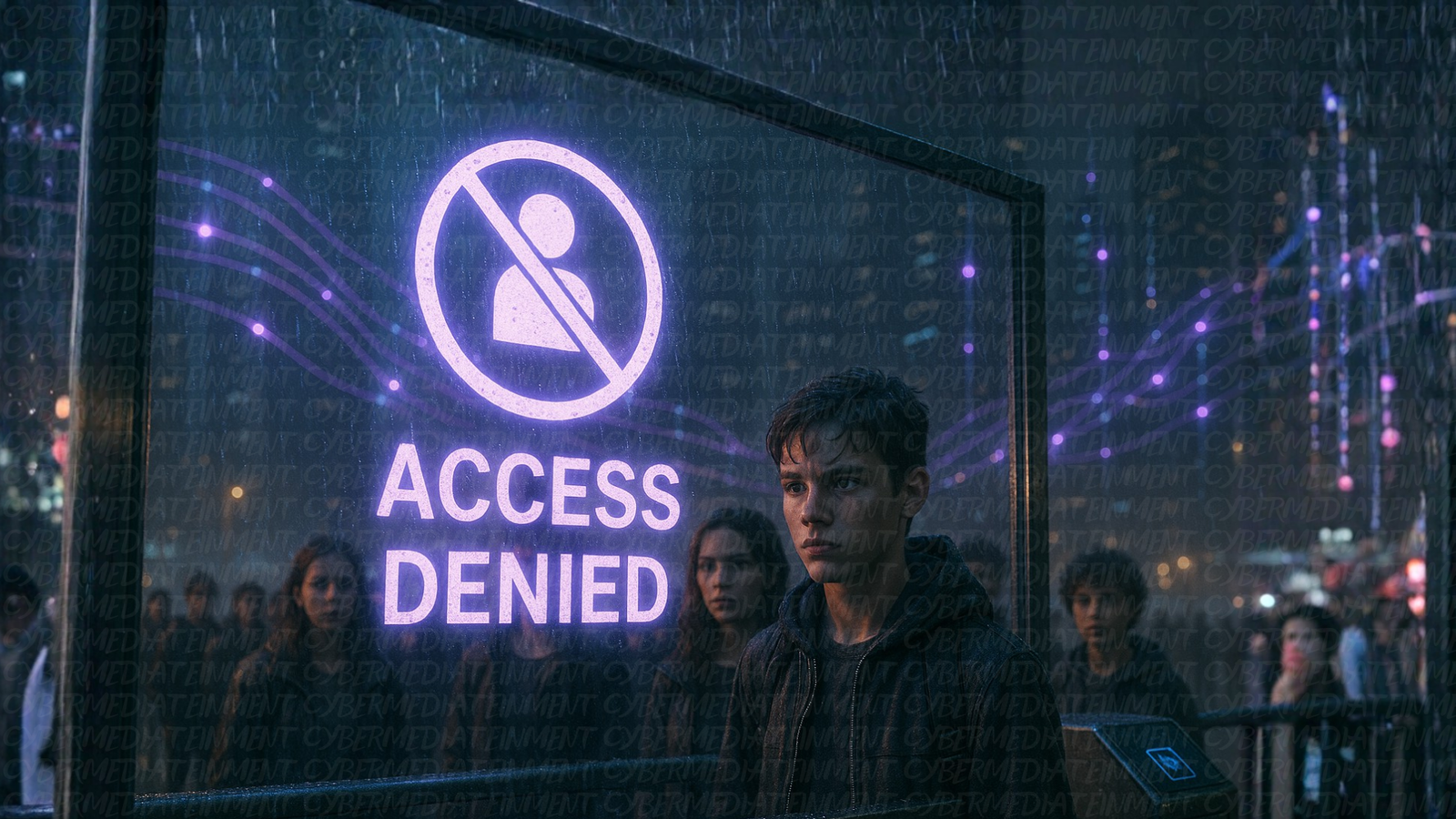
The Great Deception of the Social Media Ban – conceptual visualisation of digital surveillance and social platform control over minors.
The One Truth No One Wants to Say About the Social media ban
Some teenagers say social media saved their lives, offering support communities, spaces of acceptance, crucial connections during traumatic moments. One study shows that a third of adolescents say they feel less lonely thanks to social media, and 72% report that social has a neutral or positive impact on their mental health.
Those numbers don’t matter. Because these laws are not really about young people’s wellbeing. They are about political wellbeing – governments that get to say “we did something”. They are about economic wellbeing – platforms that get to off-load responsibility. They are about moral wellbeing – a society that can keep ignoring systemic problems while pretending it fixed them with one stroke of a pen.
In Australia, the legislative process took just nine days in November 2024. The public had a single working day to submit feedback. Many stakeholders refused to participate, saying one day was nowhere near enough to evaluate such a complex issue.
Consultation with young people, Indigenous communities, parents, mental-health professionals – the people directly affected – was minimal to non-existent.
But why consult those who will actually live with the consequences when you already have a solution that polls well?
The Data Nobody Wants to Look At
The empirical evidence on the effectiveness of social media bans is weak. Embarrassingly weak. A scoping review looked at 22 studies on mobile-phone bans in schools. Only six measured mental-health outcomes. Of those, two offered anecdotal support for bans. Four found no evidence in favour.
And the numbers get more uncomfortable when you look at who gets hurt the most.
LGBTQ+ youth. Youth of colour. Minorities. Everyone who doesn’t see themselves reflected in offline society uses social media to reduce isolation. They spend more time online. Not out of “addiction” – out of psychological survival.
“At first you think ‘This is terrible,’” explains researcher Linda Charmaraman. “But when you look at why, it’s because it helps them gain identity affirmation that’s missing in real life.”
Arianne McCullough, 17, Black, uses Instagram to connect with other Black students at her university, where only 2% of the student body is Black. “I know how isolating it can be,” she says.
Bans hit hardest those who most need these spaces.
Mental-health support. 73% of young Australians who access mental-health support do so through social media. Read that again: 73%. Platforms are the only channel where many teens in crisis feel comfortable seeking help.
Banning access means cutting off the people most in need from the only resources they would actually use.
The positive side, ignored. One third of adolescents report feeling less lonely thanks to social media. 72% say social has a neutral or positive impact on their mental health. This data exists. It’s systematically ignored because it doesn’t fit the moral-panic narrative.
And then there are effects that surveys don’t capture. Harsh restrictions foster isolation. Fuel rebellion against authority. Lead to underdeveloped digital skills. Young people will not magically wake up at 16 with fully formed critical-navigation skills for digital spaces. They need to learn earlier. With guidance. In relatively safe environments.
Bans erase that possibility.
But none of this matters. Moral panic doesn’t respond to data.
This is not protection. It’s responsibility-washing. Platforms keep designing systems that maximise engagement at any psychological cost. Algorithms keep recommending ever more extreme content because extremism drives interaction. Infinite dopamine loops keep spinning.
The only difference is that now, when a teenager gets hurt, everyone can point the finger elsewhere.
Governments say they passed a law. Platforms say they implemented checks. Parents are left to deal alone with teenagers who will find ways around the system anyway.
And minors? They learn that rules exist to be bypassed. That technology is a battlefield between ineffective laws and systems engineered for addiction. That no adult really understands or cares enough.
The Alternative Everyone Fears to the Social media ban
A legal duty of care for platforms. Simple. Clear. Effective. And terrifying – to the people who really matter in this story.
It would force Meta to redesign Instagram so it doesn’t harm teens. TikTok to kill infinite scroll. X to actively moderate self-harm content. It would impose algorithmic transparency on all platforms. It would protect privacy for all users, not just minors. And above all: it would place the burden of proof on platforms to show that their products are not causing harm.
That takes courage. It means confronting billion-dollar lobby groups. Admitting that platforms bear responsibility. Implementing real regulation instead of symbolic prohibition.
Virginia and Maryland ban the sale of minors’ personal data. Colorado, Georgia, West Virginia teach digital literacy in schools. These are approaches that tackle real problems without building surveillance infrastructure or pushing minors into grey zones.
But they require work, competence, and political honesty – three ingredients in short supply whenever populism offers shortcuts.
The ban is simpler, more popular in polls, infinitely less effective – and perfectly aligned with platform interests.
Here’s the truth nobody wants to face:
What if we banned manipulative design patterns for EVERY user? What if algorithmic transparency were mandatory by law? What if we fined platforms for the harms they cause instead of for failing to check ages? What if we treated social media like the tobacco industry – heavily regulated, but not prohibited?
It’s much easier – and far more popular – to ban instead. It’s also far more ineffective. And perfectly convenient for the platforms.
So we keep calling this “progress” while minors are pushed deeper into the web’s shadow zones. Platforms keep optimising for addiction. Both now officially free of responsibility.
Victory for governments that have “done something”. Victory for platforms that have shed the problem. A perfect victory for everyone – except the people the law claims to protect.
But that was always the point, wasn’t it?
Sources
- social media ban: Legislation & Policy: Euronews; Il Post; NBC News; Australian eSafety Commissioner; Wikipedia – Online Safety Amendment (Social Media Minimum Age) Act 2024; TIME – Meta Removes Under-16 Users Before Australia’s Ban.
- social media ban: Privacy & Surveillance: Electronic Frontier Foundation; R Street Institute; New America – Open Technology Institute; Sumsub; GovTech.
- social media ban: FOMO & Adolescent Mental Health: Bloemen & De Coninck – Social Media + Society; Franchina et al. – PMC; Servidio et al. – PMC; Fabris et al. – ScienceDirect.
- social media ban: Theoretical Frameworks: Sherry Turkle – Alone Together; Silverstone & Hirsch – Consuming Technologies; Haddon – Roger Silverstone’s Legacies: Domestication.
- social media ban: Empirical Evidence & Studies: McAlister et al. – JMIR Mental Health; KFF Health News; Australian Human Rights Institute; Foundation for Economic Education; Griffith University News.