Video editor · Creative production · Digital labor
Why demand for human video editors keeps growing as AI automates everything
The paradox the market cannot explain yet
OpenAI shut down Sora in March 2026. CapCut automates everything. Yet in the same six months AI video creators grew 66% on Fiverr, searches for human TikTok editors rose 14% and human social media managers 33%. The market hasn’t understood the contradiction yet. The answer lies in the cognitive structure of trust.
In December 2025 Fiverr published its semi-annual Business Trends Index. The most quoted figure: demand for AI video creators up 66% over the previous six months. But buried a few paragraphs down in the same document was another set of numbers almost no one reported. Searches for human TikTok editors had grown 14%. Human social media managers, 33%. Automation and craftsmanship were growing together — in parallel, on the same platform, over the same period.
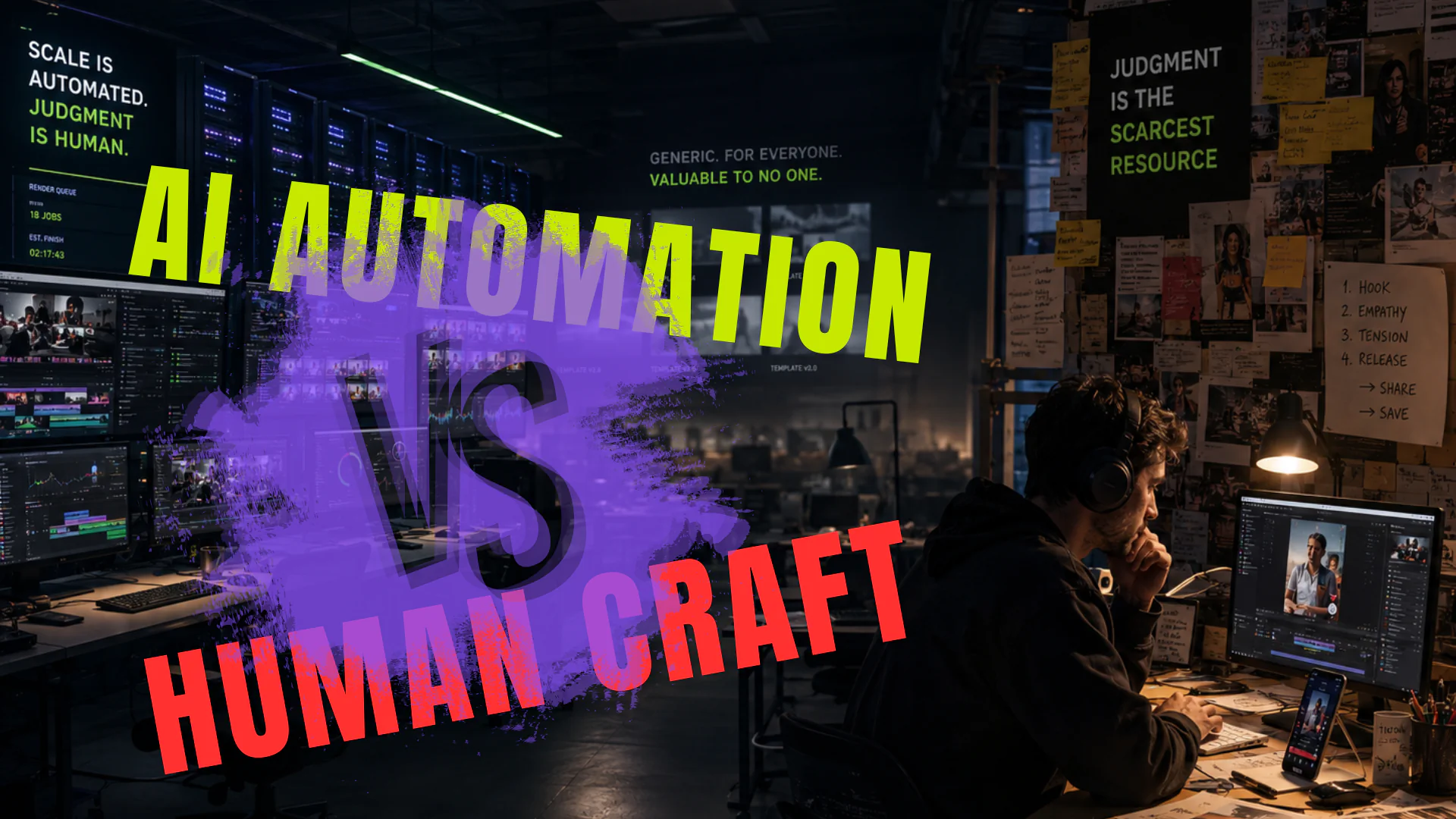
The dominant narrative around video editing in 2025 has a precise structure: AI lowers production costs, average quality rises, human labor is progressively disintermediated. CapCut generates reels automatically. Runway cuts, color-grades, syncs. OpenAI had launched Sora as the symbol of this revolution. Three months later, in March 2026, it shut Sora down — unsustainable compute costs. The freelance video editor who thought they were in decline had been picking up more work than ever.
What the numbers alone don’t explain is the mechanism: why this contradiction exists, and what it reveals about how companies make decisions when they can’t tell one frame from another.

The video editor paradox: automation and human demand grow together
The Fiverr Business Trends Index is built on millions of platform searches from May 2025 — observed behavior, not collected opinions. Companies were simultaneously looking for freelancers capable of using AI to produce video and freelancers capable of editing TikTok with human editorial judgment. Both things at once, on the same platform, in the same window.
| Category | Growth | Type |
|---|---|---|
| Faceless YouTube video creator | +488% | AI-assisted |
| AI automation | +136% | AI-assisted |
| Prompt engineering | +76% | AI-assisted |
| AI video creator | +66% | AI-assisted |
| TikTok promotion | +66% | Human |
| Social media manager | +33% | Human |
| Instagram Reels editor | +24% | Human |
| TikTok editor | +14% | Human |
The global video editing market was worth $3.54 billion in 2025 and grows at a compound annual rate of 5.88%, projected to reach nearly $5 billion by 2031. 89% of companies use video as a marketing tool. AI-assisted editing is now used by 58% of professional editors, up from 22% in 2021. Automation and demand for human labor are moving in the same direction, over the same period, on the same market.
Simple technological substitution would have produced opposite curves: AI growth, human labor decline. The data show something different.
What the data suggest has to do with the cognitive structure of how we perceive value when we cannot measure it directly.
Levi-Strauss in the edit suite: technical video editor vs. craftsperson
In 1962 Claude Lévi-Strauss published The Savage Mind. Its most cited chapter distinguishes two fundamentally different ways of making things in the world: the engineer and the bricoleur. The engineer starts from the blueprint, conceives the result in advance, develops purpose-built tools. The bricoleur does the opposite: works with what is at hand — fragments of past work, repurposed materials. There is no plan; it is the activity of making itself that guides them.
Lévi-Strauss was not describing two evolutionary stages of thought. He was describing two equally valid modes of producing meaning. Applying this distinction to video editing in 2025 produces something precise. CapCut, Runway, Kling are engineers: they operate on a plan and produce at scalable efficiency. But what happens when the brief is ambiguous? When the brand doesn’t yet know what it wants to say? When the edit must honor an editorial sensibility that cannot be specified in natural language?
Format compression as an amplifier of judgment
There is a second layer that the debate about creative work in 2025 almost always omits: the short video is not an abbreviated version of a long video. It is an editorial object with its own internal cognitive logic. The average retention rate for videos under 90 seconds sits around 50%, and 71% of viewers decide within the first few seconds whether to keep watching.
A 75-second video compresses the margin of error in a qualitatively different way from a long format. The short format requires editorial judgment to be embedded before the edit, not adjusted during it. The human professional carries this phase upstream — in the dialogue around the brief, in listening for what the client doesn’t yet know how to say.
Generative tools can position text, sync music, apply transitions. What they don’t handle is implicit context: whether that tone works for that brand at that moment in the attention cycle, whether the chosen sound trend was already saturated three weeks ago, whether a particular hard cut lands differently across audience segments in different markets. The short format does not simplify these variables — it concentrates them.
The Veblen value of cognitive craftsmanship
In 1899 Thorstein Veblen described a paradoxical economic mechanism: there are goods for which demand increases as price rises. Price itself becomes a signal for quality that cannot be directly verified. A paper published on arxiv in May 2026 formalizes this mechanism for human labor in the AI era. Markets saturated with generative AI structurally produce what the authors call “human-provenance premiums” — economic premiums for the verified presence of a human hand in the creative process.
The macroeconomics of this process have a recognizable structure. Industrial automation in the nineteenth century drove down the cost of factory-made textiles. Artisan products conquered a status market, where value was not the function of the fabric but the story of its making. We are witnessing the same process in the video production market.
AI floods creative markets with cheap synthetic substitutes: verified human presence becomes a new form of status attribute.
Video editor: the cost of what cannot be measured
In Italy in 2025 the professional video editing market has a pricing structure that reflects exactly this bifurcation. A junior video editor bills between €25 and €30 per hour. An established professional with a VAT number exceeds €70 per hour. A complete corporate video runs from €800 for standard events to over €5,000 for positioned productions in Milan. Italian Glassdoor data shows average monthly ranges between €1,625 and €3,802 for freelancers — figures that signal not a contracting category but one growing alongside the complexity of the market it serves.
The relevant figure is not the absolute price but the differential. CapCut is free in its basic version. Runway Gen-4 starts at accessible plans. A freelancer for a corporate reel bills between €150 and €500. That difference buys something the invoice cannot describe: the guarantee that someone with judgment took responsibility for the result.
Which professional survives commoditization — and why: the future of the video editor
The answer does not run through technical competence. The editor who holds up under bifurcation is not necessarily the one who uses AI tools best, nor the one with the fastest machine. It is the one who can operate in the bricoleur register within a market that is progressively rewarding engineer logic. The bricoleur takes an incomplete brief toward a result the client recognizes as their own — yet could not have imagined alone before seeing it.
Under uncertainty, AI produces hallucinations — filling gaps with probabilistic patterns. The human bricoleur, under uncertainty, waits, asks, observes, adapts — treating the gap in the brief as information to read rather than an error to correct. The most common strategic mistake in 2026 is staying in the middle ground: rates too high to compete on volume automation, positioning too generic to justify the judgment premium. That center of the market has thinned with AI — it has not simply become more competitive.
- Fiverr International — Business Trends Index H2 2025 (GlobeNewswire, Dec. 2025)
- Mordor Intelligence — Video Editing Market Report 2026–2031
- arxiv 2605.03210 — Human-Provenance Verification as Labor Infrastructure (May 2026)
- Glassdoor IT — Video Editor Salary Data (Sep. 2025)
- Cronoshare IT — Video production rates Italy 2026
Post scriptum
Professional video editing is not a technical service that AI is automating. It is an operation of meaning that uses technical tools. The difference between a translator and a simultaneous interpreter: the translator converts content. The interpreter manages ambiguity in real time — deciding what a word means in the specific context of that specific conversation. AI is a very sophisticated translator. The professional video editor is an interpreter.
The bricoleur survived the textile mill. It survives AI tools, one after another, including those that seemed destined to redefine everything — Sora lasted six months on the market. The reason is not sentimental: it is structural. The bricoleur produces something no factory has ever managed to optimize — meaning under conditions of radical uncertainty. And meaning, in 2026, is the scarcest resource in circulation.
Why does demand for professional video editors for businesses keep growing as AI automates video production? Because automation and human editorial judgment solve different problems: the former scales volume at declining cost, the latter manages brief ambiguity and provides the trust structure that B2B markets require.