Trustless. Quantum Computing, Blockchain and the End of a Promise
Quantum Computing · Cryptography · Bitcoin · Power
In forty days — from March 2 to April 8, 2026 — four separate events shifted the coordinates of the problem. Google Quantum AI redefined the technical timeline for breaking Bitcoin and Ethereum encryption with quantum computing hardware. The post-quantum standards ratified by NIST bear IBM’s fingerprint, and IBM also sells the services to implement them. Blockchain wallets with public keys exposed for sixteen years are the most vulnerable targets. The New York Times identified the possible creator of Bitcoin as the CEO of a company that monetizes that ecosystem. This article reads these facts as parts of the same power structure.
Bitcoin was designed to make trust in intermediaries obsolete: banks, states, institutions. The guarantee was mathematical — the cryptography protecting every wallet makes it impossible to derive someone’s private key from their public key, unless one commands hardware resources no single actor can concentrate. On March 30, 2026, Google Quantum AI published the calculations that shift that threshold: within minutes, using machines within reach of a state or a large corporation — precisely the actors Bitcoin was built to circumvent.
March 30 marks a point of discontinuity for reasons that go beyond a technical number. In the same week Google released the quantum computing whitepaper, NIST had already ratified post-quantum standards written by IBM; intelligence agencies had been operating for years with storage infrastructures designed for data that cannot yet be decrypted; and 1.1 million original Bitcoin sat in blockchain addresses with access keys publicly visible to anyone for sixteen years — the format most vulnerable to a quantum attack.

Quantum Computing: the Document and Its Double
On March 2, 2026, four weeks before the Google whitepaper, the Advanced Quantum Technologies Institute distributed a press release via PR Newswire titled “Cybersecurity Apocalypse in 2026.” It announced the JVG algorithm, capable of breaking RSA-2048 — the system encrypting most internet communications — in eleven hours with fewer than 5,000 qubits. The paper was posted on Preprints.org, which does not perform peer review. The lead author’s background is in fluid dynamics. The entire projection rests on experimental data covering the factorization of five small numbers — 15, 21, 143, 1,363, 67,297. Physicist Scott Aaronson, one of the world’s leading quantum computing experts, published a detailed critique within forty-eight hours. SecurityWeek had already turned the press release into an article distributed by industry newsletters worldwide.
The relevance of the JVG lies in the sequence, not the technical content: it arrived four weeks early, occupied the attention space, and fixed the emotional register — urgency, apocalypse, imminent crisis — through which non-specialist audiences would read subsequent news. When on March 30 Google published a 57-page whitepaper co-signed by the Ethereum Foundation and Stanford, demonstrating the result mathematically without disclosing the attack method and in coordination with the US government, that document was read inside a climate someone else had prepared. The technical result is real: the same cryptography protecting Bitcoin can be broken within minutes. On the same day, a second group of researchers — using different technology — reached the same conclusion: ten days for the same objective. Two groups, two approaches, the same week. Google did not publish instructions for replication.
The researchers building the hardware write in the paper: it is conceivable that the first cryptographically relevant quantum computers will be detected on the blockchain before they are announced — through anomalous wallet movements, private keys derived from already-exposed public keys, without anyone issuing a press release.
Decentralization and the Physical Constraint of Bitcoin
In November 2008, six weeks after the collapse of Lehman Brothers, Satoshi Nakamoto published the Bitcoin whitepaper on a cryptographers’ mailing list. The premise was structural: cryptography guarantees where institutions have failed, because violating it would require computational resources no single actor can concentrate. Decentralization is not proclaimed — it is built as a distributed physical constraint, one that held as long as the hardware required to break it remained beyond the reach of any single actor. Google’s whitepaper changes that condition.
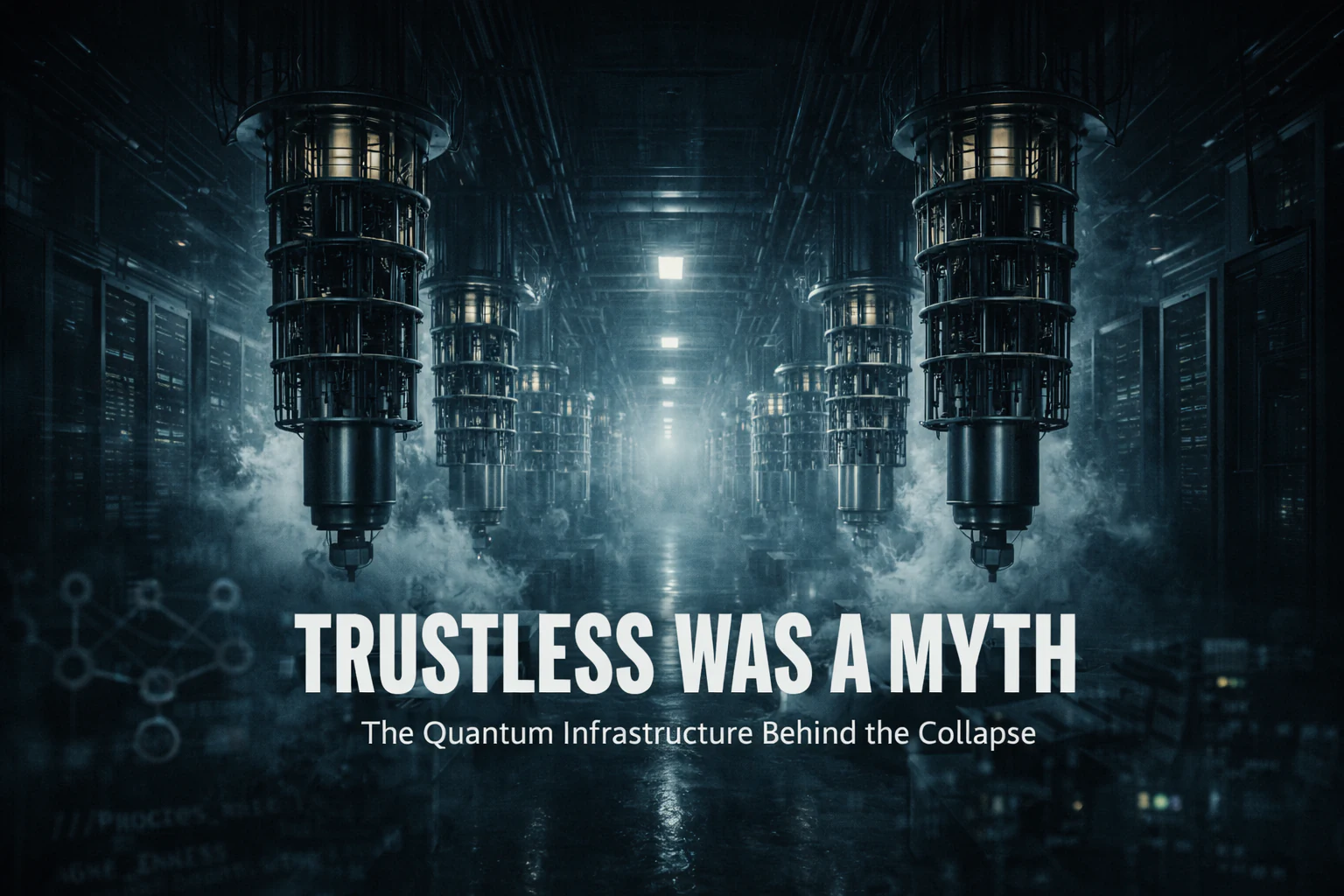
A cryptographically relevant quantum computer operates at 15 millikelvin — colder than interstellar space. IBM had to engineer a proprietary refrigerator for its own systems because nothing large enough existed on the market — described internally as a missile silo. A system capable of breaking Bitcoin’s cryptography would require multiple such devices networked together, hundreds of millions of dollars in infrastructure, and materials sourced from only a handful of suppliers worldwide. Only those with billions to invest and access to specific industrial supply chains can build it: the same nation-states, the same technology corporations, the same federally funded laboratories that the 2008 whitepaper cited as the problem to be circumvented. A technical proposal to upgrade Bitcoin’s cryptographic signatures is under testing but not yet active. Any protocol change requires consensus from the entire network — a process slow by design, built to prevent any single actor from imposing it. In the meantime, approximately 6.9 million BTC sit in addresses with access keys already visible on the blockchain.
Who Writes the Rules of Post-Quantum Cryptography
On March 25, 2026, five days before the whitepaper, Google announced it would accelerate its full post-quantum cryptography migration to 2029 — six years ahead of the US government’s deadline, four years ahead of NIST’s. That migration will use three standards already ratified by NIST as mandatory for US public administrations. All three derive from algorithms developed by IBM Research. IBM is simultaneously the leading consultancy provider for migration toward those same standards. The post-quantum cryptography market is valued at $1.68 billion in 2025, projected to reach $30 billion by 2034. Consulting and implementation account for 63.7% of revenues.
The NIST process lasted eight years with international public review — more transparent than any predecessor. The concentration of results around IBM algorithms describes an incentive structure that public discourse has not yet formalized: the same actor that won the open technical-regulatory process now sells the market that process created. The documented precedent is 2013: the Snowden revelations showed that the NSA had inserted a hidden mechanism into a NIST encryption standard — a random number generator known as DUAL_EC_DRBG — that allowed anyone who knew its parameters to derive future output from past output. No one had audited those parameters for years because they were embedded in a standard. The PQC process was open; the question is whether process openness and result concentration are compatible in the long run.
Satoshi’s Wallet on the Blockchain and the Identity Problem
On April 8, 2026, the New York Times published an investigation by John Carreyrou — the journalist who dismantled Theranos — identifying Adam Back as the most credible candidate to be Satoshi Nakamoto. Back is a British cryptographer, inventor of Hashcash — the mechanism that forces computers to expend real energy to validate transactions, cited in the Bitcoin whitepaper as a direct precedent — and current CEO of Blockstream, the company developing sidechain technology for Bitcoin and monetizing its ecosystem. The stylometric analysis — the study of authorial fingerprints in text, from rhythm to punctuation to lexical choices — cross-referenced thousands of posts across three cryptographic mailing lists from the 1990s and 2000s using three independent methodologies: double space between sentences, British spelling, “proof-of-work” hyphenated. All three converged on Back. Back denies it. No cryptographic proof exists, and by design none can: Satoshi stopped communicating in 2010 without signing anything definitive.
Satoshi’s wallet — approximately 1.1 million BTC identified through the “Patoshi pattern,” a statistical signature in the mining behavior of the earliest blocks, unmoved since 2009 — contains addresses in an older format in which the key to access funds is visible to anyone querying the blockchain. Sixteen years of exposure. At current value, over $90 billion. The Google whitepaper notes that attacks on already-visible, stationary keys are more accessible than attacks on ongoing transactions, because there is no time limit to execute them. The paper introduces the “digital salvage” framework — an analogy with maritime law on shipwrecks — to name the problem the Bitcoin community will have to confront: assets no living owner can move to addresses protected by new cryptographic standards, but that sufficient hardware could unlock. The protocol has no mechanism to handle this. The community would need to choose between two equally problematic options: freeze those wallets by collective decision, violating the principle of cryptographic property immutability; or do nothing and risk someone with quantum hardware draining them, destabilizing the network. If Adam Back were Satoshi, the person who designed a system requiring no trust would today hold a direct economic interest in the ecosystem that system generated, and his wallets would be the most exposed target to the cryptographic break on which that system is founded.
Harvest Now, Decrypt Later: the Collection That Does Not Expire
The “Harvest Now, Decrypt Later” logic is not a forecast: it is documented practice. The NSA, through the MUSCULAR program, physically tapped fiber optic cables between Google and Yahoo data centers, collecting encrypted data in bulk. Britain’s GCHQ, through Tempora, buffered traffic on transatlantic cables. China’s Ministry of State Security breached OPM databases in 2015, stealing the confidential records of 22 million US federal employees — not to use them immediately, but to archive them pending hardware sufficient to decrypt them. The NSA’s Utah Data Center, completed in 2014, was designed to store yottabytes — a trillion terabytes. These structures exist, operate, and continue to collect. Cryptographically relevant quantum computing hardware is not yet available. But the collection has already taken place, and data does not expire.
The relationship between these facts is temporal, not speculative: those who built those infrastructures knew in 2014 that quantum hardware was a real technological horizon, not a remote one. Bitcoin was founded on the premise that the computational cost of breaking cryptography is prohibitive — that breaking costs enormously more than building. When that ratio shifts, the guarantees that depend on it shift with it: the context in which the system was designed has changed, and the system was not built to adapt to that change.
Massive storage infrastructures were built between 2013 and 2014, when cryptographically relevant quantum hardware was already an identifiable technological horizon. The data collected then carries no expiration date. The hardware to decrypt it is what the March 2026 papers describe as buildable.
- Google Quantum AI — Whitepaper on ECC cryptography break, March 30, 2026
- Caltech / Oratomic — Independent paper on neutral atom architecture, March 2026
- NIST — Post-Quantum Cryptography Standardization: ML-DSA, ML-KEM, SLH-DSA
- Bitcoin BIP-360 — Post-quantum signature upgrade proposal
- New York Times / John Carreyrou — Investigation into Adam Back as Satoshi Nakamoto, April 8, 2026
- Scott Aaronson — Critique of the JVG paper / Advanced Quantum Technologies Institute
Postscript
StarkNet is the only Layer 2 — a system built on top of Ethereum to increase its speed and capacity — that the Google whitepaper cites as quantum-resistant. It qualifies because it uses a different mathematical foundation than the vulnerable one, a choice made for computational efficiency reasons, not preventive security. No other Layer 2 of comparable scale is in the same position. The rest of the ecosystem depends on a technical proposal that requires consensus from the entire network — the same slow governance mechanism that guarantees censorship resistance — to implement an urgent change. The system is protected from arbitrary modifications because no one can impose them; for the same reason it cannot be updated rapidly when context changes.
The technical window is not closed. It is narrowing asymmetrically: faster for those holding addresses of the older type, with keys exposed for years; more slowly for those operating on newer formats. That asymmetry already produces a concrete risk hierarchy today — between old and new addresses, between those who have already migrated and those who cannot because they no longer control the keys. The effects of the vulnerability precede the actual attack.