Your Face Is the Password
Disneyland and biometric control – Facial Recognition – Biometric Surveillance – Digital Identity – Algorithmic Power
From Disneyland to banks, hospitals to public space: a critical map of facial recognition in 2026. How biometrics is closing the historical gap between physical and digital identity, why anonymity becomes structurally impossible, and what it means that identity — once an intrinsic attribute of the person — is becoming a managed service, with access costs, mandatory verification, and a database as the final arbiter of who you are.
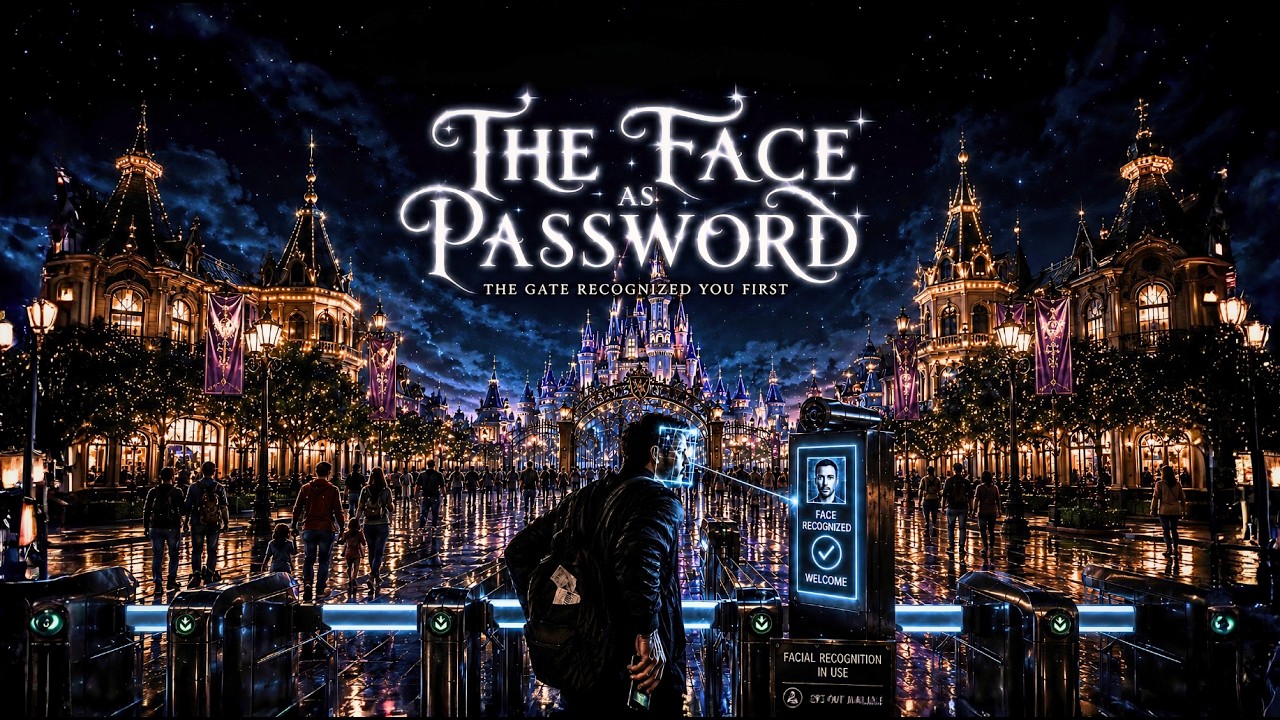
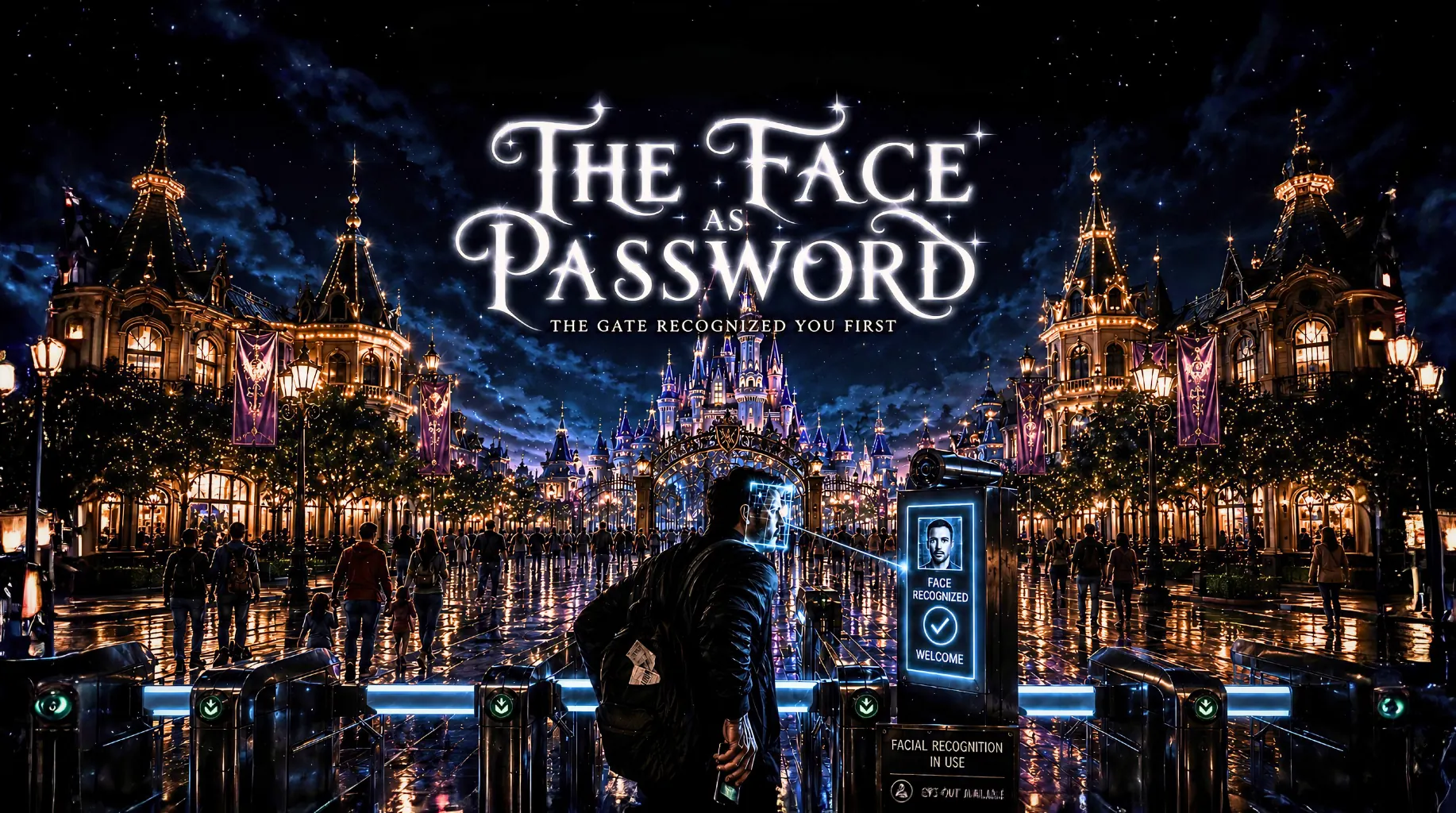
: There is a moment, almost imperceptible, when you pass through a gate and the machine has already recognized you before you’ve pulled your phone from your pocket. It happens at Disneyland, in some airports, at stadium and hospital entrances. Your face has replaced the ticket, the ID card, the password. It’s convenient. It’s fast. And it is, on closer inspection, one of the most profound transformations in the relationship between the human body and institutional power in recent decades.
Since April 2026, Disneyland Resort in Anaheim has completed the rollout of facial recognition at nearly all entry gates. But the system had been running since December 2025: signage informing visitors of their right to refuse appeared only four months after scanning began. In those four months, thousands of people were identified without knowing they could opt out.
This is not a communication failure. It is the operating logic of an infrastructure that installs itself before public consent can form — and that, in doing so, silently redefines the meaning of identity.
Disneyland and biometric control: How Does Facial Recognition Work?
The mechanism is apparently simple. At the park entrance, a camera captures the visitor’s image, converts it into a biometric template — a unique numerical code — and links it to the previously purchased ticket. On the next presentation, the comparison happens in real time: match, the gate opens; no-match, the system flags an anomaly. Disney states it deletes data within 30 days, except for legal purposes or fraud prevention. A window that immediately raises the first question: who verifies that this promise is kept, and on what legal basis does the exemption rest? The answer, in the vast majority of cases, is Disney itself.
Universal Orlando has three years’ head start: it introduced biometric gates across all its parks in 2023. Stadiums like Dodger Stadium and Intuit Dome use similar systems for access and contactless payment. Companies like BioQube and iProov supply banks with biometric onboarding technology via dynamic selfies. In some hospitals the face already replaces the patient ID card. Disneyland’s rollout is not an isolated case: it is the final piece of an already structured ecosystem.
Biometric systems don’t ask for your consent. They build the conditions in which refusing becomes irrational.
The opt-out lane formally exists. But it is drastically reduced in available gates, generates significantly longer queues, and — since cameras cover the entire entrance area — visitors who choose to refuse are still photographed. Disney states these images are not processed biometrically. No independent body is in a position to verify this. The most structurally significant point: the system launched the same day updated COPPA protections on children’s biometric data were finalized. Children under 18 can be enrolled with parental consent — a permanent biometric record acquired during a park visit, at the moment of maximum family distraction.
Disneyland and biometric control – Facial Recognition Bias: What’s the Price of Algorithm Errors?
Algorithmic bias in facial recognition is not a thing of the past. The ACLU documents that systems in use produce error rates up to one hundred times higher for people of color, women, the elderly, and young people than for white middle-aged men. These are not marginal imprecisions: they are errors that produce concrete consequences on concrete people. The case of Kimberlee Williams, documented by the ACLU in April 2026, is the most direct measure of that concreteness. Williams, a resident of Oklahoma, was arrested on a Maryland warrant for a bank robbery committed in a state she had never visited. Police had relied on a facial recognition result without conducting any independent investigation. Williams spent six months in jail. She is the fourteenth person known to have been wrongfully arrested in the United States due to a facial recognition error.
In every documented case, investigators had been warned by the software vendors that facial recognition results “do not constitute a definitive identification.” They proceeded anyway. This is automation bias in its most devastating form: the systematic human tendency to trust a machine’s output even when contradictory information is available. Adam Schwartz, director of privacy litigation at the Electronic Frontier Foundation, highlighted the parallel dimension of risk: every centralized biometric database is a high-value target for attackers, and the consequences of a breach are permanent. A stolen password can be changed. A stolen biometric template has no equivalent fix.
Digital Identity as a Service: How Biometrics Ends the Open Internet
The early internet was not designed to know who you are. The separation between physical and digital identity was not an anomaly to be corrected: it was a structural feature of the protocol. You could be a username, an avatar, a freely chosen string of text — recognizable in one forum and invisible in another, choosing the perimeters within which you made yourself traceable. This selective recognizability had precise civil implications: in political, minority, and dissenting contexts, it was a guarantee of safe participation in public life. It was not suppressed by law. It was closed by degrees, through accumulated architectural choices.
Platform real-name policies marked the first fracture. Mandatory KYC in financial services added the document as an access prerequisite. The self-declared identity — “I am who I say I am” — gave way to the verified identity — “you are who the system confirms you are.” Each step reduced the gap between body and digital credential, until the current convergence: facial biometrics as the terminal point. You cannot change your face. You cannot have multiple faces. You cannot choose which aspect to show the database. As Prof. Ari Waldman of the University of California, Irvine has noted, this is not simply the next step in surveillance: it is something qualitatively different.
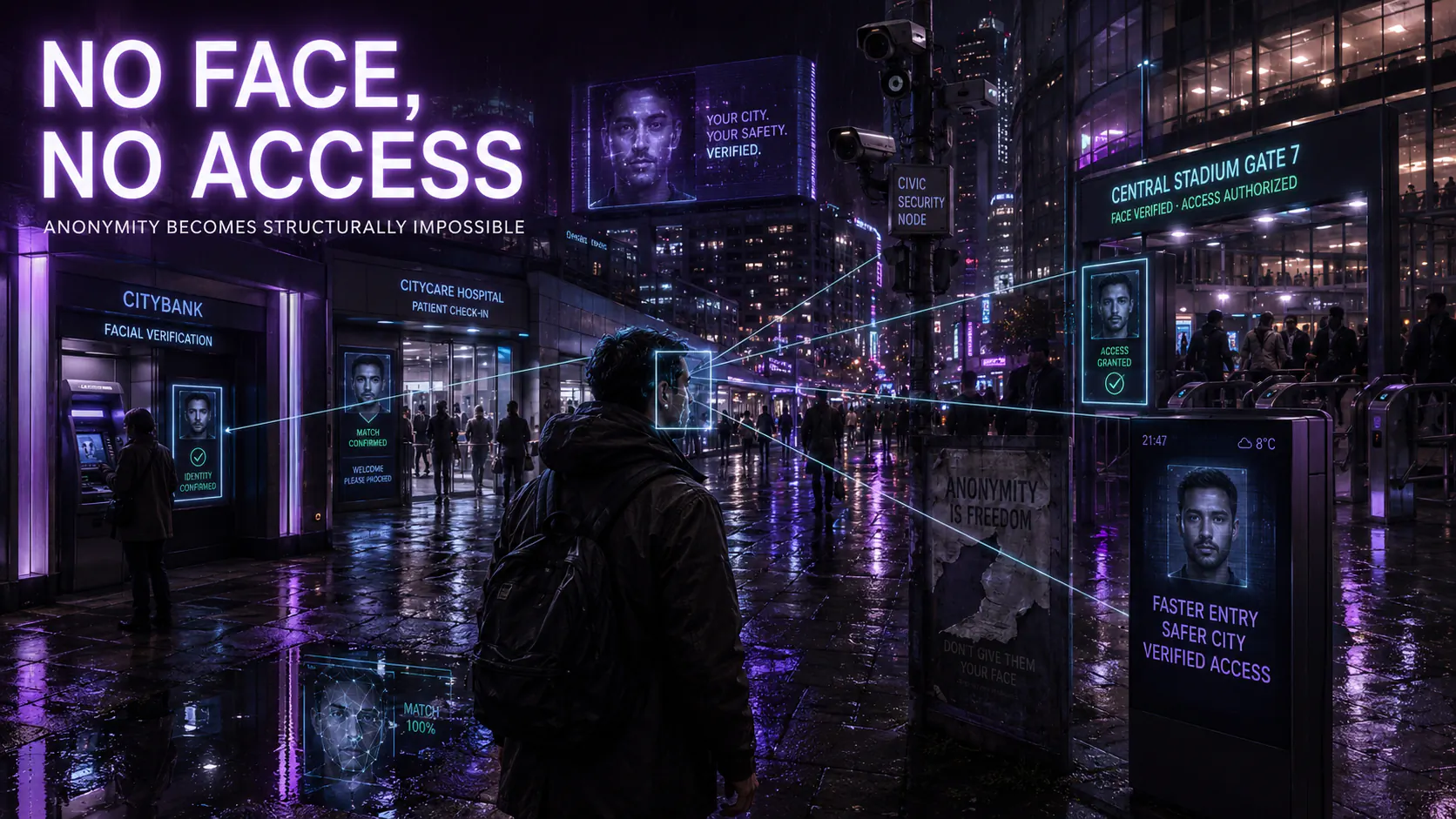
Recognizability and traceability are the two operational consequences of this convergence, and they should be kept distinct. Recognizability is synchronic: the system knows who you are in the moment you present yourself. Traceability is diachronic: every interaction generates a log — a timestamped, geolocated event tied to your biological identity. Individually, each log is trivial. Aggregated over time and across different systems, they produce something traditional surveillance never could: a continuous behavioral graph in which every access to a service, every entry into a space, every verified transaction becomes a node.
The structural impossibility of anonymity that follows is not only a loss of individual privacy — it is a political transformation. Anonymity has historically protected freedom of expression in assemblies, marches, and discussions. Not because participants had something to hide, but because the guarantee of not being individually recorded for every public act is a condition of real freedom. Mandatory biometrics in public and private spaces eliminates this possibility not through prohibition but through an architecture that makes it physically impossible. The result is not a safer society: it is a society in which the psychological cost of public participation increases, silently, for everyone.
In parallel, digital identity has transformed from an implicit prerequisite to a managed service with real access costs. In Italy, SPID is the paradigmatic model: formally free at the basic level, in practice activation requires a valid ID, an email, an active phone number, and sufficient digital literacy. For the elderly, people with low digital literacy, or those without smartphones or stable connections, this sequence carries a cognitive, logistical, and often economic cost — paid identity providers exist precisely because formal gratuity is not real gratuity. eIDAS 2.0 and the European Digital Identity Wallet extend this architecture to continental scale, with the goal of standardizing access — and with the risk of standardizing barriers too.
Normalization, Private Power, and the Logic of the Hedonic Context
There is an implicit strategy in implementing facial recognition in amusement parks worth naming precisely: normalization through hedonic context. When we accept being identified biometrically to enter Disneyland — a place associated with pleasure, family, magic — our psychological resistance to analogous systems in more serious contexts progressively diminishes. The implicit contract seems to say: you already gave your face to see Mickey Mouse. The next step is already announced: the Los Angeles 2028 Olympic Games have been designated a “national special security event” with a one-billion-dollar security budget. The ACLU has already expressed concern about the expansion of facial recognition, drones, and CCTV that the event will bring, compounded by the fact that Los Angeles and Orange Counties host between eight and ten percent of undocumented residents. The Paris 2024 precedent is instructive: France became the first EU country to legalize AI video surveillance for Olympic security. The law was experimental and set to expire. Two members of parliament have already submitted a report to extend it.
Biometric surveillance is no longer an exclusive prerogative of the state. The Madison Square Garden case provides a precise case study: the arena used facial recognition to track specific individuals, compile dossiers, and enforce algorithmic bans against people perceived as critics — including lawyers who had filed suits against the venue’s parent company. Corporations managing biometric systems accumulate three forms of power historically exclusive to public institutions: the right of exclusion, the chilling effect, and the invisibility of power, which operates through interfaces perceived as “efficient” rather than as acts of authority.
A perfectly fair architecture that errs remains unappealable. Fairness does not neutralize absolute power.
Moral Deskilling and the Biometric Iron Cage
Shannon Vallor, philosopher of technology ethics, introduced the concept of moral deskilling: the progressive atrophy of moral capabilities produced by the constant delegation of micro-decisions to automated systems. Every time a system answers “Who are you? Can you enter? Are you a risk?”, we unlearn a piece of the deeply human competence known as contextual judgment. Human interactions are intrinsically flexible: an operator can understand an exception, recognize a misunderstanding, decode a situation that falls outside the norm. For a child with the wrong ticket, a face temporarily altered by physical trauma, or an elderly person who doesn’t remember registering their biometrics: the database is binary. Match or no-match. The Williams case is also this — a chain of human decision-makers who, faced with an algorithm’s output, gave up exercising judgment. Not out of malice. Because the system’s structure had already turned them into extensions of the machine.
Max Weber described modern bureaucracy as an “iron cage” of rationality: rules born to serve human purposes that end up suffocating humanity itself. AI-managed biometric databases represent the extreme evolution of this concept. Consider, hypothetically, a perfect AI administrator — incorruptible, unbiased, mathematically equitable. We would still face an absolute power structure: an infallible system allows no appeals. The moment the database becomes the absolute source of truth, if there is a discrepancy between you and the system it is you who must prove you are yourself. Identity is no longer intrinsic to the person: it is granted by the architecture. Human oversight, in this context, becomes a procedural formality that absolves the company of legal liability without exercising any real critical function. Kimberlee Williams’s six months in a Maryland jail are not a statistical false negative. They are the measure of what is lost when the responsibility of judgment is delegated to a system that does not know what it means to be wrong.
Disneyland and biometric control: Facial Recognition Regulation in 2026 and the Race to the Bottom
The European Union has adopted a structured approach. The AI Act — the world’s first comprehensive regulatory framework for artificial intelligence — entered into force on August 1, 2024. The prohibitions on unacceptable-risk AI practices, including real-time biometric recognition in public spaces for law enforcement purposes, became binding on February 2, 2025. Full applicability, including high-risk systems, is set for August 2026. Fines can reach up to 35 million euros or 7 percent of global annual turnover. The crucial distinction, however, is between identification and verification: the AI Act does not prohibit systems like those at Disneyland — it classifies them as high-risk, with significant compliance obligations, but does not ban them. It is precisely in this nuance that companies find their operational margin.
The American landscape is radically fragmented. There is no federal law comprehensively regulating the use of facial recognition by private actors. Maryland has a law specifying that recognition results cannot constitute the sole basis for an arrest. It did not prevent the arrest of Williams. The Clearview AI case illustrates the structural problem in its starkest form: the company built a database of over 40 billion images scraped from social media without consent, selling the system primarily to law enforcement. European authorities have collectively issued over 50 million euros in fines — including 30.5 million euros in the Netherlands in 2024, plus penalties from France, Greece, Italy, and the United Kingdom. Clearview ignored all European sanctions, arguing it is not subject to GDPR. It continues to operate.
Beneath this regulatory dynamic lies a deeper argument about the structure of power. Political theorist David Grewal described network power as the form of power exercised by a network standard that grows until the cost of non-participation exceeds the cost of participation — not through coercion, but through the simple logic of exclusion. No one forces you to have SPID. But if booking a medical appointment, filing a tax return, or receiving a benefit requires it, the option of not having it ceases to be a real choice. It becomes the exclusion option. As digital identity infrastructure reaches critical mass — with biometrics as its most stringent verification layer — no active credential means the gate stays closed.
The final consequence is what this article has sought to bring into focus: identity is becoming a service. Not an intrinsic attribute of the person — recognized by the community, guaranteed by the state, inalienable by definition — but a product delivered by an infrastructure, with access conditions, differential costs, and the possibility of revocation. Those who cannot afford the access costs get a second-tier digital identity, or none at all. Those who fail to meet the system’s technical parameters are classified as anomalies. And those excluded from the infrastructure do not disappear: they simply become bodies without credentials — present in the physical world, invisible in the digital one. A condition that, in an increasingly verification-mediated society, is not very different from invisibility altogether.
- Fortune — Disneyland Facial Recognition Deployment, April 2026
- ACLU — Kimberlee Williams: Wrongful Arrest and Facial Recognition, April 2026
- European Commission — EU AI Act: European Approach to Artificial Intelligence
- Biometric Update — Disneyland Facial Recognition Rollout Analysis, 2026
- Electronic Frontier Foundation — Facial Recognition in Entertainment Venues, April 2026
- LAist — LA 2028 Olympics Surveillance Plans, September 2025
- Italian Data Protection Authority (Garante) — Clearview AI Decision
- AgID — SPID: Italy’s Public Digital Identity System
- European Commission — eIDAS 2.0 / European Digital Identity Wallet
- Washington Post — State of Surveillance: Facial Recognition, April 2026
- IAPP — Clearview AI Enforcement Tracker Europe, 2024–2026
Post scriptum
Disneyland’s facial recognition is not the beginning of this story. It is the point at which the story becomes impossible to ignore. Biometrics is already embedded in everyday infrastructure — banking, healthcare, sports, public space — and its extension happens in stages, through hedonic contexts first and normative ones later. Digital identity is reorganizing itself around the body as the ultimate identifier: not a design choice, but a structural direction. The question is not whether this system exists. It is who governs it, who is accountable for it, who is excluded from that governance — and at what cost.
The fourteen cases documented by the ACLU are not anomalies to be corrected in the next model update. They are the measure of the gap between the speed at which systems are deployed and the slowness with which institutions learn to answer for their consequences. A gap that, as long as it remains open, is filled at the expense of specific people.