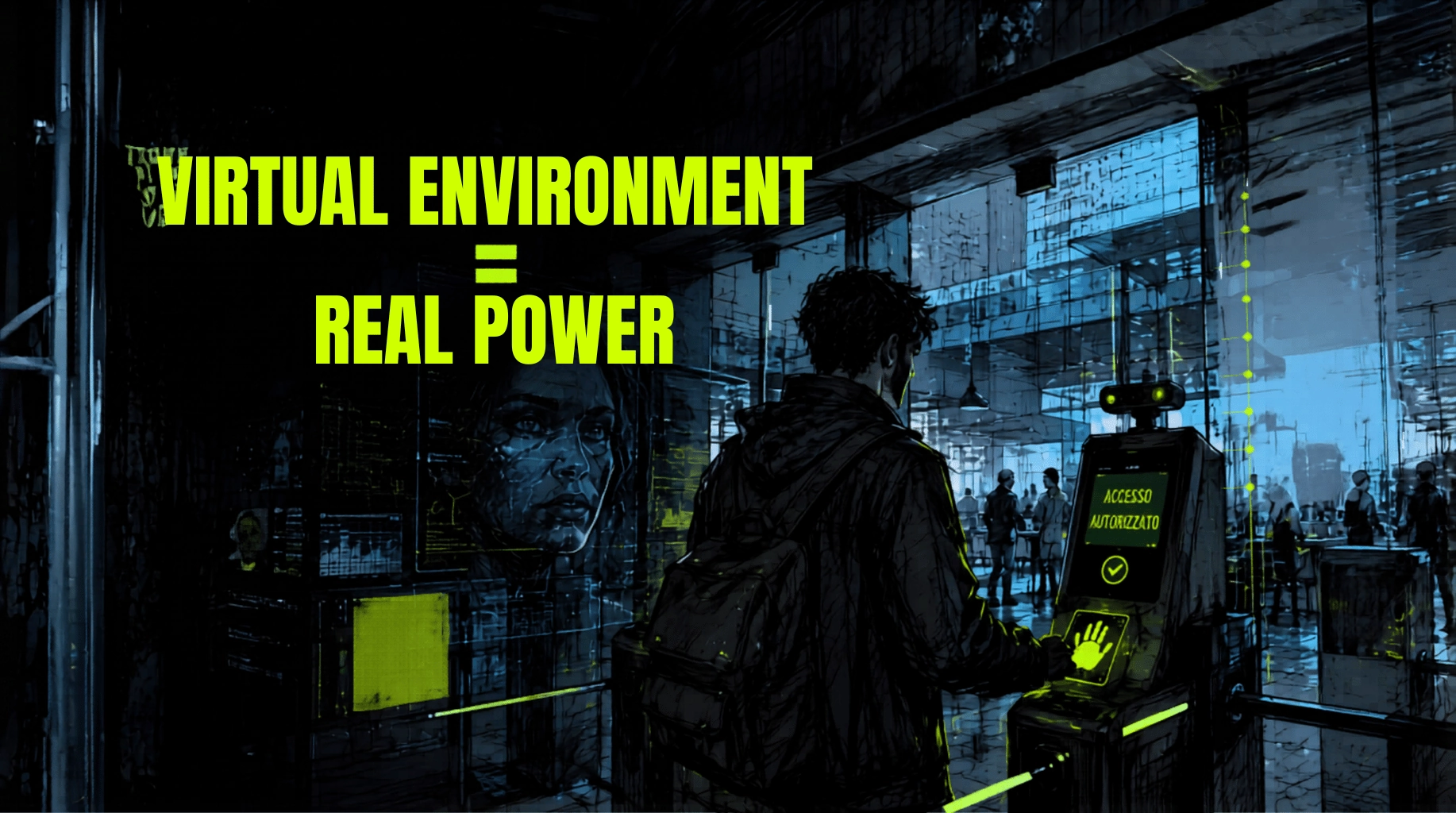
The Architecture of the Virtual Environment Is the Instrument of Power
Virtual environment & real power · Governance · Analysis · Follow The Algorithm
Real digital control doesn’t operate through surveillance or addiction: it works through the architecture of the virtual environment in which we live, think, and become who we are. An analysis crossing Fuller, McLuhan, Bateson, and Girard — arriving at a question no regulator has yet asked.
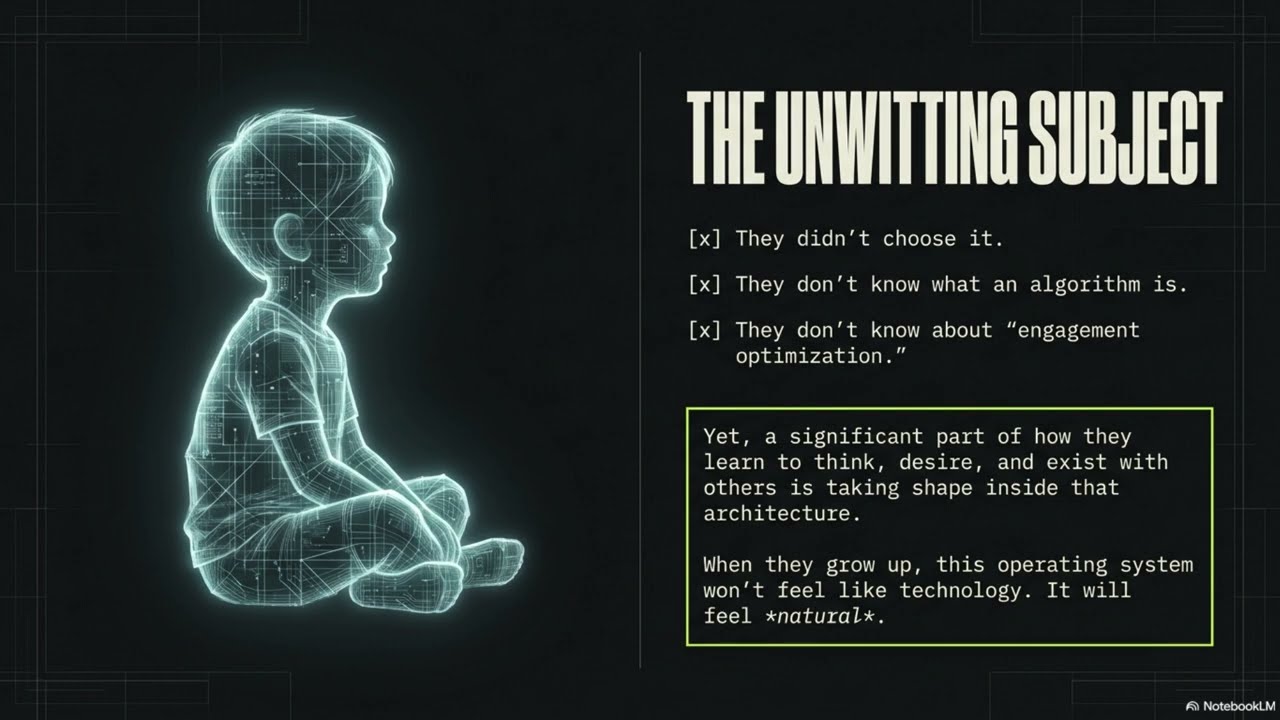
There is a five-year-old child, right now, logging into an educational platform. He didn’t choose that platform. He doesn’t know what a recommendation algorithm is. He has no idea what it means to optimize for engagement. And yet, from today on, a significant part of how he will learn to think, to want, to be with others, will take shape inside it.
By the time he is our age, he will find that way the world works simply obvious. Natural. The only imaginable one.
That child’s problem is not surveillance, not addiction, not Big Tech. Or rather: it’s not only that. The problem runs deeper, quieter, and is far harder to fight — because it has no enemy to point a finger at.
Concept 01
Social Construction of Technology
Every technical object is the sediment of a social negotiation. Once meaning hardens into architecture, it stops being negotiable — and starts running on its own.
Concept 02
Fuller’s Environment Design
You don’t change how people think by convincing them. You change the space they inhabit. The virtual environment is not a tool: it is the designer of behavior.
Concept 03
McLuhan’s Invisible Medium
An environment remains invisible until replaced by a new one. You cannot criticize the water while submerged in it — the water provides the glasses through which you see.
Concept 04
Bateson’s Immanent Mind
The mind is not sealed inside the skull. It is immanent in the circuit: brain, body, environment. A single total environment tends to produce a single form of mind.
Concept 05
Girard’s Mimetic Desire
We don’t desire objects for their qualities. We desire what others desire. Platforms are the perfect amplifier of mimetic convergence — and that’s why we participate willingly.
Three Wrong Answers About the Virtual Environment
When we criticize the digital, we usually pick one of three scripts. The first is the domination script: platforms spy on us, sell us, hook us with tricks designed to keep us from disconnecting. All true, all documented. But it’s a thesis about who — it presupposes a master, someone pulling the strings. The second is the instrumental script: technology is neutral, it depends on how you use it. Convenient, and therefore suspect. The third is its mirror image, the deterministic script: the network has an intrinsic nature, and that nature sweeps over us like an avalanche.
This article passes through all three and leaves them behind. The power operating in the digital is not exercised by anyone, does not flow through technology as a tool, and does not descend from a technical nature written in the stars. It is something subtler: the logic inscribed in the architecture of the virtual environment at the very moment it is designed. A logic that belongs to no one, and for that reason ends up belonging to everyone. A logic that begins to live on its own.
You never change things by fighting the existing reality: you change them by building a new model that makes the existing one obsolete.
To get there, we first need to dismantle the idea that the network “is just like that.” We tend to think of technology the way we think of science: a neutral advance toward truth. But historians of science, from Koyré to Kuhn, have taught us otherwise. The same applies to the tools we build. The internet has no given nature. It has the nature we attributed to it: the symbolic value its creators and early users stitched onto it. It is no accident that the network has changed face repeatedly — from military project to libertarian dream, from nerd bulletin board to surveilled shopping mall. Each time, a different social negotiation.
Fuller, or How to Change People Without Talking to Them
Sociologists of technology call this process SCOT — the Social Construction of Technology. At first, a technical object lives through a phase of interpretive flexibility: different groups assign different meanings, argue over it, bend it to their purposes. Then closure arrives: one interpretation wins, sediments into design, and the object begins to appear obvious, fixed, necessary. From that moment, what was contingent seems inevitable. Once social meaning becomes architecture, it stops being negotiable in the old way. It objectifies. It hardens into structure. And structure, from that point on, works on its own.
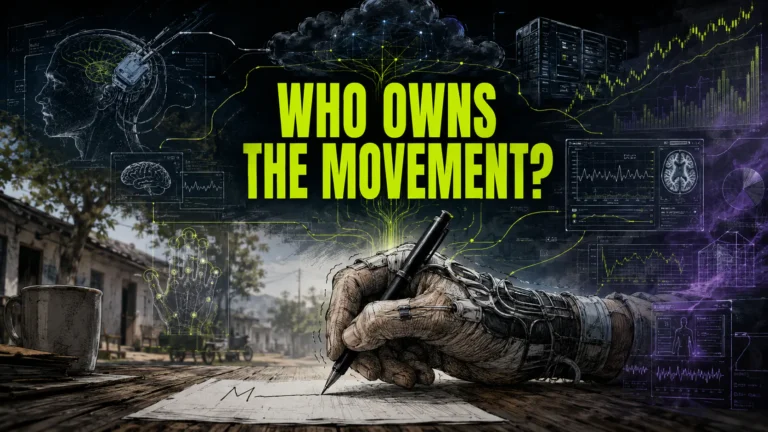
To understand what “structure works on its own” means, the master is someone who loved technology rather than hated it: Buckminster Fuller. Fuller was a radical optimist. He wanted a positive society, wanted to make the planet work for one hundred percent of humanity. And he had a brilliant idea for how to achieve it: don’t moralize people, don’t convince them — change the environment. He said that if you want to teach someone a new way of thinking, don’t waste time teaching it. Give them a tool, and the use of that tool will lead them to think in a new way. The design of the virtual environment is the design of behavior — not through coercion, not through persuasion, but through structure.
Immersed in the Virtual Environment — Fish Don’t Know They’re Swimming
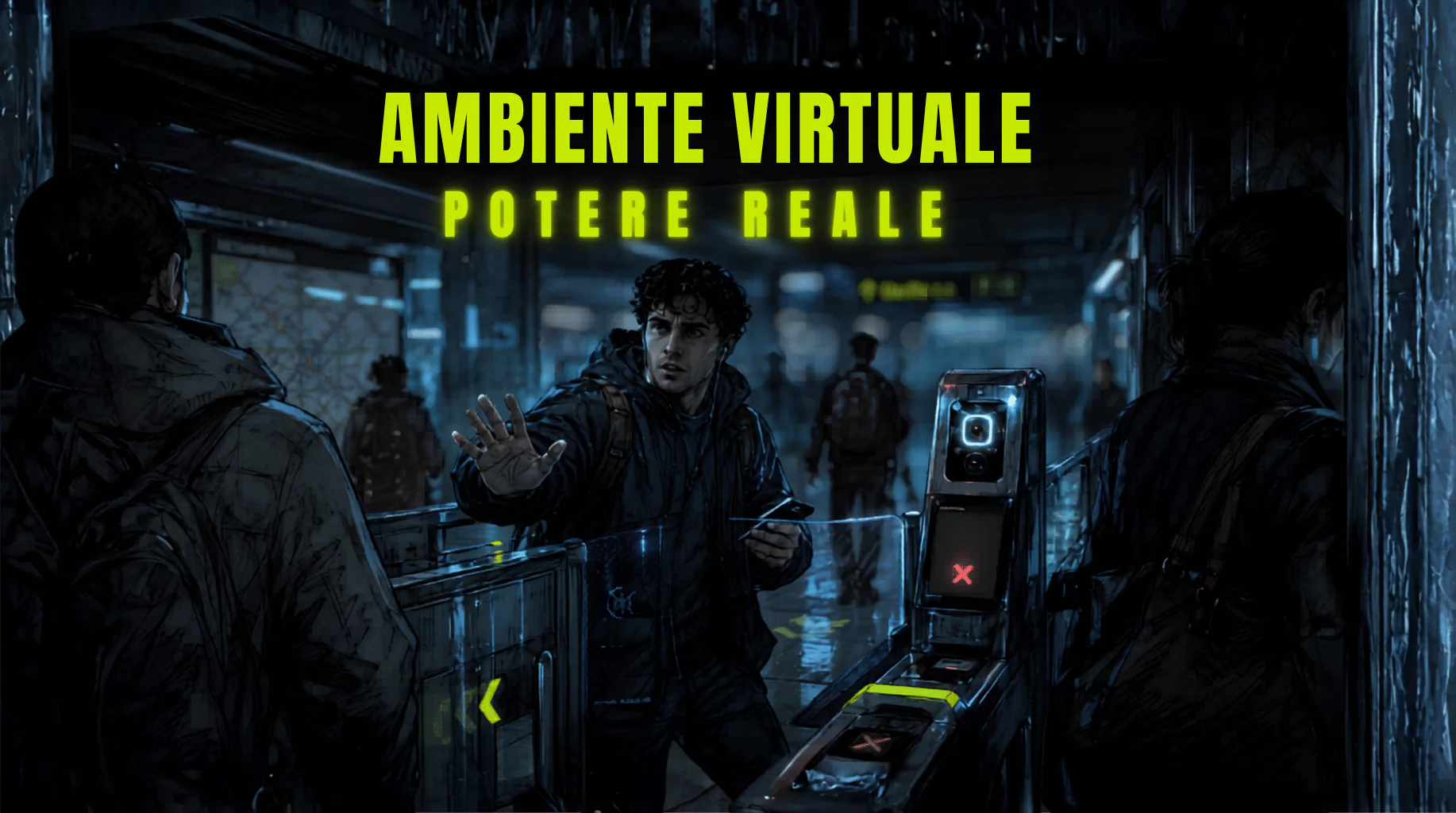
That design is politics is not a rhetorical flourish. Langdon Winner wrote it in a celebrated essay: certain technical configurations embed power relations regardless of who uses them and how. Bruno Latour provided the precise mechanism: every object carries inscribed within it a script — a set of instructions prescribing what you can and cannot do. The spring door closes itself without needing a guard. The platform optimized for time-on-site holds you without giving you any order. Behavior is delegated to structure. That is why a virtual environment can govern without governors.
Fuller’s principle — change the environment, not the people — is neutral with respect to purpose. It works to liberate exactly as it works to subjugate. Platforms were not designed to dominate us. They were designed to function, to be used, to scale. But every single design choice — what I measure, what I reward, what I make visible — builds a virtual environment that steers behavior without ever declaring it. Google doesn’t need to control the individual student. It just needs to design the space in which behaving as Google anticipated is simply the thing that makes sense to do.
McLuhan, Innis, and Ong, following Havelock, explained that media are not neutral channels carrying content. They are environments that reorganize how we perceive and think. “The medium is the message” means exactly this: the content is the bait, the real transformation happens in the medium. And every new medium creates an environment that remains invisible until replaced by a new one. An invisible environment cannot be criticized — because it provides you with the very criteria you would need to criticize it.
Your Mind Does Not End Where Your Skull Ends
Gregory Bateson opens a level where Fuller and McLuhan don’t reach. The mind is not sealed inside the brain: it is in the circuit comprising brain, body, and environment. The mind is immanent in the wider system — person plus environment. If the mind lives in the system, then the environment doesn’t help you think from the outside. It co-constitutes you. And if the environment becomes a single, total one, the mind immanent within it tends to become a single form as well.
Merleau-Ponty, however, gives us the distinction that saves the argument from fatalism: between me and the background there is no relationship of objective conditioning — there is a relationship of motivation. The virtual environment doesn’t condition you the way a cause produces a mechanical effect. It motivates you. It offers a background already saturated with meaning, on which every choice you make takes shape. It doesn’t remove your freedom. It grafts it onto a situation you didn’t choose, and that is now designed by someone else. If mind, body, and behavior are formed in relation to the environment, then a single planetary virtual environment, circulating homogeneous models, becomes the most powerful factor in the formation of who we are.
If you want to teach someone a new way of thinking, don’t waste time teaching it. Give them a tool.
Virtual Environment and Desire — Why Do We Want It?
Fine, the virtual environment shapes us. But why does it pull us all toward the same things? A single environment could, in theory, host infinite variety. And yet we all look in the same direction. René Girard answers: human desire is mimetic. We don’t desire an object for its qualities. We desire what someone else desires. The model comes before the object. Our identity is built by imitating the desire of others — and this is not a pathology: it is the very structure of desire.
Now take that mechanism and place it inside an environment built specifically to amplify it. The like is its elementary form: it makes visible that I desire what others desire, which causes others’ desire to grow. The algorithm only accelerates the game, surfacing what generates the most imitation. Virality is pure imitation. A trend is that moment when everyone looks in the same direction because everyone looks in the same direction. Mimetic desire always converges on a single mediator. Once it was the king, the god, the scapegoat. Today it is the platform itself — which doesn’t mediate this or that content, but mediates desire as such. Girard explains what neither Fuller nor McLuhan could fully account for: why we participate willingly in our own convergence. Enthusiastic participation in the environment that produces you is the most successful form of power.
Power Without a Master
The digital has a characteristic no previous medium possessed: it is simultaneously a tool, a living environment, and the device through which we interpret both. It is an environment that interprets itself. Those who live in cyberspace use cyberspace to understand cyberspace. There is no external vantage point from which to observe it, because the tool with which you read reality is reality. AI takes this to the extreme — it is not just a virtual environment, it is a virtual environment that responds to you, mirrors you, personalizes itself for you. It returns the statistical average of the human dressed up as your own identity. Everyone’s desire presented as if it were yours.
Carl Schmitt wrote that every era has a central domain around which all cultural, political, and economic life organizes itself. For the twentieth century, that domain is technology. What Schmitt could not have imagined is that the central domain would also become the only space of experience. Today the digital is not merely the central domain: it is the total environment — in an almost literal sense a nomos, an ordering that precedes every rule, that establishes what is thinkable before thinking begins. And the system produces the subjects who perpetuate it. Children formed inside platforms become adults who find that logic obvious, replicate it, defend it in the name of efficiency and progress. The critique of Big Tech is the surface diagnosis. Underneath, something operates that belongs to no one: a logic of the social body that would continue to act even if the owners, the business models, and the intentions all changed. Power does not belong to the masters of technology. It resides in technology as environment.
- Bijker, Hughes, Pinch — The Social Construction of Technological Systems (MIT Press)
- Langdon Winner — Do Artifacts Have Politics? (Daedalus, 1980)
- Gregory Bateson — Steps to an Ecology of Mind (1972)
- René Girard — Mensonge romantique et vérité romanesque (1961)
- Marshall McLuhan — Understanding Media (1964)
Post scriptum
The conclusion, ironically, belongs again to Fuller. If power lies in the architecture, then criticism is not enough — because criticism uses the tools of the very environment it wants to contest. The answer is not critique: it is alternative design. Build a model that makes the existing one obsolete.
The question we leave open — the only one that matters — is who has real access to the moment when meaning is decided, that is, to the design of the virtual environment. And whether that moment still exists.