How to create a digital creative campaign that actually works
CREATIVE CAMPAIGN · MEMORY · ATTENTION · BRAND
A digital creative campaign is not won on content volume: it is won on the trace it leaves in memory. Encoding, dual coding, narrative transportation — and the reason three out of four award-winning campaigns fail to move market share.
In 2010, Old Spice launched “The Man Your Man Could Smell Like.” Isaiah Mustafa’s character — white towel, a horse, then a boat, then a steam room — became a cultural object within forty-eight hours. The campaign won virtually every advertising award in existence. It generated millions of organic views before the concept of “going viral” had been codified in any marketing textbook. Old Spice sales grew 125% in the first year.
The story is often told as proof that creativity works. But there is a less cited version: a few years later, that growth had plateaued. The product was unchanged. The iconic character had become a replicable format — and therefore something that could be ignored.
Something in this story does not add up, and that something is worth finding. A 2019 analysis by Kantar across a sample of Cannes Lions winners found that only one in four of those pieces built measurable long-term brand impact. Peter Field — who analysed nearly six hundred cases from the IPA databank over twenty-four years — concluded that award-winning creative campaigns were no longer systematically more effective than non-awarded work. Something had broken between the way the industry evaluates work and the way that work acts on the minds of the people who receive it.
What is a digital creative campaign?
A digital creative campaign is a coordinated system of content, formats and channels designed to produce a durable trace in the audience’s memory and modify purchase propensity over time. It differs from the simple production of ads in three ways: a recognisable encoding mechanism — visual, sonic, emotional — that functions as a retrieval cue; a structural integration between narrative and brand, where the product is part of the story rather than a guest in it; and measurement on long time scales, beyond the cycle of clicks and impressions.
From this definition follows what effective branding actually means: building mental associations that remain available at the moment of decision, weeks or months after exposure. Campaigns that generate immediate response without depositing structure produce activation, not branding. The two things are measured with different instruments and decay at different rates — which is why confusing them is the most expensive error a brief can make.
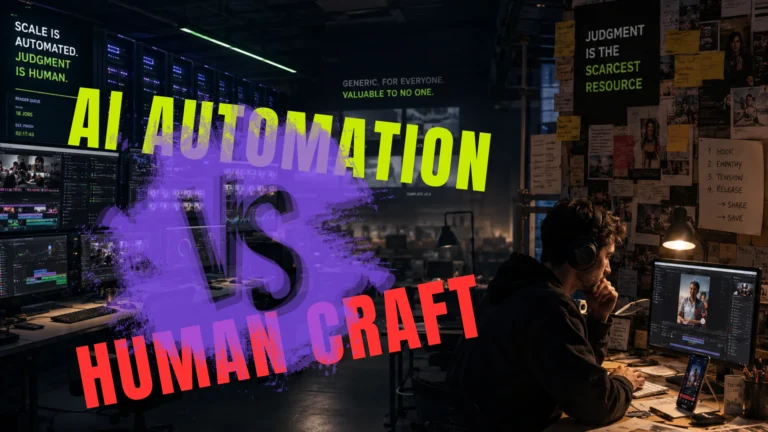
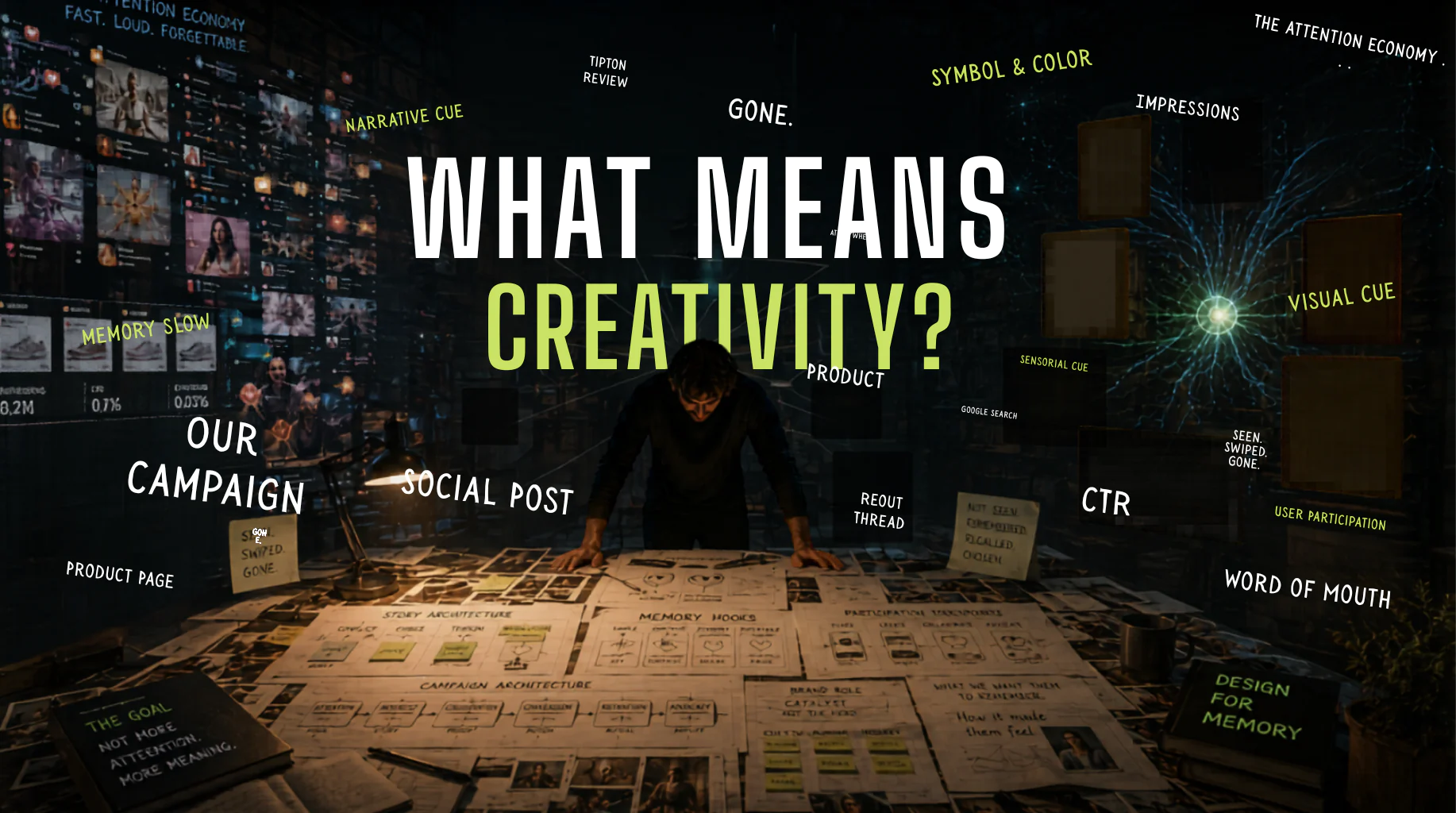
And what does creativity mean today? When automated generation makes average-quality content available at near-zero cost, creativity stops coinciding with aesthetic execution. It becomes the capacity to design what must remain in a person’s mind after the screen goes dark — and to build the mechanism that makes it possible. The rest of this article takes that mechanism apart, piece by piece.
How the context in which a digital creative campaign must survive has changed
The attention threshold has contracted — and the process has not stopped
In 2004, researcher Gloria Mark at the University of California measured the average duration of continuous attention on a digital device at roughly 150 seconds. By 2012 it had already fallen to 75. Data from 2024 place it at around 47 seconds. The trajectory is not random: it is an emergent property of a media system designed to maximise switching frequency, not depth of experience.
In 2025, the average social media user is exposed to over 5,000 pieces of content per day, versus 1,400 in 2012. Teenagers switch apps every 44 seconds. A Facebook mobile ad loses its residual effect on purchase propensity within six days. YouTube mobile: eight days. In this environment, the question is not “how do we get seen.” It is what happens in the mind of whoever saw it, after.
The purchase journey has fragmented into touchpoints the brand does not control
The classic funnel model — awareness, evaluation, purchase — assumes a linear sequence in which the brand accompanies the consumer through each step. No digital buyer follows that sequence any more. Jim Lecinski, Google Vice President, formalised the concept of the Zero Moment of Truth in 2011: the moment in which a consumer, between the initial stimulus and the actual purchase, conducts independent research that completely redefines their expectations. Subsequent studies show that 81% of buyers conduct online research before deciding, consulting an average of at least ten different sources.
A digital creative campaign does not only compete with other campaigns. It competes with specialist site reviews, Reddit threads, YouTube comparison videos, AI-generated answers and the residual memory of every previous interaction with the brand. It enters a conversation that was already happening, by rules it did not write.
| Linear model (pre-digital) | Fragmented model (today) |
|---|---|
| Advertising stimulus | Stimulus (any channel) |
| In-store exposure | Pre-ZMOT: social, UGC, word of mouth |
| Purchase | Independent research (ZMOT) |
| Comparison on third-party platforms (AI, reviews) | |
| Purchase — or abandonment |
Generative AI has lowered the cost of average creativity — and raised the value of the creative campaign that leaves a trace
From 2023 onwards, visual and text generation tools have made median-quality advertising content available at marginal cost: visually coherent ads, functional copy, variants at industrial scale. Production accelerates. Content volume increases. The environment becomes more crowded still.
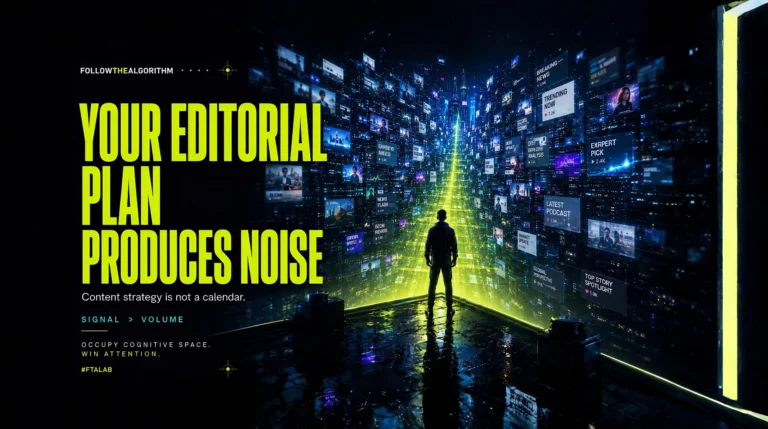
The paradox is that this acceleration has not solved the attention problem: it has made it worse. When the production cost of “sufficient” content reaches zero, the only thing that remains scarce is the capacity to leave a trace in the audience’s memory system. The digital creative campaign that works in this context does not compete on volume — that contest it always loses. It competes on the quality of the trace it produces in the mind of whoever encountered it.
How advertising memory works: what most briefs ignore
Why the effect of a creative campaign does not decay uniformly
Audiences do not watch campaigns. They process them — or fail to — while doing something else. Nielsen’s research on advertising memory shows that recall of a digital ad drops by 50% within the first twenty-four hours of viewing. This is not a consequence of creative quality: it is a property of the human memory system, which without a consolidation mechanism rapidly dissolves recent traces.
The less obvious point is that decay is not uniform. Some campaigns disappear almost completely. Others stabilise at a significantly higher level. The difference does not depend on budget, on the breadth of initial exposure, or on the aesthetic quality of the visual. It depends on how the information was encoded during first contact.
Why creative campaigns are forgotten even when they are beautiful
The encoding specificity principle, formulated by Endel Tulving and Donald Thomson in 1973 and later extended by consumer research, states that memory retrieval is more effective the more closely the conditions at the moment of retrieval resemble the conditions under which that memory was formed. Advertising is not remembered in the abstract: it is remembered inside a context — emotional, sensory, situational. If the campaign was tied to a specific mood, a recognisable sound, a precise moment of the year, an unresolved tension, retrieval occurs when that state or tension recurs.
A campaign that encodes only a message — “this product exists, it is good, buy it” — has a single entry point into memory. That door, in most cases, stays shut. Campaigns that last build more doors.
What is the difference between a memorable creative campaign and one that builds brand over time?
The dual trace: the mechanism that multiplies retrieval cues
Allan Paivio proposed in the 1960s what has become one of the most robust models in cognitive psychology: dual coding theory. The human cognitive system has two separate but interconnected channels — verbal and visual — and information encoded through both produces stronger memory traces than information encoded through only one.
For creative work, this means something concrete. A campaign that builds recognisable visual consistency — palette, figures, rhythm of movement — is not only working on aesthetics. It is multiplying the entry points into memory. The logo is not decoration: it is a retrieval cue. The music is not atmosphere: it is a contextual marker the brain uses to locate and reactivate the experience.
But there is a limit worth stating. Paivio describes an encoding system, not a persuasion system. A campaign can be perfectly encoded across both channels and remain entirely dissociated from the brand it was supposed to represent. This is exactly what Kantar found when analysing the 2019 Cannes Lions: the most common problem was not creative quality, but dissociation between the work and the brand.
People remembered the ad. They did not remember who it was for.
| Creative element | Verbal channel | Visual channel | Memory traces |
|---|---|---|---|
| Text only | Yes | No | 1 |
| Image only | Yes (associated) | Yes | 2 |
| Text + image | Yes | Yes | 2+ |
| Music + visual | Yes (associated) | Yes | 3+ |
| Full narrative | Yes | Yes | n × cues |
When the story transports the audience outside critical evaluation
There is a mechanism more powerful than the dual channel, and considerably harder to control. It is called narrative transportation. Melanie Green and Timothy Brock formalised the construct in 2000: when an individual is “transported” into a narrative — that is, becomes so immersed in the story that they temporarily lose contact with the surrounding physical environment — the tendency to counter-argue decreases, beliefs update in the direction of the narrative, and the effect persists over time, even after the story ends.
Advertising narrative that works does not describe the product: it places the audience inside a situation where the product becomes intelligible as a response to something they have already felt. It does not say “this deodorant is better.” It shows a man crossing impossible worlds with an absurd nonchalance — and the meaning of that gesture is understood before it can be articulated.
The trap that produced the crisis Field documented hides precisely here. Narrative transportation works only when the story is strong enough to absorb attention completely. When the narrative is excellent but the brand is marginal — when the story works as an autonomous object and the product is an awkward guest — transportation occurs, but the persuasion is about the story, not the brand. People leave with an emotion. Without a modified purchase propensity. The award-winning campaign that fails to shift market share is not a paradox: it is the logical consequence of excellent execution applied to the wrong brief.
What separates a creative campaign that works from a cultural anomaly
Spotify Wrapped: when the creative campaign becomes an object people choose to use
Spotify Wrapped is not a campaign. It is an architecture of participation. Every December, the platform transforms each user’s listening data into a personalised narrative object — a small mirror that reflects back: this is who you were, this year. The user looks at it, recognises it, shares it. Not because Spotify persuaded them to. Because Wrapped built something the user wants to show, independent of any interest in the brand.
The mechanism is structurally different from a traditional campaign. There is no message travelling from brand to audience: there is an object the brand delivers to the user, which the user then employs as raw material for building their own public representation. The encoding is precise for specific reasons. The trace is not “I saw a Spotify ad”: it is “I remember the year I listened to that song a hundred times.” Spotify becomes the container of an autobiographical experience. When Wrapped returns, everything returns.
This is the level that separates an award-winning creative campaign from something that enters cultural structure. The design question that changes everything: does the work ask for attention, or does it build participation? Does it transmit a message, or does it create an object people choose to use?
| Dimension | Standard campaign | Wrapped / participation |
|---|---|---|
| Flow | Brand → audience | Brand ↔ user |
| Object | Message | Autobiographical tool |
| Emotion directed at | Product / brand | Oneself |
| Sharing driver | External persuasion | Identity construction |
| Memory trace | “I saw an ad” | “That year, that song” |
| Effect duration | Weeks | Years |
Why the time that goes unmeasured is what determines the result
Peter Field and Les Binet, in their analysis of nearly a thousand campaigns in the IPA databank, found that the optimal ratio between brand building and sales activation is approximately 60 to 40. Brand building requires time, repeated exposures, emotional consistency. Activation works in the short term — it generates immediate response without building structure.
The data show that industry practitioners had systematically underinvested in brand building by at least fourteen percentage points relative to the optimum. The effect of an incentive system built around the short term: the available metrics — clicks, impressions, conversion rate — measure the immediate with millimetric precision and ignore what happens in the months that follow.
Karen Nelson-Field’s research quantified the phenomenon by platform: a television ad takes an average of 109 days to lose its residual effect entirely. A Facebook mobile ad: six days. YouTube mobile: eight days. The difference is not one of creative quality — it is structural, tied to the attention mechanisms and encoding context of each medium. The question “does this campaign work?” is almost meaningless without specifying over which time scale.
How much does an effective digital creative campaign cost — and how is it really measured?
The systemic error: the brief written downward
There is a precise moment at which a creative campaign stops being creative and becomes a format. It does not happen when the audience grows bored — it happens earlier, when the brief stops containing a real question and becomes an instruction to produce something resembling last year’s campaign.
Agencies are incentivised to produce award-worthy work. Awards reward formal novelty more than the soundness of the mechanism. The result is a system in which the campaign optimal for winning a Lion does not coincide with the campaign optimal for moving market share. The industry knows this. Field has documented it with data upon data. The incentive system remains intact. The brief is written downward — toward execution, toward formal novelty, toward the photography that works at Cannes. Rarely is it written upward: toward the question of what must be true in a person’s mind six months from now, in the moment they stand before a shelf or a product page.
How to assess the real value of a digital creative campaign, even for SMEs
The budget of a digital creative campaign is not measured only in euros of production. It is measured in the ratio between investment and the duration of its effect on the audience’s memory. A 5,000-euro campaign with weak encoding — no recognisable visual trace, no emotional hook, no retrieval cue — may exhaust its effect within three days. A 15,000-euro campaign built around a genuine participation mechanism can generate spontaneous brand advocacy for months.
The questions to ask a creative agency before approving a brief immediately reveal whether the project has been conceived downward or upward. What is the encoding mechanism — visual, emotional, contextual — that this campaign activates? Is the brand integral to the narrative, or is it a guest in the story? Over what time scale is success measured? Is there an element the audience will want to use, share or make their own — or does the campaign simply ask for attention?
| Question | Minimum answer |
|---|---|
| What must be true in the audience’s mind in 6 months? | Defined cognitive objective |
| What is the primary retrieval cue? | Visual / emotional / contextual |
| Is the brand in the story or is it the story? | Integrated / guest |
| Which specific emotion is encoded? | Not “positive”: which one |
| How is the effect measured at 90 days? | Defined metric |
| Is there an object people will choose to use? | Yes/no + description |
The question that remains
At the end of every digital creative campaign that has truly worked — that has built something durable in the cognitive system of whoever encountered it — there has always been a design question that no one articulated aloud. Something less glamorous, and far harder to answer than “how do we make it beautiful”: what must be true in someone’s mind — six months from now, in the moment they buy or do not buy — for this campaign to have worked?
Answering it requires knowing how memory works, what retrieval cues are, what it means to build an emotional trace, how to design an object people choose to use instead of ignore. It requires resisting the pressure of the short term — which is always stronger than the logic of the long term, because the short term has numbers while the long term has arguments.
The campaigns that last did not find the right answer to this question. They had the patience not to stop asking it.
- Peter Field — The Crisis in Creative Effectiveness (IPA databank, 2019)
- Kantar — Analysis of Cannes Lions winners’ effectiveness (2019)
- Gloria Mark (UC Irvine) — Attention Span, research 2004–2023
- Karen Nelson-Field — The Benchmark Series
- Green & Brock (2000) — The Role of Transportation in the Persuasiveness of Public Narratives
- Clark & Paivio (1991) — Dual Coding Theory and Education
- Jim Lecinski (Google) — Winning the Zero Moment of Truth (2011)
Postscript
The attention problem does not only concern those who buy: it concerns those who design. Every brief approved without an answer to the six-month question is an investment that decays in days, not quarters.
The audio version of this article is available below.