Scriptwriting: why the words you say in a video are never the right ones
Scriptwriting Analysis // Writing and Cognition
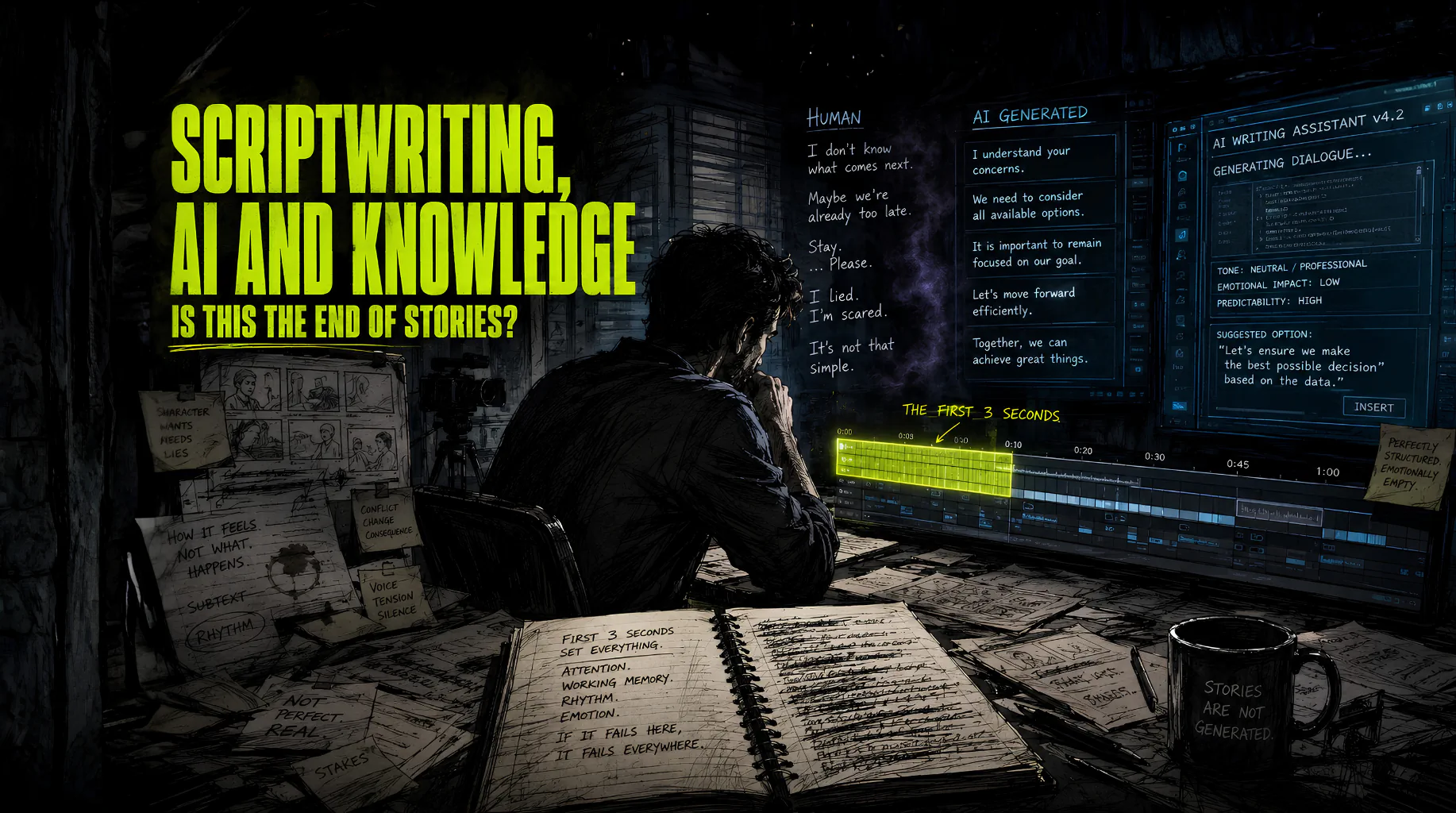
A badly written video costs more than a badly shot one: footage can be fixed in post, words cannot. The script governs attention, working memory and rhythm before the camera even turns on. This is why a wrong word at the third second weighs more than a wrong shot.
A video’s retention curve almost always tells the same story. It starts at one hundred and drops immediately. On short formats, the decision to stay or scroll lands in about three seconds. On long formats, more than half the audience leaves within the first minute, and around a third leaves in the first ten seconds.
The temptation is to read that collapse as an editing or an algorithm problem. In most cases it is a writing problem. The images can be perfect: if the first words do not open a gap in the viewer’s attention, that attention closes and does not return.
This article starts there and reaches a wider question. In a world where information is the most widespread good, what still makes a story valuable?
Scriptwriting: why does the audience leave in the first seconds?
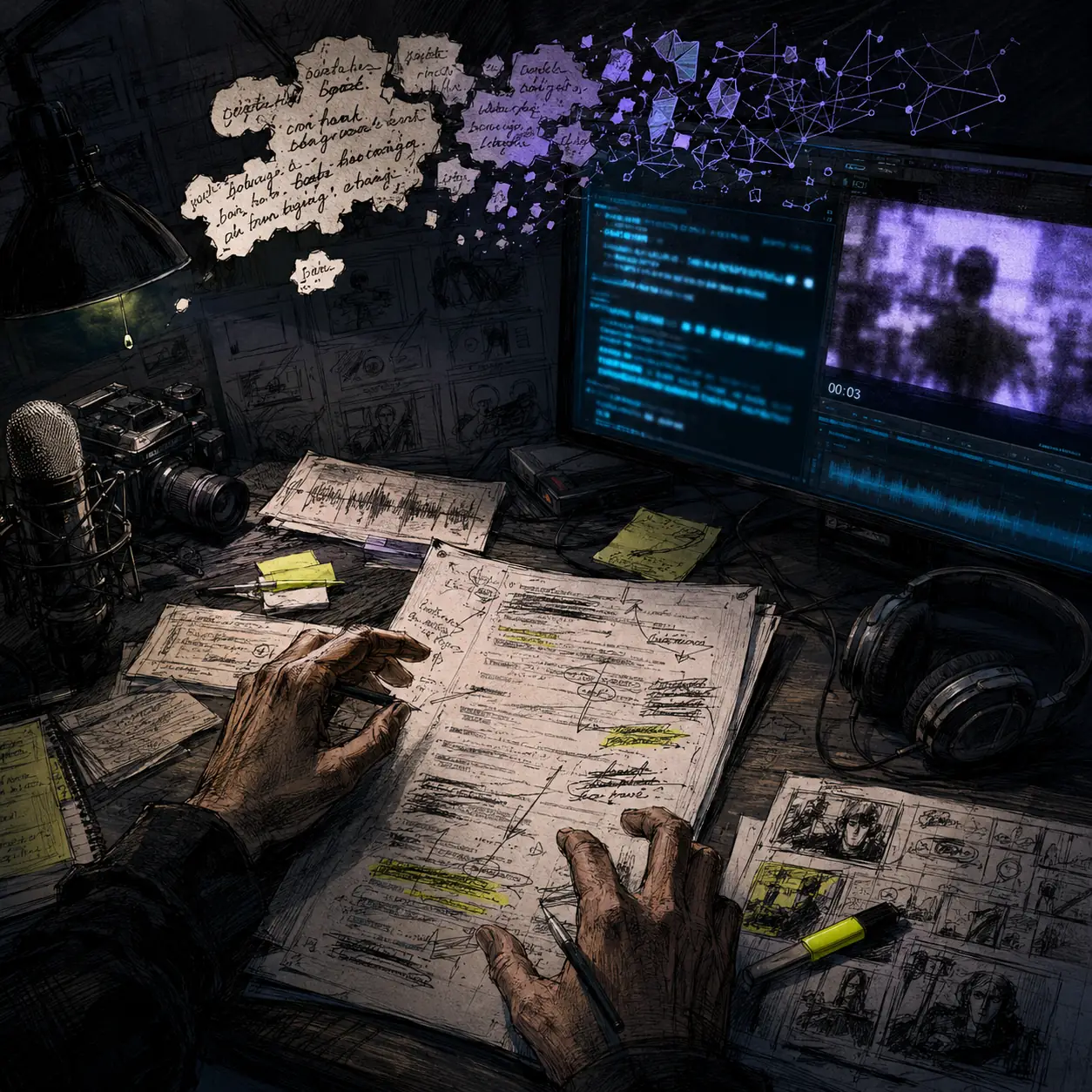
The opening of a video is not where you introduce yourself. It is where you make a promise and pay part of it right away. When the title announces one thing and the first seconds show another, the viewer registers the gap and leaves. The early collapse does not measure image quality. It measures the distance between what was promised and what gets delivered at the exact moment the promise had to be honored.
Industry data converges on a narrow threshold. On short formats the verdict falls within three seconds. On long formats the first minute is the critical zone, where it is decided whether the audience stays or scatters. Anything that delays the value, the intro sequence, the self-presentation, the preamble, works against retention. Effective writing brings the value forward instead of postponing it.
What changes between writing a text and writing a script?
A written text leaves control to the reader. Whoever reads sets the pace, goes back, rereads the difficult sentence, jumps ahead. A video takes all of this away. The pace is imposed, the experience is linear, rereading does not exist. Whoever listens has a single pass to understand. The script must be written for that single pass.
Here the limit of working memory comes in. In 1956 George Miller set the threshold around seven units, the famous number seven, and he himself noted that the number had nothing magical about it. Later revisions, in particular those by Nelson Cowan, lowered the estimate to about four chunks once rehearsal and external supports are controlled. The operating principle stands: working memory has a reduced capacity, and when cognitive load saturates it, comprehension collapses.
This is why a script works in chunks. It groups information into meaningful units, one at a time, and feeds them through a bottleneck of just a few elements. A sentence that forces the viewer to keep too many units open at once is not understood; it is skipped. Writing a script means designing the flow of information so that it fits that narrow capacity without breaking it.
Copywriting and scriptwriting: where do they split?
Copywriting writes for the eye, for a reader who controls their own pace, goes back and chooses what to reread. Scriptwriting writes for the ear and for a single pass, where the pace is imposed and rereading does not exist. The persuasion techniques resemble each other, the handling of time and memory differs.
A copywriting headline can afford a dense sentence, because the reader rereads it. The same sentence, spoken in a video, saturates working memory and gets lost. This is why an effective script works as an architecture designed for the real time of listening, more than as an advertising text read aloud.
When information costs nothing, value migrates toward what makes it memorable: form.
Does the three-act model hold in a thirty-second video?
No, at least not in the form taught for feature films. Thirty seconds leave no room for three acts. What scales down is the scale, not the structure. Robert McKee, in his work on dramatic writing, insists on one precise point: story is form, not formula. The irreducible unit is not the act, it is the beat, the minimal exchange that changes the value of a scene.
For McKee, the substance of story is the gap between what a character expects and what actually happens. A scene where the value does not change is, in his vocabulary, a non-event. The same logic applies to a fifteen-second video. It needs at least one turning point, a change of charge, a gap between expectation and result. Narrative structure does not disappear in short form. It compresses to its minimal unit, and that unit still has to be written.
Are rhythm and silence part of the script?
Rhythm is the management of processing load. A dense stretch followed by a pause gives working memory the time to consolidate what it has just received. Silence works: it is the interval in which the last chunk gets fixed. Removing it to save seconds means taking away the space in which information becomes memory for the viewer.
Word choice is also a cognitive instrument, not a matter of style. Research on embodied cognition shows that concrete language, anchored in the body and in perception, is processed through a sensorimotor simulation and settles deeper than abstract language. A script that names concrete things lands deeper than a script that states concepts. Rhythm, pauses and vocabulary are writing decisions, and they are made on the page before the set.
Operational glossary: the words of scriptwriting
- Scriptwriting
- The writing of a text meant to be heard in a single linear pass, designed to govern the attention, rhythm and memory of the viewer. It differs from a simple transcription of speech.
- Retention curve
- The graph showing the percentage of viewers still present moment by moment. It starts at one hundred, and the shape of its decline signals where, and why, the audience is lost.
- Hook
- The first seconds in which the script makes a promise and delivers part of it at once. It decides whether the viewer stays, before the content even gets going.
- Chunk and chunking
- A chunk is the unit of meaning into which information is grouped. Chunking compresses several pieces of data into a single unit, so they fit the reduced capacity of working memory.
- Cognitive load
- The amount of processing that working memory has to sustain at a given moment. Beyond a certain threshold, comprehension collapses and the viewer leaves.
- Working memory
- The limited-capacity mental store, estimated at around four units, through which everything the viewer processes in real time has to pass.
- Beat
- In McKee’s framework, the minimal exchange of action and reaction that changes the value of a scene. It is the irreducible unit of narrative structure.
- Turning point
- The point where the gap between expectation and result opens and the charge of the scene reverses. Without at least one turning point, a video stays a list of events.
- Controlling idea
- The idea that every element of the script must serve or test. It holds the writing together and defines what should remain with the viewer.
- Embodied cognition
- The view that we understand language by simulating it at a sensorimotor level. It follows that concrete language settles deeper than abstract language.
Beyond scriptwriting: if knowledge is the most common good, what still makes a story valuable?
In 1971 Herbert Simon described the inversion that defines our present. In a world rich in information, he wrote, a wealth of information creates a poverty of attention. Information consumes the attention of whoever receives it, and when the former becomes unlimited the latter becomes the real bottleneck. The scarcest good of the past, knowledge, has become the most common good. What is scarce now is attention, and the memory able to hold it.
Walter Benjamin, in 1936, had already separated two regimes. Information is worth something only in the instant in which it is new; it lives in that instant and is exhausted with it. The story keeps its own force and continues to release meaning over time, passed from one generation to the next. For Benjamin, communicable experience had fallen in value, and with it the very figure of the storyteller. Knowledge transmitted through stories, accumulated vertically across generations, gave way to a horizontal flow of consumable news.
Byung-Chul Han carries this diagnosis into the digital age. In the information society, narration flattens into information, and storytelling becomes storyselling: stories are charged with emotion in order to sell, and they bind only an ephemeral community of consumers. The form of the story survives, its communal function empties out.
From here comes the answer to the question. A story is no longer valuable for the information it carries, because anyone can find that information, sooner and better, in an archive or a search. The value migrates toward two functions that stayed scarce: capturing attention and producing durable memory. The script is the contemporary craft of this conversion. It takes abundant information and gives it a form that gets past the four-chunk bottleneck and the three-second verdict. A script is measured by what stays in the viewer’s memory, more than by the words you say.
How do you write a script that stays?
The principles seen so far translate into a working sequence. It holds from a fifteen-second video to the long format, because it acts on the same cognitive thresholds.
- Start from the controlling ideaDecide in one sentence what should remain in the viewer’s memory. Every line after that serves or tests that sentence.
- Open by paying the promiseIn the first seconds, deliver part of what the title announces right away. Cut intro sequences, self-presentations and preambles that delay the value.
- Write for a single passWhoever listens does not reread. Build sentences understandable on first listen, with no references back to what has already gone by.
- Work in chunksGroup information into a few units of meaning at a time. Never keep more units open than working memory can hold.
- Add at least one turning pointEven in fifteen seconds, you need a gap between expectation and result. If the charge does not change, the viewer perceives a non-event and leaves.
- Use concrete wordsName perceivable things instead of abstract concepts. Language anchored in the body is remembered better.
- Write the rhythm and the silencesAlternate dense stretches and pauses. Silence is the space in which the last unit becomes memory.
- Check against memoryReread asking yourself what would remain for the viewer after a single listen. That is the measure of the script, before the visual delivery.
- Herbert A. Simon, Designing Organizations for an Information-Rich World (1971)
- Walter Benjamin, The Storyteller. Reflections on the Work of Nikolai Leskov (1936)
- Byung-Chul Han, The Crisis of Narration
- George A. Miller, The Magical Number Seven, Plus or Minus Two (1956)
- Nelson Cowan and the debate on the limit of working memory
- Robert McKee, Story. Substance, Structure, Style (1997)
Postscript
This piece comes out of a series on writing for digital media. The thread is always the same: form decides the fate of a piece of content the moment information is no longer enough to set it apart.
Below, a video deep dive on cognitive scriptwriting.