The hand that opens again
Brain Computer Interface — Dossier — Human Hybridation — Neurotechnology
In 2026 China approved the world’s first commercial brain implant. Before this becomes a geopolitical headline, it is worth tracing the fifty years of science, failure and political decision-making that made Dong Hui’s gesture possible. And asking who owns that movement now.
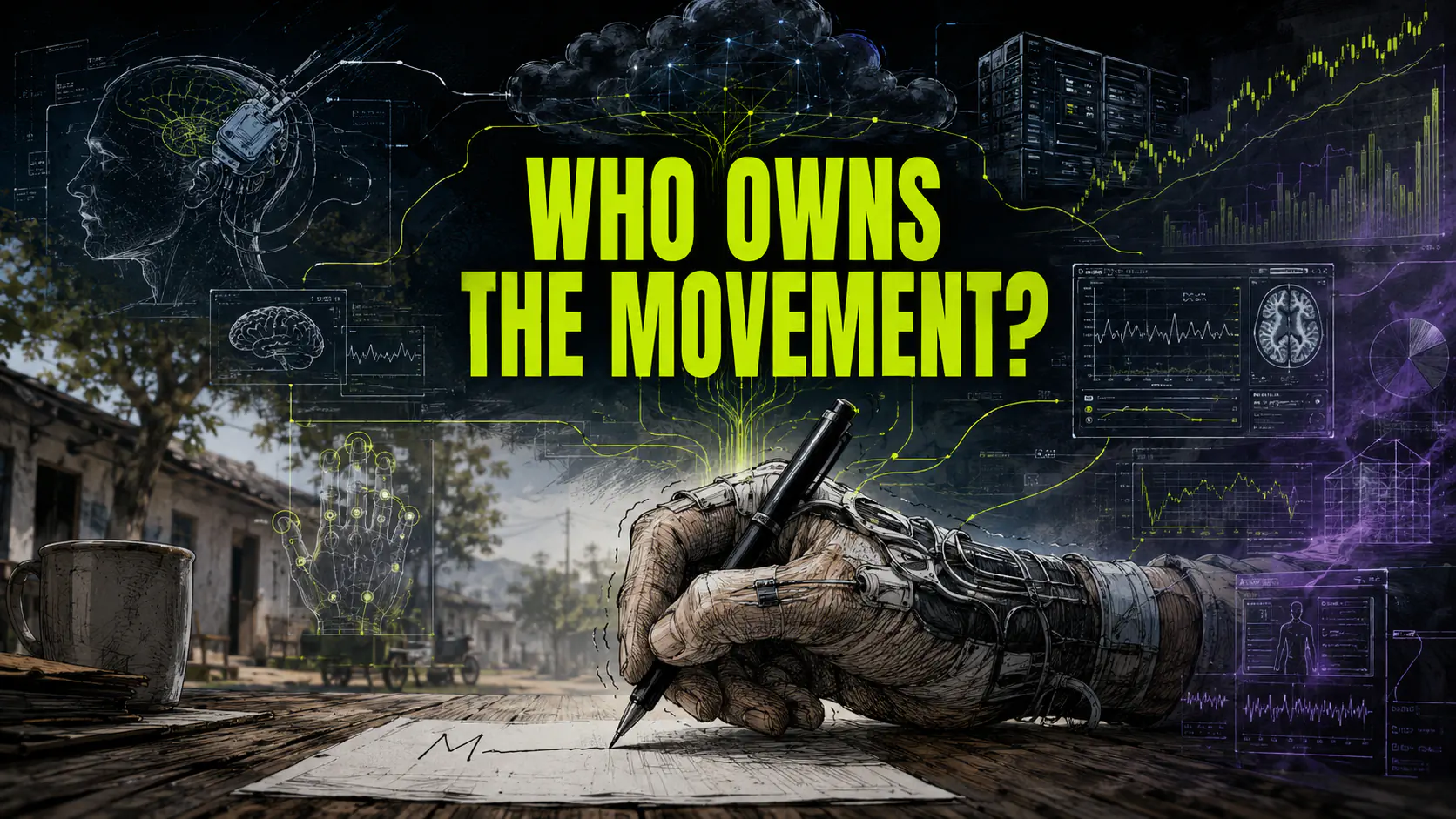
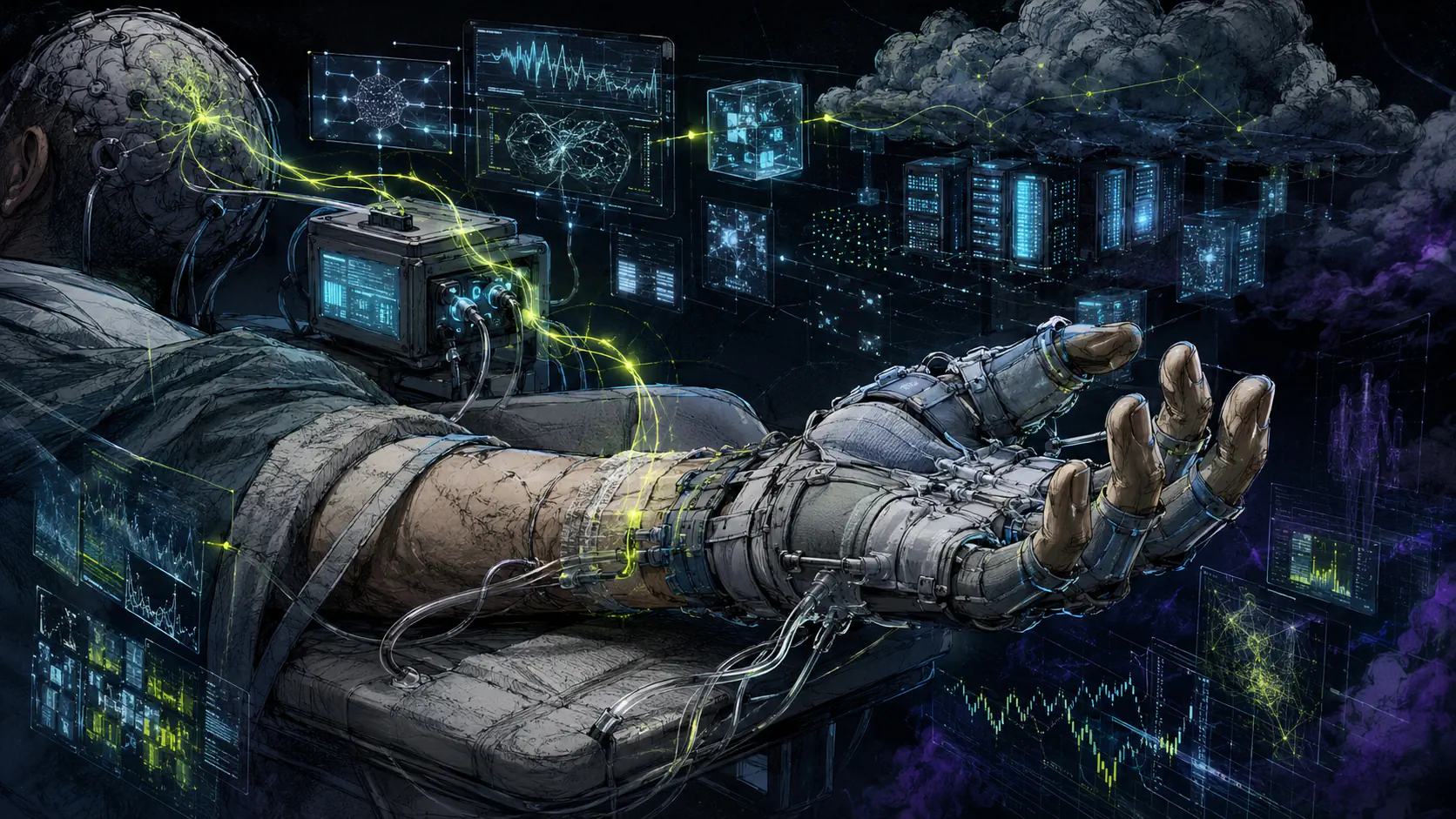
One day in October 2025, in the courtyard of a house in Henan province, Dong Hui decided to try holding a pen. He was thirty-nine years old and had been paralyzed from the neck down for six years. He wrote his name, wrote “Thank you”, wrote the date. He was so emotional that he missed a stroke in his own name. The hand worked. Eleven months earlier, a surgeon had opened his skull to rest eight sensors on the membrane protecting his brain. No electrode penetrated the tissue. No wire threaded into the cortex. Just eight discs on the dura mater, a transmitter fixed to the skull, and a pneumatic glove that translated the intention to move his fingers into the act of actually moving them.
The gesture is real. That needs to be said immediately, because everything that follows risks sounding like an attempt to diminish it, and it is not. A man who could not move his fingers moves them again. No market analysis erases that missed stroke. The point is not to doubt Dong’s hand. It is to follow the thread that starts from that hand and see how far it reaches, because it reaches much further than the courtyard. To understand where it reaches, you first need to understand where it comes from: half a century of neuroscience, electrodes, frustrated monkeys, locked-in patients, startups with zero revenue and five-year plans written with the precision of a stock market prospectus.
How the brain-computer interface was born: from Berger to Vidal, fifty years of brain computer interface research
The history of brain-computer interfaces begins with a question that nobody, in 1924, yet had the courage to formulate openly: does the brain speak in a language that a machine can read? Hans Berger, a German psychiatrist, posed that question indirectly by attaching electrodes to the skulls of his patients and recording the electrical oscillations of brain tissue. The EEG was born — electroencephalography — and with it the idea that mental activity was a form of signal, not an immaterial quality. That was the epistemological foundation without which no BCI would ever have been conceivable: you first have to believe that thought has a measurable electrical form, and only then can you ask how to intercept it.
It took almost fifty years for someone to frame the question operationally. In 1973 Jacques Vidal, a computer scientist at UCLA, published the paper that formally introduced the term “brain-computer interface” into the scientific literature, with a title that was already a manifesto: Toward Direct Brain-Computer Communication. The concept was as simple as it was radical: use EEG signals not to diagnose but to control. In 1977 Vidal demonstrated that a subject could mentally steer a cursor through a digital maze by staring at flashing lights. The resolution was low, the interface crude, the response times slow. But the principle was established: the intention to move something could, through the brain, actually move something.
Vidal, J.J. (1973). Toward Direct Brain-Computer Communication. Annual Review of Biophysics and Bioengineering, 2, 157–180. The text introduces the term “brain-computer interface” into peer-reviewed literature for the first time and poses the problem of intentional control of external devices via EEG signals. It is the discipline’s ground zero.
The Eighties and Nineties were the time of monkeys. Literally: the bulk of invasive research was conducted on primates, in the laboratories of Miguel Nicolelis at Duke University and other groups, who trained animals to control robotic arms using neural activity recorded by electrode arrays implanted in the motor cortex. Nicolelis showed that populations of neurons, not individual cells, encoded movement in a stable enough way to be decoded in real time. The finding had profound implications: the motor signal did not reside at a precise point in the brain — it was distributed, and that distribution could be captured with enough electrodes and enough algorithms. The problem was that silicon electrodes, rigid and hard, caused inflammation in brain tissue over time. The signal degraded. The body rejected the machine.
Brain computer interface
The first intracortical implant in a human being arrived in 1998. Philip Kennedy and Roy Bakay, at Emory University in Atlanta, placed a device in the brain of Johnny Ray, a man with locked-in syndrome caused by a brain-stem stroke. Kennedy had developed a neurotrophic electrode system — glass cones coated with growth factors that encouraged neuronal projections to grow into the electrode itself, creating a biologically stable contact. Ray learned to move a cursor up and down. It was an elementary movement, but it was controlled by thought, and it was the first high-quality human signal extracted directly from cortical tissue. Ray died in 2002 of a brain aneurysm. The device was still functioning.
BrainGate and the clinical turning point: when the brain-computer interface touches the cortex
2004 marked the transition from feasibility to clinical practice. BrainGate, the system developed by John Donoghue at Brown University with Cyberkinetics Neurotechnology, was the first formal human trial with a high-density intracortical implant: ninety-six electrodes arranged in a four-by-four-millimetre silicon array, sunk into the right motor cortex of Matt Nagle, a twenty-four-year-old quadriplegic injured in an assault. Over nine months of experimentation, Nagle learned to use the computer cursor, open emails, play video games, switch the television on and change channels, and move a robotic arm. He was not cured. He did not recover the function of his own body. Yet his motor intention was leaving the brain, being captured by the electrodes, translated into a digital command, and executed by an external machine. The chain worked.
The cursor moved. The mind was already outside the body before anyone thought to ask who owned the signal.
In the ten years that followed, BrainGate research — carried forward by Donoghue together with Leigh Hochberg, first at Brown and then at Harvard — accumulated results that progressively pushed the boundary of what was possible. In 2011 a woman with locked-in syndrome demonstrated continuous cursor control one thousand days after implantation: signal stability over three years had been considered an unsolvable problem until that point. In 2012 two patients with tetraplegia were asked to imagine reaching for a foam ball: the intention, captured by the cortical array, was transmitted to a robotic arm that managed to grasp the ball in fifty percent of attempts. One of the two participants used the arm to lift a bottle of coffee and drink through a straw. It was the first time, in that type of configuration, that a complex action had been completed. Each new paper raised the ceiling. Each new paper also clarified how often the ceiling was still very low.
Neuralink
The structural problem remained the same: silicon electrodes damage tissue over time. The brain’s immune response forms a glial scar around the electrodes, which progressively isolates itself from the surrounding neurons. The signal degrades. The devices stop working. These were problems known since the late Nineties, and research into flexible, biocompatible materials that would conform to the softness of nervous tissue rather than oppose it proceeded alongside the clinical work without having yet found definitive solutions. It is in this technical context that, in 2016, Elon Musk and a group of neuroscientists founded Neuralink, with the promise of solving the biocompatibility problem through flexible polymer threads, as thin as a hair, implanted by a surgical robot with a precision no human hand could achieve. And in this same context, in the same year, two biomedical engineering PhDs from Tsinghua University in Beijing — Xu Honglai and Huang Xiaoshan — decided not to penetrate the cortex. To stop before.
Neuracle NEO and NMPA approval: why the first commercial BCI is epidural and Chinese
The epidural approach — sensors on the dura mater, not inside the cortical tissue — is not a compromise. It is a technical choice with precise philosophical and regulatory consequences. An electrode that penetrates the cortex records the signal of individual neurons or small neuronal populations: very high resolution, low noise, but risk of haemorrhage, glial scarring and signal degradation over time. An epidural sensor records the aggregate electrical field of larger populations: lower resolution, noisier signal, but zero tissue penetration, significantly lower surgical risk, and faster regulatory approval. NEO has eight sensors and a transmitter fixed to the skull. The operation takes approximately one hour and forty minutes. The patient begins rehabilitation with the glove within a few days of surgery.
Number of sensors: 8 electrodes + wireless transmitter fixed to the skull
Surgery duration: ~1h 40min
Target patients: adults aged 18–60, tetraplegia from cervical spinal cord injury with residual upper-limb function
Trials completed at time of approval: 36 (4 feasibility + 32 GCP multicentre)
Brain-controlled grasp success rate: 100% across 32 GCP trials
Declared operational life: 20 years (currently supported by ~2 years of clinical follow-up)
On 13 March 2026 the NMPA, China’s regulatory agency equivalent to the FDA, granted NEO-ONE SCI commercial registration as a Class III medical device. It is the first invasive brain implant approved for sale outside clinical trials anywhere in the world. Neuralink, at that date, had completed implants in twenty-one patients under FDA-supervised research protocols. Commercial approval for Neuralink, according to investor documents cited by Bloomberg, was not expected before 2029. The speed of what happened in the days following Neuracle’s approval is in many respects more revealing than the milestone itself. On 22 March — nine days later — the national health administration assigned NEO an insurance reimbursement code. On 23 March the Shanghai authority added it to its device catalogue. On 24 March the product was listed and available for purchase in approved hospitals. From approval to reimbursability: twelve days. Avinash Singh, a BCI researcher at the University of Technology Sydney, told MIT Technology Review that China’s regulatory pathway had already been designed around the device before the device arrived. The infrastructure was waiting for the product, not the other way around.
China’s five-year plan — the fifteenth, published the same day Neuracle received its approval — lists brain-computer interfaces among six key industries for future competitiveness, alongside quantum technologies and humanoid robots. The word AI appears fifty times in the document. Semiconductors, paradoxically, are barely mentioned — a signal of a strategy that bets on the application layer rather than the infrastructure layer. BCI is not an accessory line in a long list. It is a strategic category with a name, a budget and a regulatory system already built around it. As analysed in relation to the dynamics of free will and automation in technocratic systems, the speed with which the Chinese state converted a clinical milestone into a commercial product reflects a governance logic where political decision precedes market maturity and scales through the volume of users.
Brain computer interfaces — Who controls neural data: ownership of the brain signal and neurorights in BCI
Every time Dong Hui puts on the glove and begins a rehabilitation session, his brain produces data. Aggregate electrical signals, captured by the eight sensors on the dura mater, transmitted to the computer beside his bed, decoded into a motor command, returned to the glove as a sequence of pneumatic pressures. Each session lasts approximately two and a half hours. He has completed hundreds of them. That data goes somewhere. It is stored on Neuracle’s servers. It feeds the decoding model that with each session becomes more precise, more capable of distinguishing the intention to close the thumb from the intention to extend the index finger. Every session Dong completes improves the system for the next patient. This is how machine learning works in neurotechnology: individual clinical data becomes a collective training resource. In this sense, Dong is not only a patient. He is also, simultaneously, an involuntary producer of assets.
An analysis published on arXiv in 2025 (Training Data Governance for Brain Foundation Models) documents how consumer neurotechnology devices already collect neural signals from millions of users every day. Meta collects EMG data through its wristband. Apple patented EEG-sensing AirPods in 2023. Invasive BCI companies — Neuralink, Synchron, Paradromics — stream continuous data from implanted patients. The paper identifies an emerging model: a company might collect neural data not to improve its own hardware, but specifically to sell or license it as a commodity to third-party developers. Brain data ceases to be a tool of care and becomes one of care’s primary justifications.
The question of neural data ownership is not theoretical. In 2023, Chile’s Supreme Court ordered the California company Emotiv to delete EEG data collected from a Chilean senator using a consumer device. It was the first concrete application of a provision Chile had inserted into its Constitution in 2021: the first country in the world to codify protections for brain activity and the data derived from it at constitutional level. Behind that reform was the American Neurorights Foundation, which had systematically lobbied governments to recognise the brain as a space that cannot be appropriated without explicit consent. The Foundation’s 2024 audit of thirty consumer neurotechnology companies found that 96.7% reserved the right to transfer brain data to third parties, that fewer than 20% mentioned data encryption, and that only 10% adopted all measures considered elementary for security. The most intimate data a human being can generate was being handled with less care than navigation logs. A dynamic not unlike the one already analysed in relation to biometric access as surveillance infrastructure in large-scale commercial systems.
The legislative response is fragmented and geographically asymmetric. In 2024 Colorado and California passed the first US state laws on neural data privacy. Minnesota introduced civil and criminal penalties for violations in the consumer sector. In Europe, Spain incorporated neurotechnology into its Digital Rights Charter, requiring that every use guarantee individual control over identity and self-determination. France published a charter for the responsible development of neurotechnologies. In November 2025, UNESCO adopted in Samarkand the first global recommendation on the ethics of neurotechnologies, signed by all 194 member states — non-binding, but indicative of a convergence of principles that includes cognitive liberty, mental privacy and equitable access. None of these instruments applies to data collected from an invasive implant in China by a patient who signed an informed consent form in Mandarin to participate in a trial whose results feed a 345-million-dollar stock market prospectus.
BCI as an infrastructure of power: bodily sovereignty, decoder control and neural geopolitics
When a bodily intention passes through an external decoder, that decoder has an owner. This sentence is not a metaphor: it is a technical description of what happens the moment Dong raises his hand. The raw brain signal is not directly readable by the glove. It must be interpreted by an algorithm that transforms electrical patterns into motor commands. That algorithm is Neuracle’s proprietary software. The training of that algorithm depends on data accumulated across all previous patients. Every future patient will benefit from the learning extracted from Dong. Dong will never receive a royalty for that contribution. The prospectus filed with the STAR Market provides no compensation mechanism for the patients who generate the training data. It calls them “clinical trial participants”. Legally, that is accurate. On the question of signal ownership, the matter remains open.
A paper published in Humanities and Social Sciences Communications in 2023 draws a precise distinction between “read-out” BCIs — those that read intentions and execute commands, as NEO does — and “write-in” BCIs — those that stimulate the brain to modify its activity, as some therapeutic applications for depression or epilepsy do. The distinction is crucial for governance: the ethical risks of the two types are fundamentally different, and regulations that treat them indiscriminately produce inadequate protections for both. A read-out device like NEO raises questions about signal ownership and cognitive privacy. A write-in device raises questions about identity manipulation and psychological continuity. The fact that most current regulatory frameworks — including China’s, which encompasses the 2024 Ethical Guidelines for Brain Computer Interface Research and the Personal Information Protection Law — do not systematically draw this distinction is one of the structural problems that commercialisation is making urgent before solutions are ready. It is ground on which the reflections developed in the context of algorithmic resistance and the protection of subjectivity in technocratic environments become necessary analytical tools.
The geopolitical dimension adds a further layer. Researcher Meicen Sun of the University of Illinois, interviewed by MIT Technology Review on the Neuracle case, observes that the United States and China are not racing toward the same definition of victory in the BCI field. For Americans, winning means the highest resolution — the single neuron recorded with maximum precision, the technological frontier. For China, winning means the widest distribution — reaching the greatest number of patients, covering a social scale that no clinical trial system can reach. These are two metaphysics of the body dressed as industrial strategies. The American one treats the body as an obstacle to be crossed in order to reach the pure data. The Chinese one treats the body as the terrain where the data must return to have clinical meaning. NEO’s epidural choice — less resolution, less risk, more patients operable — is consistent with the second metaphysics. Whether that consistency is intentional or structural is uncertain. It is probably both, and the distinction would not change the results.
Chile (2021) — First nation to insert protections for brain activity into its Constitution. The Supreme Court has already applied the provision, ordering the deletion of neural data collected by Emotiv from a senator.
Colorado + California (2024) — First US state laws on neural data privacy. The definition of “biological data” was however narrowed by industry lobbying to cover only data used for identification, excluding most cognitive data.
Minnesota (2024) — First state to provide criminal penalties for consumer neural privacy violations. Signed into law by Governor Tim Walz.
UNESCO (November 2025) — Global recommendation on neurotechnology ethics, adopted in Samarkand by 194 countries. Non-binding. Establishes principles on cognitive liberty, mental privacy and equitable access.
China (2024) — Ethical Guidelines for Brain Computer Interface Research + Personal Information Protection Law. They do not systematically distinguish between read-out and write-in BCIs. The insurance reimbursement code for NEO precedes any specific framework for protecting neural data collected commercially.
Who owns the movement: Dong Hui’s gesture between rehabilitation, stock exchange and dataset
On 11 June 2026, three months after approval, Neuracle filed for listing on the Shanghai STAR Market. The prospectus reveals numbers worth holding firmly in view. In 2025 the company reported revenue of 108 million yuan — all from non-invasive electroencephalographs sold to hospitals and research centres. The NEO implant, the device that circled the world, generated zero revenue. Cumulative losses over three years exceeded 328 million yuan. There were thirty-two implanted patients. The amount Neuracle wants to raise is equivalent to more than twenty-three years of its current revenue. What is being listed in Shanghai is not a product that generates cash: it is a promise. The promise that the mind is decodable, that the body will cede its sovereignty to the signal, and that the signal will become an industry. The functionalist view of the mind — the idea that thought is portable and monetisable information — is not here a philosophical position for a seminar. It is the foundation of the stock market valuation. A logic that has already transformed the body into data in other contexts — as documented in relation to biometric access and digital identity sovereignty — and that with invasive BCIs reaches the deepest level of biological intimacy yet commercialised.
Back to Dong, because he is the point from which everything else must be viewed, not the other way around. His hand opens again through a chain he does not entirely own: the sensors belong to a company going public, the decoder runs on proprietary software, the reimbursement code belongs to the state, and the data his brain produces in each session feeds a model that will make the next implant more precise. The movement is his. The infrastructure that makes it possible is not. This is not a criticism of Dong’s hand, nor of the technology that made it possible. It is a precise description of a power architecture being built right now, while the first patients sign their consents and the first insurance codes enter the catalogues. The question that remains open, and that will become more urgent with every new approval, is not whether BCIs work. They work. It is who controls the decoder when the decoder becomes the mandatory intermediary between an intention and its completion. At that exact point — between the signal leaving the brain and the command reaching the glove — something is being decided that no IPO prospectus calls by its name. We will call it: the ownership of the human gesture, in the era when the gesture crosses a server before becoming movement.
- MIT Technology Review — China has approved the world’s first invasive brain-computer chip (1 June 2026)
- HelloChinaTech — Neuracle IPO: Inside China’s First Brain Implant Business (STAR Market prospectus, 2025 financials)
- BigGo Finance — Neuracle Technology STAR Market IPO: technical and commercial analysis of NEO
- Humanities and Social Sciences Communications — The functional differentiation of BCIs and its ethical implications (2023)
- PMC — Paradigm Shift in Global Governance of Medical BCI (2026) — regulatory framework China, USA, EU
- ScienceDirect / Neuron — Beyond neural data: Cognitive biometrics and mental privacy (2024)
- Frontiers in Psychology — Chilean Supreme Court ruling: neurorights, personal data, neurodata (2024)
- arXiv — Training Data Governance for Brain Foundation Models (2025)
- Works in Progress — Brain-Computer Interfaces: clinical history from Kennedy to BrainGate (2026)
- Bioelectronic Medicine / Springer — Historical perspectives on implantable BCIs for sensorimotor applications (2021)
Postscript
The video below approaches the same questions as this dossier from a complementary angle: what it means, concretely, that the movement of a paralysed body must cross a decoder before becoming a gesture. Whoever owns that decoder owns a part of the movement. Fifty years of neuroscience made Dong Hui’s hand possible. The question of who controls the thread between the signal and the glove is the most urgent question of the next fifty.