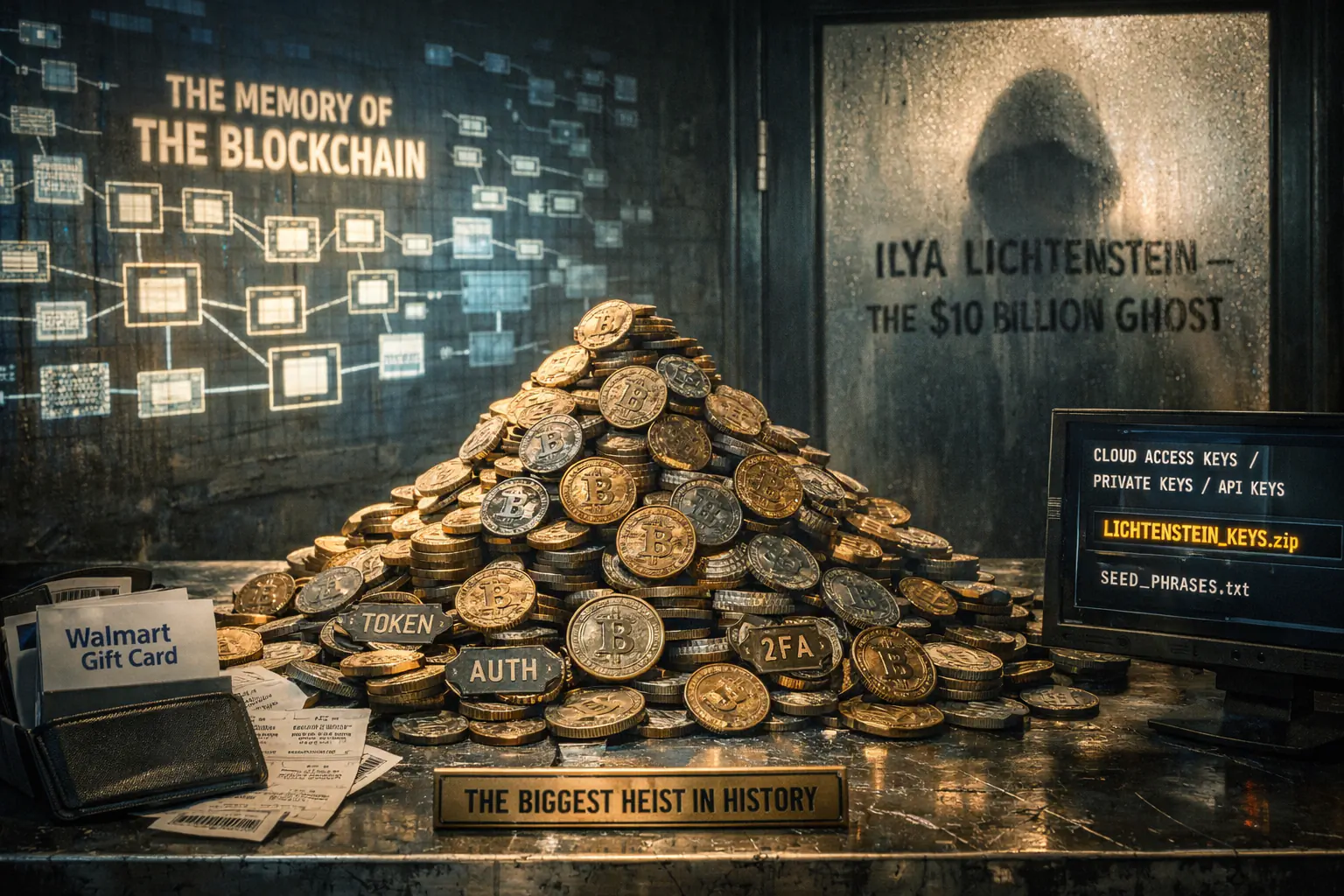
DEUS MACHINA
The story of Ilya Lichtenstein, the man who stole ten billion dollars with a laptop, hid in plain sight for six years, and is now asking the world for a second chance
“Blockchain memory: impossible anonymity in the digital age”
The Arrest of Ilya Lichtenstein
The door gives way on the third battering-ram strike.
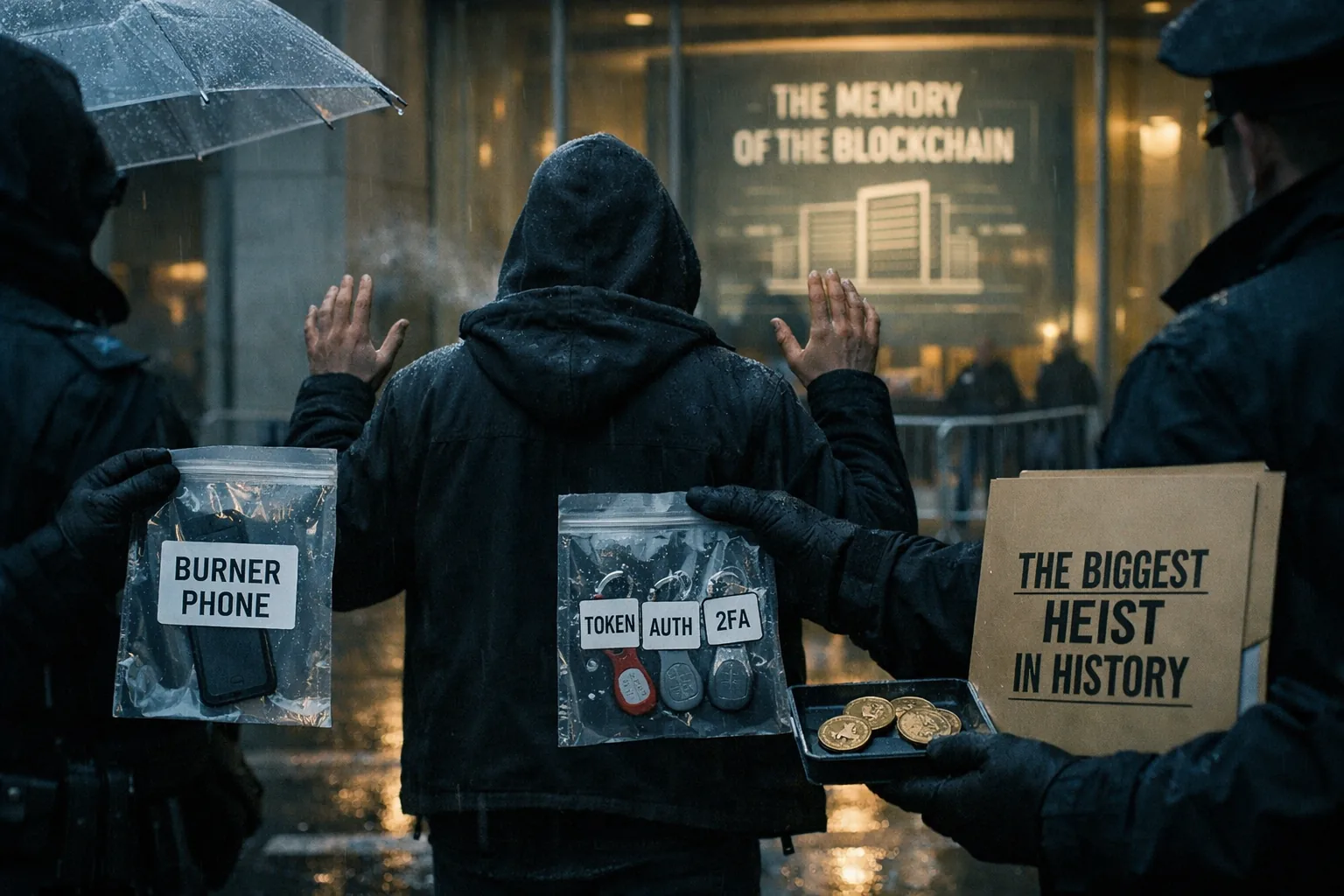
Twelve federal agents pour into the apartment. Fifteenth floor, 75 Wall Street. It’s 6:47 a.m. on February 8, 2022, and Manhattan is still wrapped in winter darkness. The man they’re looking for is asleep. His wife wakes up screaming.
“FBI. Don’t move.”
Ilya Lichtenstein, 34, opens his eyes to a dozen guns trained on him. He doesn’t resist. He doesn’t say a word. He lets them cuff him with the calm of someone who’s always known this moment would come — sooner or later, one way or another.
The search begins.
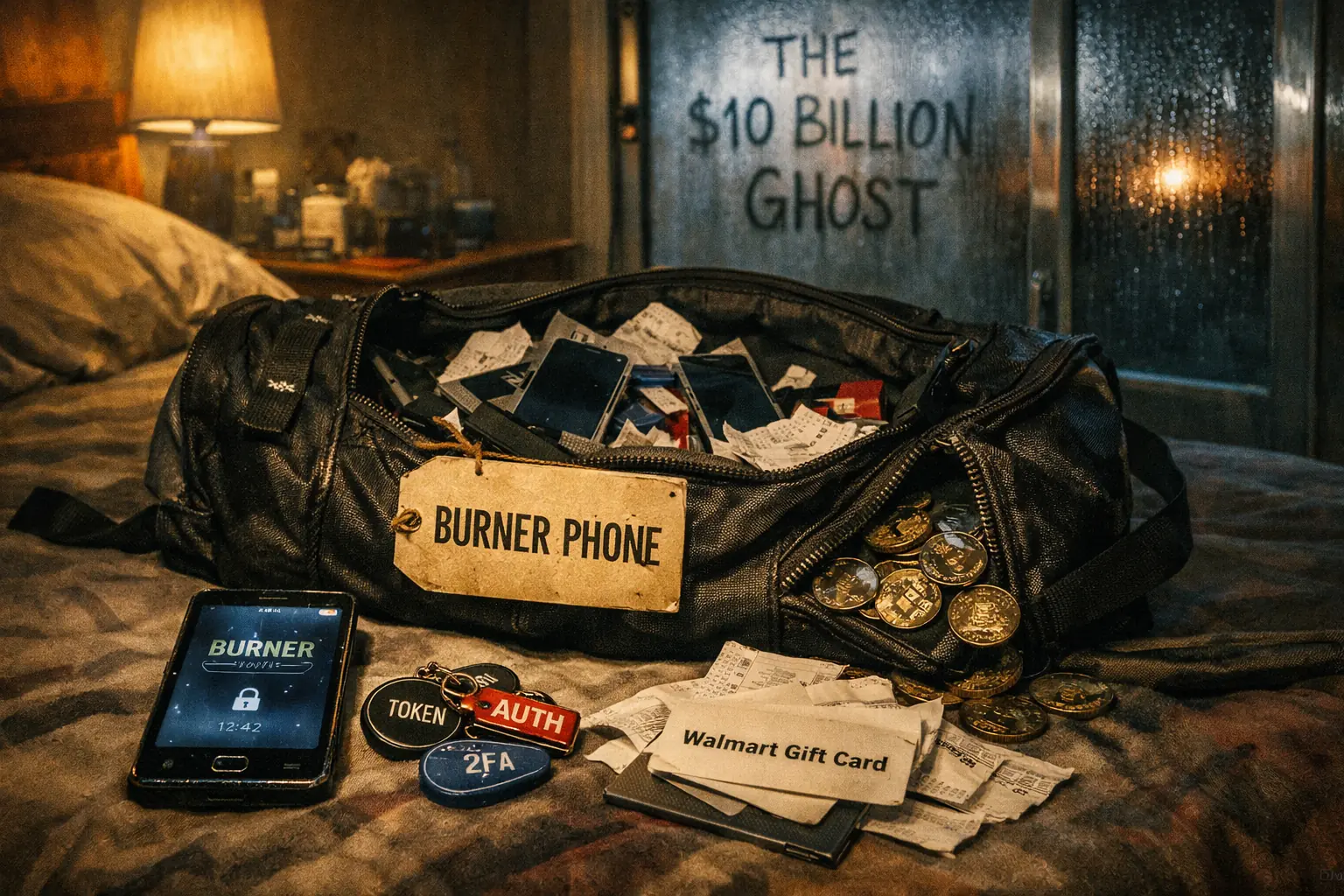
Fake passports in a drawer. Foreign currencies tucked between clothes. And then, at the back of a closet, a canvas bag. On it, written in black marker in a jittery hand: “BURNER PHONES”.
Special Agent Chris Janczewski stares at it. Twenty years at IRS Criminal Investigation. He’s seen traffickers bury millions in backyards. He’s seen bankers hide fortunes in postcard-named tax havens. But this is different. This is new.
A bag labeled “burner phones.” Like a street sign pointing to the crime scene. Like the suspect wanted to be found.
Or maybe — and this is the thought Janczewski can’t shake — when you live for six years sitting on $4.5 billion in stolen money, the weight becomes so heavy that some part of you wants someone to knock on the door.
Because the numbers are these: 119,754 bitcoin. Taken in 2016 from Bitfinex, one of the largest crypto exchanges on the planet. Back then, they were worth $72 million. Today, as Lichtenstein is dragged out in handcuffs, they’re worth more than ten billion. It’s the largest single heist in human history. And the man who pulled it off never carried a gun. Never threatened anyone. Never set foot in a bank.
He only typed. Lines of code in the dark of a room while the rest of the world slept. And then he vanished — not to a no-extradition country, not to a tropical island — but into everyday life. Tech entrepreneur. Startup mentor. Husband.
The problem is that in the digital world, ghosts leave traces. Bitcoin’s blockchain — that public, immutable, eternal ledger — records everything. Every transaction. Every movement. Every attempt to make the loot disappear. It’s like stealing gold bars that broadcast an impossible-to-disable GPS signal.
Janczewski followed that signal for six years. Night after night, transaction after transaction, through mixers and tumblers and dark web markets. The longest hunt of his career. And now he’s here, in this luxury apartment that reeks of dirty money and bad decisions, watching a man who thought he was smarter than everyone.
Next to Lichtenstein, still dazed, is his wife Heather. The world will soon know her by another name: Razzlekhan, the Crocodile of Wall Street. Rapper. Influencer. Author of music videos so bad they look like parodies. Accomplice.
But that comes later.
What matters now is understanding how. How a kid from Chicago, the son of a Russian immigrant, became the architect of the largest digital heist in history. How he lived six years with ten billion dollars in virtual money he couldn’t spend. And how, in the end, he was betrayed not by the technology he breached, but by the same technology that made him rich.
The answer lies in a name. In a carefully chosen pseudonym that sounds like both tribute and challenge. In a father who, twenty years earlier, had walked the same road.
Deus Machina. The Machine of God.
That’s where you have to begin.
I. MANUS DEI
The Genealogy of Ilya Lichtenstein — the Digital Ghost
To understand Ilya Lichtenstein, you first have to understand his father. And to understand his father, you have to accept an uncomfortable truth: the talent for intrusion, like music or mathematics, is sometimes passed down in blood.
Yevgeniy “Eugene” Lichtenstein arrived in the United States from southern Russia more than thirty years ago, bringing with him a degree in agricultural engineering from the Rostov Institute and dreams of a better life. He settled in Glenview, a sleepy suburb north of Chicago where lawns are perfectly trimmed and neighbors greet each other by name. He became a mortgage broker — a respectable, invisible profession, perfect for someone who wants to disappear into American normalcy.
But Eugene had another talent — one that didn’t appear on his business card.
In 2005 — the same year his teenage son began working as tech support at Northwestern University — Eugene Lichtenstein broke into the systems of First National Bank of Indiana. He never managed to cash out. He was discovered, but instead of going to prison, he did something far more interesting: he cooperated. The Secret Service took him in as an informant. The charges evaporated. Eugene went back to life as a mortgage broker as if nothing had happened.
His nickname in underground circles was “Manus Dei” — the Hand of God. Shortened by friends to “Deuce.” His son Ilya, years later, would choose a pseudonym that sounded like both homage and challenge: “Deus Machina” — the Machine of God. As if to say: if you are the hand, I will be the mechanism that moves the world.
This connection — suggested by the Netflix documentary “Biggest Heist Ever” and supported by cybercrime experts like Brett Johnson — was vehemently denied by Ilya himself. “My father doesn’t even know how to use Instagram,” he publicly stated after sentencing, trying to protect the man who, knowingly or not, had taught him that systems exist to be breached.
But in the digital world, denials leave traces as surely as confessions. And the choice of a pseudonym tells a story no rebuttal can erase.
Ilya Lichtenstein: The Education of a Predator
Young Ilya grew up in that gray zone between genius and deviance that defines so many early talents in computing. He attended Glenbrook South High School from 2002 to 2006 — the years when the internet was coming of age, and with it the possibilities of exploring its darker boundaries. From 2005 to 2006, he was already working as tech support at Northwestern University in Evanston — his first official contact with complex systems.
Unlike his father, Ilya chose a conventional academic path. He enrolled at the University of Wisconsin–Madison, where he earned a degree in psychology — a choice that seems incongruous for a future hacker, but reveals deep understanding of the craft. Hacking, in its highest form, isn’t about computers. It’s about people. Their habits. Their weaknesses. Their predictable mistakes.
Psychology teaches you to read behavioral patterns. Social engineering — the art of manipulating humans into revealing sensitive information — is applied psychology. Lichtenstein wasn’t studying the human mind out of academic curiosity. He was sharpening a weapon.
After graduation, he built an impeccable front. He co-founded MixRank, a B2B sales software startup. He became a mentor at 500 Startups, one of Silicon Valley’s most prestigious accelerators. He founded Endpass, focused on decentralized identity and blockchain authentication. He invested in other companies. He wrote articles about crypto security, ironically criticizing those who didn’t adequately protect their private keys.
On LinkedIn he described himself as a “technology entrepreneur, programmer and investor with a strong interest in blockchain, automation and big data.” It was all true. It was also all cover.
Because while by day Ilya Lichtenstein attended tech conferences and shook hands with potential investors, by night — in the quiet hours when most of the world sleeps — Deus Machina studied Bitfinex’s systems the way a surgeon studies a patient’s anatomy before an operation.
II. THREE HOURS TO BECOME A BILLIONAIRE
Hong Kong, August 2, 2016. While the city slept in the humid heat of tropical summer, Bitfinex’s servers kept humming in their climate-controlled data center. Billions of dollars in bitcoin flowed through their circuits every day, protected by what was then considered state-of-the-art security: a multi-signature system in partnership with BitGo.
The principle was elegant in its simplicity: to authorize any transaction, you needed at least two keys out of three. One was held by Bitfinex, one by BitGo as an external guarantor, and one was stored offline as a backup. It was like a vault with two locks and two different keys — no one could open it alone.
No one, except someone who had discovered that Bitfinex had made an unforgivable mistake.
A confidential Ledger Labs report, commissioned after the attack and never made public until the OCCRP obtained a copy, reveals the fatal flaw: two of the three keys were stored on the same device. It was like building a vault with two locks and then hanging both keys on the same nail.
Lichtenstein had spent months studying Bitfinex’s architecture. Not from the outside, like a thief watching a bank from the street, but from within — quietly infiltrating systems, acquiring credentials, mapping every connection, every protocol, every weak point. He was already inside the walls when no one yet knew the walls had been breached. During trial, he would reveal he had also compromised individual accounts on other exchanges such as Coinbase and Kraken.
That August night, he decided it was time.
Anatomy of a Perfect Heist
Picture him sitting in front of his laptop. The screen light illuminating his face. Fingers moving across the keyboard with the precision of a pianist who has rehearsed the same piece thousands of times.
The first step was acquiring “security tokens” — credentials that allowed him to manipulate Bitfinex’s operating system. According to the Ledger Labs report, the compromised tokens were associated with two accounts: a generic one simply called “admin,” and one linked to “giancarlo” — Giancarlo Devasini, the exchange’s CFO, a former Italian plastic surgeon with a controversial business past.
With those tokens in hand, Lichtenstein did something brilliant in its simplicity: in less than a minute, he raised the daily transaction limit. It was as if a thief, before emptying a bank, had convinced the manager to increase the withdrawal cap.
Then he started transferring.
In just over three hours, 2,072 unauthorized transactions emptied Bitfinex users’ wallets. 119,754 bitcoin flowed into a single address controlled by Lichtenstein — an address that would become one of the most watched and traced in blockchain history.
At the value that night, the haul amounted to roughly $72–78 million. Already an astronomical figure. But Lichtenstein couldn’t have known — no one could — that he was stealing something that would grow to be worth more than ten billion. Immediately after the attack, Bitcoin’s price crashed by 20%. Bitfinex was forced to suspend all operations for nearly a week.
The Paradox of Transparency
Here lies the great irony of crypto theft, the paradox that would haunt Lichtenstein for the next six years: he had stolen a fortune that was perfectly traceable.
Bitcoin’s blockchain is a public ledger. Every transaction, every movement of funds, every fraction of bitcoin that moves from one address to another is recorded permanently, visible to anyone who wants to look. It’s like stealing gold bars that broadcast an impossible-to-disable GPS signal.
“The problem with laundering cryptocurrency,” Tom Robinson of Elliptic — one of the leading blockchain analytics firms — would explain years later, “is that if you make a mistake five years ago, that mistake stays on the blockchain for everyone to see. Forever.”
Lichtenstein knew it. That’s why, in the hours after the hack, he did something crucial: he deleted access credentials and log files from Bitfinex systems, wiping traces of his physical presence in the exchange’s infrastructure. Then he prepared for the hardest part of the job.
Stealing the bitcoin had been the first act. Making it disappear would be the second — an undertaking that would take years, ingenuity, and the help of a woman the world would come to know as Razzlekhan.
III. GHOST COINS
Laundering 119,754 bitcoin is an operation that requires monastic patience, high-level technical skill, and a certain dose of madness. Lichtenstein had all three.
For the first five months after the hack, he didn’t move a single satoshi (the smallest unit of bitcoin, equal to one hundred-millionth of a BTC). The funds sat still at the destination address, like a predator waiting for the waters to calm before moving. It was a discipline investigators would later describe as “typical of state actors or elite organized crime groups” — not a lone hacker operating from his bedroom.
Ilya Lichtenstein’s Wife
Heather Rhiannon Morgan was, on paper, everything Lichtenstein was not: extroverted, loud, obsessed with public attention. Born in 1983, originally from Chico, California. She graduated in economics and international relations from UC Davis in 2011. She built a career as an entrepreneur (founder of SalesFolk), journalist (a Forbes contributor from 2017 to 2021 and an Inc. columnist), and marketing expert.
But it was her alter ego that would capture the world’s imagination: Razzlekhan, the Crocodile of Wall Street.
On YouTube and social media, Morgan published rap music videos of such low quality, with lyrics so absurd, that it’s difficult to tell whether they were an experiment in postmodern anti-art or simply the product of an ego completely disconnected from reality. The video for “Versace Bedouin” — in which Morgan raps in faux fur in Manhattan locations — would rack up millions of views after the arrest, becoming a viral meme.
“If you’re Ilya and Heather and you have this money,” Nick Bilton, the Vanity Fair journalist who followed the case, observed, “you’re probably terrified of being found out. People handle anxiety and stress in different ways. Some have panic attacks. Some throw themselves into obsessive exercise. It’s steam that has to come out somehow. For Heather, I think creating Razzlekhan and rap was the release valve.”
The two got engaged in 2019 and married in 2021. A photographer contacted by Morgan to document the engagement told The Daily Beast that Lichtenstein was “into gray and black style, leather and goth ninja.” At the wedding — an elegant event in New York — guests received gift cards as favors. Those gift cards, investigators would later learn, were purchased with bitcoin stolen from Bitfinex. It was a choice of near-Shakespearean arrogance: celebrating love with the proceeds of a crime, inviting dozens of unsuspecting witnesses to become, technically, recipients of laundered value.
But it was precisely that choice that contributed to their downfall.
The Laundering Labyrinth
The couple implemented an extremely sophisticated laundering process, running from 2016 to 2022, designed to break the on-chain traceability of the stolen bitcoin:
| Technique | Description |
|---|---|
| Chain-Hopping | Systematic conversion into other cryptocurrencies, including privacy-focused assets like Monero, to sever the link with Bitcoin’s transparent blockchain |
| Mixers and Tumblers | Use of Bitcoin Fog (at least 10 times by Lichtenstein’s admission), Helix and ChipMixer to blend funds and anonymize flows |
| Darknet Markets | Deposits on AlphaBay and Hydra, using platforms as obfuscation tools |
| Fake Identities | Creation of numerous accounts at exchanges and financial institutions using false identities |
| Fiat Conversions | Use of Russian and Ukrainian accounts to convert into traditional currency |
| Physical Gold | Conversion into gold coins, later hidden physically |
| Gift Cards | Purchase of Walmart gift cards — the fatal mistake that led to capture |
The paradoxical element that contributed to the final capture was the most banal one: Walmart gift cards redeemed through an account registered under Heather Morgan’s real name. That operational mistake gave investigators the first tangible bridge between the digital world of the heist and the suspects’ physical identities.
IV. THE HOUND AND THE PREY
Ilya Lichtenstein and Blockchain Memory
Chris Janczewski joined IRS Criminal Investigation with a computer science degree and a love of puzzles. The Bitfinex case would become the puzzle of his life.
The investigation began almost immediately after the 2016 hack, involving IRS-CI, the FBI, and HSI (Homeland Security Investigations). But for years it remained in a kind of limbo. Investigators knew where the bitcoin was — the blockchain doesn’t lie — but they didn’t know who controlled it. Addresses were just alphanumeric strings. Transactions were visible, but the faces behind them stayed in the shadows.
The breakthrough came in 2017, from an unexpected direction: the takedown of AlphaBay.
When the FBI and international law enforcement dismantled the largest dark web marketplace, they gained access to its internal logs — transaction records linking deposits and withdrawals to specific users. It was like finding an intermediary’s secret diary: suddenly, anonymous transactions had names. The wallet tied to the 2016 hack was concretely linked to accounts used for laundering.
As Tom Robinson of Elliptic explained: “This shutdown gave authorities access to the service’s internal transaction records, making it possible to definitively link the money flows.”
The File in the Cloud
The final blow landed in early 2022, when investigators obtained a search warrant for a cloud storage account linked to Lichtenstein. What they found inside was, as one agent put it, “like finding the treasure map with an X marking the exact spot.”
The file contained a spreadsheet with around 2,000 cryptocurrency addresses and their corresponding private keys. Nearly all of those addresses were directly tied to the Bitfinex hack. It was the definitive proof — and Lichtenstein had kept it in the cloud as if it were a grocery list.
“Some people live with secrets so enormous that the weight becomes unbearable,” a forensic psychologist interviewed by the American press theorized. “Sometimes, consciously or not, they sabotage themselves in order to finally be free.”
The Department of Justice carried out the largest financial seizure in its history: roughly 94,000 BTC, valued at about $3.6 billion at the time.
When authorities raided Morgan and Lichtenstein’s apartment, producer Nick Bilton described the items found as “things that look like they came out of a terrible spy novel” — including that bag labeled “Burner Phones,” which Janczewski called “a first” for the department.
In a surreal detail, just ten days after the raid, Razzlekhan resurfaced online posting a rap video on her AirPods as if nothing had happened.
V. THE RECKONING
The Price of Cooperation
In the months after the arrest, Lichtenstein made a choice that would define the rest of his story: he decided to cooperate.
He didn’t just confess. In August 2023, he pleaded guilty to conspiracy to commit money laundering and publicly admitted, for the first time, that he alone carried out the Bitfinex hack. “I hacked Bitfinex, I stole and laundered thousands of bitcoin, and I am so sorry for everything,” he said in a public video from jail. “I can’t change the past, but I can and will do everything possible to make amends.”
Morgan also pleaded guilty to one count of conspiracy to commit money laundering and one count of conspiracy to defraud the United States.
But Lichtenstein’s cooperation went far beyond confession. In March 2024, he took the witness stand in the trial against Roman Sterlingov, the operator of Bitcoin Fog — the same mixing service he had used at least ten times to launder the stolen funds. His testimony was devastating: he provided technical details on how the service worked and how he used it to conceal the origin of the money.
Sterlingov was sentenced to 12 and a half years in prison — more than double what Lichtenstein himself would receive. Prosecutors determined Bitcoin Fog had processed over $400 million in transactions from illegal markets like Silk Road, Agora, and AlphaBay. It’s a dynamic that raises deeper questions about justice: Lichtenstein, the thief, becomes a tool to catch other criminals.
The Sentences
On November 14, 2024, Ilya Lichtenstein was sentenced to 60 months in federal prison plus three years of supervised release — a fraction of the maximum twenty-year sentence, precisely because of his “substantial” cooperation. The sentence included credit for time already served in custody after his 2022 arrest.
Four days later, Heather Morgan received 18 months plus three years of supervised release.
VI. THE FIRST STEP ACT AND THE CONTROVERSY
Early Release
On January 2, 2026 — just over a year after sentencing — Ilya Lichtenstein announced on X that he had been released early and transferred to home confinement.
“Thanks to President Trump’s First Step Act, I was released from prison early,” he wrote. “I remain committed to making a positive impact in cybersecurity as soon as possible. To supporters, thank you for everything. To haters, I can’t wait to prove you wrong.”
The First Step Act is a bipartisan criminal justice reform law signed in 2018 during Donald Trump’s first term. It allows eligible federal inmates to reduce their sentences through credits earned for participating in rehabilitation programs, educational and work activities, and through periodic risk assessments.
Lichtenstein met the requirements because his crime was classified as non-violent (money laundering conspiracy), he participated in rehabilitation programs while incarcerated at FCI Allenwood, and he provided substantial cooperation to federal authorities.
An official from the Trump administration confirmed to CNBC that Lichtenstein “served a significant portion of his sentence and is currently in home confinement in accordance with Bureau of Prisons laws and policies.” The federal inmate locator system still showed an official release date set for February 9, 2026, indicating he remains technically under supervision.
The idea that a man responsible for a ten-billion-dollar heist could return to civilian life after roughly fourteen months of actual incarceration has reignited the debate over proportionality in sentencing for cybercrime — and the message this outcome sends to a generation of would-be hackers watching from the dark corners of the net.
On one side, advocates of criminal justice reform argue that the First Step Act is working as intended, offering second chances to non-violent inmates who demonstrate rehabilitation. On the other, critics raise concerns about the message this sends to future cybercriminals: deterrence becomes central.
Heather Morgan was released in October 2025 after serving about eight months. Still inhabiting the persona of Razzlekhan, she openly criticized how the media portrayed her, released new songs including one “written from solitary confinement” dedicated to her husband, and began offering personalized videos on Cameo. On January 28, 2025, her attorneys sent cease-and-desist letters to Netflix and Library Films alleging defamation and invasion of privacy.
VII. WHAT FUTURE FOR ILYA LICHTENSTEIN?
It’s January 2026, and Ilya Lichtenstein lives under home confinement supervised by the Residential Reentry Management office in Sacramento. Technically he’s still a prisoner — the Bureau of Prisons lists a formal release date of February 9 — but he’s back in the world, connected to the internet, present on social media, ready to build what he calls a “second chance.”
His first post after release was about artificial intelligence. “I’ve been offline for four years,” he wrote on X. “What’s the fastest way to catch up on AI?” He showed interest in advances in learning models but expressed disappointment with language models’ limits in logical reasoning. It was the tone of someone rushing to recover lost time, someone eager to prove that the technical genius that made him notorious can be redirected toward legitimate ends.
Lichtenstein has said he wants to work in cybersecurity — to use the skills he once used to breach systems to protect them. It’s a seductive, almost archetypal narrative: the thief who becomes a guardian, the black-hat hacker who puts on a white hat. The history of infosec is filled with former hackers who found legitimate careers.
But there is something different about Lichtenstein’s case. The scale of the crime. The arrogance of living “hidden in plain sight.” The fact that his cooperation, however valuable, came only after arrest, not before. He didn’t repent; he was caught.
The Legacy of the Bitfinex Case
The Bitfinex investigation accelerated the development of new investigative models, such as the “Three-Flow” model that integrates blockchain analysis with business records and real-world identity data. As crypto policy expert Ari Redbord observed: “Law enforcement has never had a more open way to follow the money.”
The attack’s legacy forced the entire digital asset industry to evolve. The adoption of standards like Multi-Party Computation (MPC), which eliminates single points of failure typical of older multi-sig systems, is now the norm for major custodians.
As for the recovered bitcoin: in January 2025, U.S. prosecutors filed a motion to return the assets to Bitfinex. However, those funds must be used to compensate victims under the Mandatory Victims Restitution Act. In 2025, Trump signed an executive order to create a Strategic Bitcoin Reserve that includes seized bitcoin, but the Department of Justice recommended that the Bitfinex funds go to victims.
The Blockchain as Memory
There’s one last reflection worth making before closing this story.
Bitcoin’s blockchain — the immutable ledger that made Lichtenstein’s capture possible — still contains every transaction from the original hack. Every subsequent movement of funds. Every attempt at obfuscation. It’s all there, recorded forever, readable by anyone who wants to look.
In an era when so much of our digital past can be deleted, edited, manipulated — when memories are fluid and narratives are rewritten — the blockchain represents something rare: a memory that does not forget. That’s what convicted Lichtenstein. And that’s what, in a sense, redeems him.
Because if the blockchain remembers his crimes, it will also remember what he does next. Every action, every choice, every attempt to rebuild a legitimate life will leave equally permanent traces. The “second chance” Lichtenstein is asking for isn’t an eraser: it’s a new chapter added to a story already written.
The thief of ten billion dollars is free. The world is watching. The blockchain, as always, records everything.
TIMELINE — Ilya Lichtenstein
| Date | Event |
|---|---|
| Aug 2, 2016 | The hack: 119,754 BTC stolen (~$72M). Bitcoin drops 20%. |
| Early 2017 | Laundering begins: first movements toward AlphaBay. |
| Jul 2017 | AlphaBay shut down: FBI gains access to internal logs. |
| 2019 | Lichtenstein and Morgan get engaged. |
| 2021 | Wedding in New York. Gift cards paid with stolen bitcoin. |
| Jan 2022 | Federal raid on the couple’s apartment. |
| Feb 8, 2022 | Arrest in Manhattan. Record seizure: ~94,000 BTC (~$3.6B). |
| Aug 2023 | Guilty plea. Lichtenstein admits the hack. |
| Mar 2024 | Testifies against Sterlingov (Bitcoin Fog), sentenced to 12.5 years. |
| Nov 14, 2024 | Lichtenstein sentenced to 60 months in federal prison. |
| Nov 18, 2024 | Heather Morgan sentenced to 18 months. |
| Dec 6, 2024 | Netflix releases “Biggest Heist Ever”. |
| Jan 28, 2025 | Morgan sends cease-and-desist letters to Netflix. |
| Oct 2025 | Heather Morgan released early. |
| Jan 2, 2026 | Lichtenstein in home confinement (First Step Act). |
SOURCES — Ilya Lichtenstein
Now I have all the sources. Here’s the updated HTML block with working links:- U.S. Department of Justice — Press release on the arrest and $3.6B seizure (Feb. 2022)
- U.S. Department of Justice — Sentencing announcement (Nov. 2024)
- OCCRP — Ledger Labs confidential report on Bitfinex security lapses
- Elliptic — Blockchain forensics analysis of the Bitfinex theft
- TRM Labs — Investigative methodology and case analysis
- CNBC — Early release under First Step Act (Jan. 2026)
- Vanity Fair — “The Ballad of Bitcoin Bonnie and Clyde” by Nick Bilton
- Netflix — “Biggest Heist Ever” documentary (Dec. 2024)