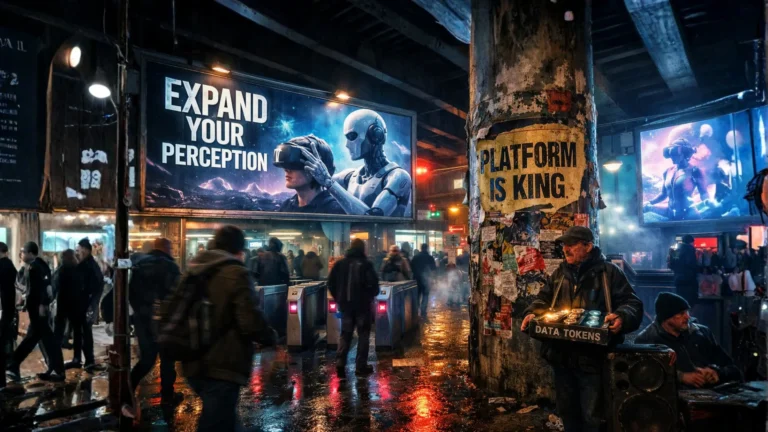

SEO: Threads vs X • Meta ecosystem • gatekeepers • algorithmic control • DMA
Threads vs X: How the META ECOSYSTEM Devours Competition
Distribution Beats Innovation
How Meta conquered microblogging by exploiting its dominant ecosystem and the algorithmic control of attention
The overtake had been in the air for months, but January 2026 data confirms a historic turning point in the social media landscape: Threads has surpassed X (formerly Twitter) in daily active users on mobile devices, reaching 143.2 million versus 126.2 million for Elon Musk’s platform. This isn’t just a battle of numbers—it’s empirical proof of how the market power of an ecosystem—amplified by algorithmic control of attention—can “reroute” millions of users from one sector to another simply by pulling the levers of distribution.
The Threads case is not a story of superior technological innovation. Rather, it is a perfect manual for how a digital gatekeeper exercises its dominant position through practices that European regulators call “self-preferencing” and “leveraging.” And while antitrust authorities around the world investigate Meta for abuse of dominance, Threads’ success offers a rare snapshot of how digital markets really work in 2026.
Threads vs X: THE ANATOMY OF THE OVERTAKE
When Mark Zuckerberg launched Threads on July 5, 2023, the platform reached 100 million sign-ups in just five days—an absolute global record. Today, two and a half years after launch, the numbers point to planetary success: 320 million monthly active users (January 2026) and a year-over-year increase of 37.8% in mobile traffic, while X loses ground with an 11.9% decline.
But behind these numbers lies a strategy that goes far beyond product quality.
The advantage of forced onboarding
The first distinguishing factor is integration with Instagram. Unlike any other emerging social network, Threads could tap into Instagram’s user base—over 2 billion people—offering the ability to import followers and profiles with a single click. This feature demolished what economists call the “cold start barrier to entry”: the problem that sinks every new social network is finding its first users. Threads simply bypassed the problem.
“Meta didn’t build a ‘better Twitter,’” an analysis by Italy’s competition authority explains, “it built a ‘Twitter that’s already on everyone’s phone.’” The difference is substantial.
Entanglement: when the user doesn’t choose
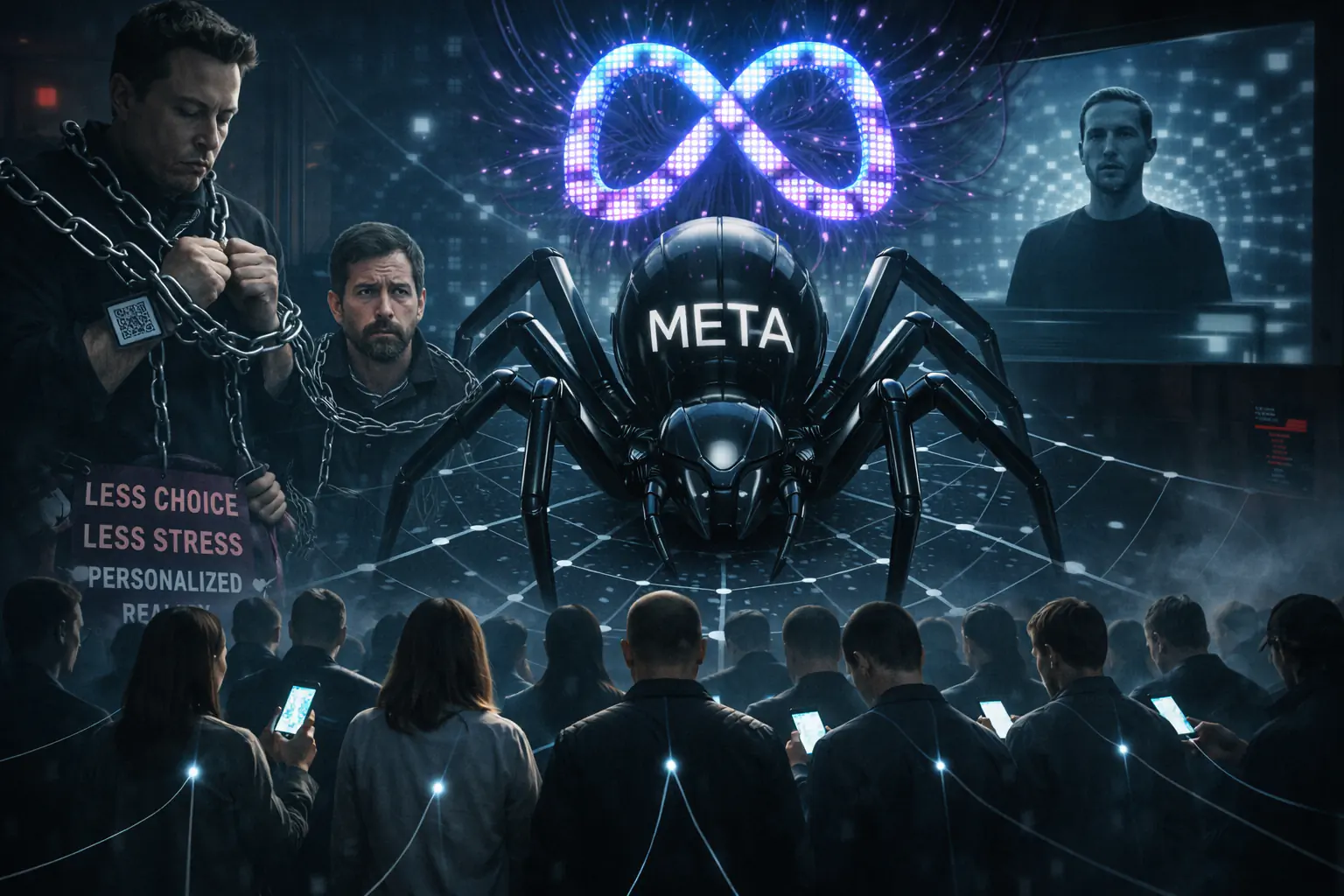
But there’s more. Threads isn’t a standalone app: it is integrated directly into Instagram and Facebook feeds and stories. The user doesn’t have to actively choose to “go to Threads”; the platform is presented—or, critics argue, visually imposed—while they are using other Meta apps. In technical jargon this is “lock-in” or “entanglement”: once inside the Meta ecosystem, every feature pushes toward other Meta features.
The most significant data point emerges from the mobile–desktop comparison: while Threads dominates on mobile with 143 million daily active users, on desktop the situation flips dramatically. X retains 140.7 million daily web visits versus just 8.5 million for Threads.
This divergence is not accidental. Threads is a platform passively “consumed” via already-installed apps, where cross-platform integration works at full throttle. X, by contrast, remains a tool for professional users or those who access it from a computer—contexts where choice is more deliberate. The gap between mobile success and desktop irrelevance exposes an uncomfortable truth: without the ecosystem architecture pushing users, Threads would be ordinary.
“Distribution beats innovation,” a Similarweb report summarizes. “And when distribution is controlled by the owner of the ecosystem, competition becomes structurally asymmetric.”
The algorithm as a force multiplier
But technical integration is only half the story. The other half is the algorithm: the recommendation system that decides what to show, when, and to whom.
Instagram’s algorithm doesn’t merely “suggest” Threads to users. It identifies which of your contacts are already on the platform and shows them to you repeatedly, creating what behavioral psychologists call “algorithmic FOMO”—the fear of being left out, artificially amplified. The algorithm decides when to show you the sign-up prompt (preferably when you’re in a “low cognitive load” state, distracted scrolling), which friends to highlight, how many times to repeat the message.
This isn’t spontaneous social pressure—it’s social pressure engineered by algorithms. As Tristan Harris, co-founder of the Center for Humane Technology, explains: “The system is designed to make you feel like you don’t have a choice. Or rather, to make the choice not to sign up psychologically costly.”
According to an analysis by 404 Media, Threads’ algorithm inherits the DNA of other Meta platforms: it prioritizes “engagement-driven” content—arguments, controversy, emotionally charged posts—because they generate more interactions. Not because they are more important or true, but because they maximize time-on-platform. The goal isn’t to show the best content for the user, but the content that will keep them glued longer.
Threads vs X: THE THEORETICAL FRAME
To fully understand what is happening with Threads, we need to look at the economic theory of digital platforms and two-sided markets—a field of study that exploded over the last twenty years precisely to explain phenomena like this.
In 2003, economists Jean-Charles Rochet and Jean Tirole published “Platform Competition in Two-Sided Markets,” a paper that became seminal (cited over 1,800 times) explaining how platforms create value by connecting two user groups: in this case, content consumers and advertisers. The platform’s value grows exponentially with the number of users—not linearly.
This is what MIT’s Nicholas Economides calls the “network effect”: the more people use WhatsApp, the more valuable WhatsApp becomes for each individual user. And conversely: the fewer people use an alternative, the less useful that alternative is. The result is a self-reinforcing mechanism that tends to concentrate the market around a single dominant player.
In Meta’s case, this effect is multiplied by the fact that the company controls about 70% of total time spent on social media in the Western world through its “Family of Apps” (Facebook, Instagram, WhatsApp, Messenger). When Meta launches Threads, it doesn’t start from zero: it starts from 3–4 billion social relationships already mapped.

Threads vs X: From network effects to “network coercion”
But the classic theory of network effects describes phenomena presented as almost natural: the more people use a service, the more useful it becomes. In modern algorithmic platforms, however, those effects are not spontaneous—they are actively designed.
Meta doesn’t passively wait for users to choose WhatsApp. The architecture makes WhatsApp structurally indispensable through asymmetric notifications (if you don’t have WhatsApp, your contacts receive signals that create social pressure), exclusive features available only if “everyone” has it, degradation of alternatives in search and sharing flows.
This is what some critics call “network coercion”: the network effect transformed from a spontaneous phenomenon into an active control tool. The algorithm doesn’t passively record user preferences—it shapes them.
Lock-in: why we can’t leave
There is also a second mechanism, just as powerful: the lock-in effect. As an analysis published on Culture Digitali explains, “the lock-in effect occurs when users become trapped in an ecosystem due to dependence on compatibility, familiarity, ease of use, and the presence of a large user base.”
In practical terms: if all your contacts are on WhatsApp and Instagram, you can’t migrate to alternatives (Signal, Mastodon) without losing your “social capital”—relationships accumulated over years. Switching costs are not monetary but social, and therefore even more insurmountable.
But there’s a deeper layer. Meta spent 15 years perfecting algorithms that exploit neurochemical vulnerabilities: the “variable intermittent reinforcement” that creates addiction—the same mechanism used by slot machines. Every time you open Instagram you don’t know what you’ll find—like, comment, important message, or nothing. This unpredictability creates compulsion. Threads inherits this machinery of psychological dependency.
The example of Bluesky is emblematic. The platform, created by Twitter founder Jack Dorsey as a “decentralized” alternative, reached a peak of 40 million users at the end of 2024. Six months later, daily active users had collapsed to 3.6 million (-44.4% year over year). Not because of technical inferiority, but because without the architecture of addiction—without the algorithm bombarding users with digital dopamine—people don’t develop the compulsion required.
THE DIGITAL MARKETS ACT: EUROPE VS GATEKEEPERS
It is precisely to counter these dynamics that the European Union introduced the Digital Markets Act (DMA) in 2022, fully in force since March 2024. The regulation identifies “gatekeepers”—tech giants with durable market power—and imposes strict obligations to prevent abuse.
The six giants under scrutiny
In September 2023, the European Commission designated six gatekeepers: Alphabet (Google), Amazon, Apple, ByteDance (TikTok), Meta, and Microsoft. For Meta, the designation covers Facebook, Instagram, WhatsApp, Messenger, and Marketplace—essentially the entire ecosystem.
The two most relevant prohibitions for the Threads case are:
Article 5(2) — Ban on combining data: Gatekeepers cannot combine personal data collected from different services without the user’s explicit consent.
Article 6(5) — Ban on self-preferencing: Gatekeepers cannot give their own services more favorable treatment than comparable third-party services.
Penalties are severe: up to 10% of global turnover for a first violation, 20% for repeated violations. In cases of systematic infringement, the Commission can impose break-ups or prohibit new acquisitions.
Threads and the European delay: the real-world test
The most significant sign of the DMA’s impact is Threads’ launch in Europe. While on July 5, 2023 the platform debuted in over 100 countries, in the European Union it remained blocked—for five months.
Adam Mosseri, head of Instagram, confirmed the delay was due to “regulatory uncertainty”—a reference to the DMA. The problem was twofold:
1. Mandatory login via Instagram amounted to self-preferencing: Meta was using dominance in one market (photo-sharing) to conquer another (microblogging).
2. Combining Instagram–Threads data for targeted advertising conflicted with Article 5(2): Meta collected data on one platform and used it for profiling on another without separate consent.
Only on December 14, 2023—five months after the global launch—did Threads arrive in Europe, with a modified architecture to avoid sanctions. Meta had to partially separate recommendation systems, require explicit consent for cross-platform data combination, and allow opt-outs from integration.
“This shows,” an analysis by GDPR Lab notes, “that without ex-ante regulation, Meta would tend to build a fully impenetrable ‘walled garden.’ Only preventive constraints can limit leveraging.”
The interesting data point? Threads grows more slowly in Europe than in the rest of the world. Not because Europeans don’t want microblogging, but because without full ecosystem weaponization, growth becomes more ordinary—closer to a product competing on merit.
ANTITRUST CASES: META UNDER SIEGE
While Threads was growing, Meta faced a series of unprecedented antitrust proceedings—both in the United States and in Europe. Three cases, in particular, illuminate Menlo Park’s strategies and reveal the limits of traditional antitrust.
Case 1: FTC vs Meta — the “Buy or Bury” strategy
The most important proceeding is the one brought by the U.S. Federal Trade Commission in December 2020, accusing Meta of building and maintaining a monopoly through the acquisition of potential competitors.
At the center are two key acquisitions: Instagram (bought for $1 billion in 2012) and WhatsApp ($19 billion in 2014). According to the FTC, Meta did not buy these companies to integrate them productively, but to eliminate them as competitive threats.
The evidence is significant. Internal Zuckerberg emails that emerged during the case reveal an explicit strategy summarized in a 2008 maxim: “It’s better to buy than compete.” In other messages, Zuckerberg describes Instagram and WhatsApp as “existential threats” to neutralize.
After a seven-week trial in April 2025, Judge James Boasberg ruled in Meta’s favor. The reasoning? The FTC defined the market too narrowly (only “personal social networking”: Facebook, Instagram, Snapchat, MeWe), ignoring competition from TikTok and YouTube. In a broader market, the judge held, Meta does not have an current monopoly.
On January 20, 2026, however, the FTC filed an appeal: “ByteDance and Google are not true competitors to Meta—they are other digital empires. This is not a competitive market; it is an oligopoly of closed ecosystems.”
The case shows the limits of traditional antitrust: if everything competes with everything (microblogging, short video, long video), it becomes almost impossible to prove monopoly. But if everything competes with everything, it also means no one truly competes.
Case 2: European Commission vs Meta — the “Pay or Consent” model
In Europe, Meta faced a different but equally serious allegation: violating the DMA through the controversial “Pay or Consent” model.
In November 2023, anticipating the DMA, Meta introduced a choice for European users of Facebook and Instagram: pay €9.99–€12.99 per month for an ad-free version, or keep using the platforms for free but accept ad targeting.
The Commission opened an investigation, culminating on April 23, 2025 with a €200 million fine. The reasoning was surgical: the model does not offer a truly equivalent choice. The empirical proof? Less than 1% of users chose the subscription.
This statistic is devastating: it shows the “choice” is economically coercive. Users can’t afford to pay, but they also can’t leave because Meta made its platforms psychologically indispensable through 15 years of algorithmic optimization. So they “consent” to profiling not out of free choice, but out of necessity.
“The ‘Pay or Consent’ model creates a false alternative,” the Commission said. “It lacks an intermediate option: free non-personalized ads.”
In November 2024, Meta introduced a third option—non-personalized but “unskippable” ads—which appears to have satisfied regulators. In December 2025, the Commission accepted commitments and closed the case.
Case 3: AGCM vs Meta — Meta AI on WhatsApp
The most recent case—and perhaps the most illuminating for Meta’s future strategy—concerns artificial intelligence. In July 2025, Italy’s competition authority (AGCM) opened an investigation into Meta for abuse of dominance linked to the integration of Meta AI into WhatsApp.
The problem is twofold:
1. Meta AI was preinstalled in WhatsApp in a prominent position without explicit user consent—amounting to self-preferencing.
2. On October 15, 2025, Meta introduced new clauses in the “WhatsApp Business Solution Terms” that completely ban competing AI chatbots from operating on the platform.
On December 22, 2025, the AGCM imposed an urgent interim measure: immediate suspension of the clauses to preserve access to WhatsApp for competing chatbots.
“Meta is using dominance in messaging to conquer the emerging AI market before competition can exist,” the Authority stated. It is the same Threads playbook applied to a different sector: leveraging dominance from a mature market into a nascent one, preventing a competitive market from forming.
The European Commission is coordinating the investigation to extend it across the entire European Economic Area.
THE STRATEGIC PATTERN: COPY, DISTRIBUTE, DOMINATE
If we look at Meta’s recent history, a recurring pattern emerges that analysts call “Copy-Distribute-Dominate.”
When Snapchat invented Stories in 2013, it revolutionized ephemeral sharing. Meta copied the feature and distributed it across Instagram (2016), Facebook (2017), and WhatsApp (2018). Result: Instagram Stories now has 500 million daily active users. Snapchat remained marginal.
When TikTok exploded with short video, Meta launched Reels—essentially a copy—and instantly distributed it to billions of users on Instagram and Facebook through aggressive algorithmic promotion.
When BeReal introduced the dual-camera for “authentic” shots, Meta tested a similar feature on Instagram.
The mechanism is always the same: an innovator creates a disruptive feature, Meta replicates it and distributes it on its captive user base via ecosystem + algorithm, erasing the first-mover advantage.
“Firms initially reach high market shares thanks to innovations and superior efficiency,” MIT economist David Autor writes in a paper on “superstar firms.” “Once they attain a leading position, however, they use market power to erect entry barriers and defend dominance.”
Meta doesn’t invent—it absorbs others’ innovation and scales it. And when you have 3 billion users and algorithmic control over their attention, you can scale anything faster than anyone else.
Threads vs X: Data as a competitive weapon
But there is an even more insidious element: data for artificial intelligence.
Meta uses billions of daily interactions generated on Threads, Instagram, Facebook, and WhatsApp to train Llama—its family of language models. Competitors in AI do not have access to a comparable stream of “real-time human interactions.”
This creates a self-reinforcing loop: more users on Meta platforms → more data generated → better AI models → more accurate recommendations → more time users spend on the platforms. It is a cycle that feeds itself, creating data-side economies of scale: the advantage grows automatically with size, building ever-higher barriers to entry.
WHOEVER GOVERNS ATTENTION GOVERNS THE MARKET
The Threads case raises questions that go beyond economic competition and touch deeper issues of power and control in the digital age.
Economist Herbert Simon said in 1971: “Information consumes attention. So a wealth of information creates a poverty of attention.” Meta built an empire on this equation.
Platforms don’t “connect people”—they extract attention and monetize it. The business model is simple: capture as much human attention time as possible and sell it to advertisers. Threads is projected to generate $11.3 billion in revenue. X, in decline, generates $2.5 billion (-13.7%).
According to estimates, the “average annual per-capita value of personal data” is about $616.82. Multiply that by billions of users, and you understand why Meta’s market cap exceeds the GDP of many nations.
But this extraction carries hidden costs. Studies link intensive social media use to higher anxiety and depression (especially among adolescents), reduced concentration, and erosion of time devoted to real relationships. The algorithm is optimized to maximize time-on-platform, not user well-being.
Threads vs X: Who decides what we see?
When Meta controls the algorithm that decides what 320 million people see daily on Threads—and what 3 billion see on Facebook and Instagram—it doesn’t just control a commercial market. It controls a significant portion of the global public discourse.
Frances Haugen, Facebook whistleblower, testified to the U.S. Congress in 2021: “The algorithm knows divisive, extreme, polarizing content generates more engagement. More engagement means more profit. So it systematically amplifies extreme voices.”
No one elected Mark Zuckerberg. No one can vote him out. And yet the algorithms his company controls decide what hundreds of millions of people see of the world every day. It is a form of unelected political power—exercised not for the common good, but to maximize shareholder profits.
One of the DMA’s most revolutionary provisions is the interoperability obligation: gatekeeper messaging services must allow third-party services to communicate with them.
Imagine being able to send a message from Signal to WhatsApp, or from Telegram to Messenger. Suddenly, lock-in dissolves: you’re no longer a prisoner of the ecosystem “where all your friends are.” You can choose the service with the privacy policy you prefer, or the less manipulative algorithm—while still keeping your contacts.
Meta has four years to make WhatsApp interoperable for video calls, and must do so “immediately” for end-to-end individual messaging. But every incentive is to delay: interoperability means losing algorithmic sovereignty—the ability to track every interaction, profile across platforms, manipulate attention, monetize captivity.
“Interoperability,” explains digital rights activist Cory Doctorow, “is the kryptonite of gatekeeper power. It breaks lock-in and makes competition possible. That’s why platforms fight it.”
META AS AN ECOSYSTEM: the platform society
The success of Threads is not just the story of a social network. It’s the story of how power works in the digital economy of 2026.
Meta didn’t invent microblogging. It didn’t create a revolutionary user experience. It didn’t offer features X didn’t already have. It simply used control over the global social infrastructure—Instagram, Facebook, WhatsApp—to reroute hundreds of millions of users to a new service. It did so through technical integration, algorithmic promotion, and exploitation of psychological dependencies refined over 15 years of behavioral optimization.
This is what scholars call “leveraging” dominance. It’s what regulators call “abuse.” It’s what Mark Zuckerberg calls “organic growth.”
As philosopher Robert Nozick wrote in 1974: “The problem of regulation is that the state prohibits capitalist acts between consenting adults.” But what do we say about private platforms that “behave like parallel states, generating revenues and market caps on the scale of national GDPs”?
The Threads case tells us that in 2026 the true battlefield of competition is no longer between products, but between ecosystems. And when an ecosystem controls 70% of online social time for billions of people, the question is no longer “which product is better?”, but “who controls the infrastructure—and who controls the algorithm that decides what we see?”
Europe’s answer is clear: no one should control it without preventive rules. The Digital Markets Act, with all its limits, is the first serious attempt at ex-ante regulation of platform power. Threads’ delay in Europe, the forced changes to “Pay or Consent,” and the interoperability obligation show real impact.
America’s answer is more ambiguous, oscillating between antitrust tradition and geopolitical pressure. The ruling in Meta’s favor in the FTC case shows that 20th-century antitrust—designed for industrial markets—struggles to capture the power dynamics of the digital economy when “everything competes with everything” but no one truly competes.
And while the debate continues, Threads keeps growing—not because it’s better, but because it’s already there, on everyone’s phone, one click away from the Instagram profile, pushed by an algorithm that knows exactly when and how to capture your attention.
Distribution beat innovation.
At least for now.
Methodological note: This article draws on public Similarweb data (January 2026), documents from the European Commission and the Italian Competition Authority (AGCM), court materials on FTC v. Meta (No. 20-3590, D.D.C. 2025), peer-reviewed academic research (Rochet & Tirole 2003, Economides 1996, Autor et al. 2020), and public whistleblower testimony (F. Haugen). Claims about algorithmic strategies rely on analyses by independent experts (Center for Humane Technology, 404 Media, AlgorithmWatch) and documented behavioral patterns. Meta declined to comment for this article, referring to previous public statements that “our systems are designed to help people discover relevant content.”
Sources & documents — Threads vs X
- TechCrunch — Threads surpasses X in daily mobile users (January 2026)
- The Verge — Threads overtakes X on mobile (January 2026)
- Forbes — Similarweb: 143.2M daily mobile active users (January 2026)
- Engadget — Threads growth (+37.8%) and X decline (-11.9%) on mobile (January 2026)
- European Commission — DMA gatekeepers list (designations)
- European Commission — DMA decision: Meta fined over “consent or pay” (April 2025)
- AGCM — Measures on WhatsApp Business Terms / access for competing chatbots (December 2025)
- Reuters — FTC appeals ruling in Meta antitrust case (January 20, 2026)
- FTC — Official page for FTC v. Meta
- Rochet & Tirole — Platform Competition in Two-Sided Markets (PDF)
- Economides — The Economics of Networks (PDF)
- Frances Haugen — Written Testimony (U.S. Senate, 2021, PDF)