THE FENCE
WILD WILD WEB AND THE NEW FRONTIER
The internet didn’t “get ruined”: it was always being enclosed. The frontier story sold us openness while infrastructure, filters, and terms of service quietly became a private jurisdiction.
There was a moment — brief, almost imperceptible — when the internet felt like territory without landlords. You remember it, even if you weren’t there. The myth was enough: a space where distance collapsed, where borders between bodies and geographies dissolved, where knowledge circulated without gateways. The frontier. The open prairie. The promised land of horizontal communication.
Stewart Brand said “information wants to be free.” John Perry Barlow wrote a declaration of independence for cyberspace. It was 1996. The fences were already being built.
The settlers’ narrative has always worked the same way. A space is declared empty — conveniently ignoring whoever already lived there, or had already mapped it, or had already understood its value. A wave of enthusiasts arrives, convinced they’re explorers. They’re followed by the land barons.
WILD WILD WEB AND THE NEW FRONTIER
And by the time the newcomers realize they’re not pioneers but labor force, the surveyor pegs are already in the ground. The internet didn’t escape this script. It reproduced it with engineering precision.
We started inhabiting the internet convinced we were exploring a new free space of interaction and exchange. We found ourselves in a new territory of domination.
THE OPEN SPACE WAS THE BAIT. THE FENCING WAS THE PLAN.
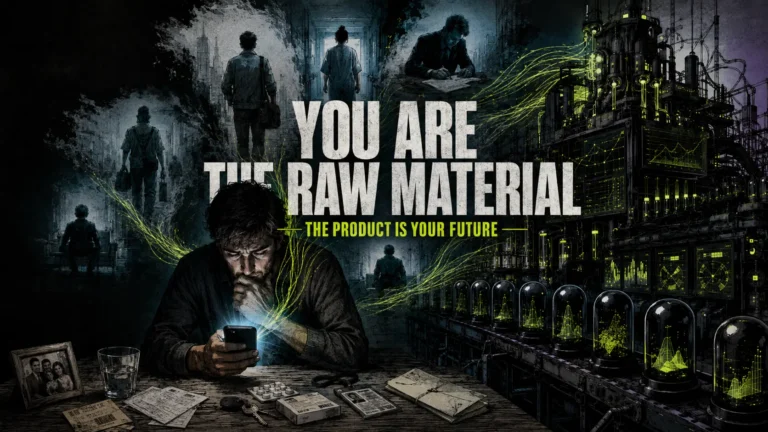
The mechanism was elegant in its brutality. Shoshana Zuboff calls it surveillance capitalism — a definition that sounds technical until you understand the body horror underneath it: your behavior was transformed into raw material before you even knew you were in a mine. Not your data. You. The unconscious gesture doesn’t perform. It reveals.
NETWORKS PRODUCE CENTERS – THE MITH OF THE WILD WEB
Manuel Castells had already told us that every network produces central nodes — and those nodes don’t belong to the users. The myth of the horizontal network, of a voice for everyone, of digital democracy as a structural fact, was always an optical illusion produced by the architecture’s perspective.
From the edges, it looks flat. From the center, you see the hierarchy. And the center was being occupied while we were all distracted by the view from the edges.
Google indexes and filters knowledge — it decides what exists and in what order. Meta decides what you see and what you don’t, optimizing not for your understanding but for your permanence on the platform.
Amazon owns the cloud infrastructure the internet runs on: the invisible pipes through which most global digital traffic passes, an electricity grid in private hands without public regulation.

WILD WILD WEB: RAILWAYS, ROBBER BARONS, PLATFORMS
These are not services. They are sovereign powers without electoral mandate, without opposition, without borders. With a legal system written in Terms of Service that no one reads and everyone signs. With territorial jurisdiction defined by protocol, not geography.
Nick Srnicek describes the platforms as the new railways — and the historical precedent is precise. Those who controlled the 19th century railway networks controlled the circulation of goods, people, information. They decided which cities grew and which declined.
WHOEVER CONTROLS THE BASE LAYERS CONTROLS EVERYTHING BUILT ABOVE THEM.
ENCLOSURE AS PRODUCT DESIGN
The pioneer narrative served a precise function: covering an ongoing process of appropriation with the story of freedom. While we were celebrating the democratization of communication, the commons were being enclosed.
While we were building our digital presence, we were building someone else’s database. While we thought we were using the platforms, the platforms were using us — in the most technical, material sense of the term. This is not a metaphor. This is the architecture.
The extraction didn’t happen despite the promise of freedom. It happened through it. The open space was the bait. The fencing was the plan.
There’s a phrase that circulates in strategic contexts: if you’re not sitting at the table making decisions, you’re on the menu. We were never invited to sit down. Not because of an oversight. Because the table was designed for someone else — for the shareholders, the advertisers, the data brokers who never had to introduce themselves.
We arrived as users. We were processed as raw material. And the distance between those two conditions is the distance between a settler and a serf — which is to say, the distance that the frontier myth was built to make invisible. The fence was built while we were busy celebrating open space. The dust was always there. So was the blood.
- John Perry Barlow — A Declaration of the Independence of Cyberspace (EFF)
- Google — How Search Works (Crawling, Indexing, Serving)
- Meta Transparency — Explaining Facebook Feed Recommendations
- AWS — Global Infrastructure
- Shoshana Zuboff — The Age of Surveillance Capitalism (HBS listing)
- Nick Srnicek — Platform Capitalism (Polity, 2016)
- Quote Investigator — “Information Wants to Be Free” (history & attributions)